Q.A square coil of side 10 cm consists of 20 turns and carries a current of 12 A. The coil is suspended vertically and the normal to the plane of the coil makes an angle of 30∘ with the direction of a uniform horizontal magnetic field of magnitude 0.80 T. What is the magnitude of torque experienced by the coil?
🔒You're viewing a preview — the full solution, concept, methods & PYQ mapping are locked.
🔒 Start your 14-day free trial to unlock the full solution →Concept understanding — Magnetic Force Balance
Magnetic Force Balance
When a current-carrying wire or coil sits in a magnetic field, it feels a force F=BILsinθ (or, for a point charge, F=qvBsinθ). On its own that force just pushes the conductor - but in many real situations the push is deliberately set up to CANCEL another force, so the whole system sits in equilibrium. That equilibrium condition - magnetic force balanced against weight, against another wire's magnetic force, or against a mechanical counterweight - is what "magnetic force balance" means, and it is also historically how the ampere itself was defined.
The balance condition
Whenever a conductor is in equilibrium under a magnetic force and one other force, the two must be equal and opposite:
BILsinθ=Fother
Solving this equation for whichever quantity is unknown (B, I, L, or the other force) is the entire skill in this class of problem - the only new step, beyond the force law itself, is correctly identifying what the magnetic force is opposing.
Case 1: a wire suspended against gravity
A straight horizontal wire of mass m and length l, carrying current I, can be held up ("floated") in mid-air by a horizontal magnetic field perpendicular to it. The upward magnetic force must equal the downward weight:
BIl=mg⟹B=Ilmg
For example, a 200g, 1.5m wire carrying 2A needs B=(2)(1.5)(0.2)(9.8)≈0.65T to stay suspended.
Case 2: two wires balancing each other
Two long parallel wires carrying currents I1,I2 exert a force per unit length on each other of 2πdμ0I1I2 (attractive if the currents run the same way, repulsive if opposite). If one wire is free to move, this magnetic force can itself balance that wire's weight:
2πhμ0I2L=mg⟹h=2πmgμ0I2L
This is exactly how a "current balance" apparatus works, and historically it is how the ampere was defined: the current that, flowing in two infinite parallel wires one metre apart, produces a force of exactly 2×10⁻⁷N per metre of length.
Case 3: balancing on a beam
A current-carrying coil arm hanging from one pan of a beam balance feels an extra force F=NBIl when only that arm sits in an external field. Re-balancing the beam means adding a mass m so that mg=NBIl.
Always check which length enters the formula - for a coil of N turns the force multiplies by N; for a single suspended straight wire it doesn't. …
Why this formula?
Magnetic Force Balance: Why the Key Formulas Hold
The Magnetic Force Balance describes when the magnetic force on a charged particle or current-carrying conductor is exactly balanced by another force (gravity, electric force, or tension). Let's build the reasoning step-by-step.
1. The Core Idea: What Does "Balance" Mean?
A force balance means the net force on an object is zero:
Fnet=0
For magnetic forces we use the Lorentz force law:
- On a moving charge: Fm=q(v×B)
- On a current-carrying wire: Fm=I(L×B)
When this is balanced by another force (say gravity Fg=mg):
Fm+Fother=0
2. Case 1: Charged Particle in Crossed Fields (Velocity Selector)
A charged particle moves perpendicular to both electric field E and magnetic field B.
- Electric force: Fe=qE (along E)
- Magnetic force: Fm=q(v×B) (perpendicular to both v and B)
For straight-line motion (no deflection), the two forces must cancel:
qE=qvB⇒v=BE
Key insight: Only particles with this exact speed pass undeflected — this is how velocity selectors work in mass spectrometers.
3. Case 2: Current-Carrying Wire Balanced by Gravity
A horizontal wire carrying current I sits in a perpendicular magnetic field B, suspended by strings.
The magnetic force on a straight wire is Fm=ILBsinθ; for a wire perpendicular to the field (θ=90∘), Fm=ILB. Setting this equal to the weight Fg=mg for equilibrium:
ILB=mg
Key insight: This balance lets you measure B if I, L, and m are known — the principle behind a current balance experiment.
4. Case 3: Circular Motion of a Charged Particle …
Concept: Magnetic Force Balance — torque on a current-carrying coil in a uniform field.
Step 1: Formula for torque
For a planar coil of N turns, area A, carrying current I, in a uniform field B, the magnitude of torque is
τ=NIABsinθ
where θ is the angle between the normal to the coil and the magnetic field.
Step 2: Insert values
Side =10 cm=0.10 m, so A=(0.10)2=0.01 m2. …
The torque on a current-carrying coil in a magnetic field is given by τ=NIABsinθ. Here, N=20, I=12 A, A=(0.10 m)2=0.01 m2, B=0.80 T, and θ=30∘ (the angle between the normal and the field). The magnitude is τ=20×12×0.01×0.80×sin30∘=0.96 N⋅m.
Why Magnetic Torque?
When a current loop sits in a magnetic field, each side of the loop experiences a magnetic force. If the loop is oriented so that its plane is not parallel to the field, these forces produce a torque that tries to rotate the loop. For a coil with multiple turns, the torque simply multiplies by the number of turns.
The key formula is:
τ=NIABsinθ
where θ is the angle between the normal to the coil’s plane and the magnetic field direction.
Notice: the problem gives the angle between the normal and the field directly — that’s exactly the θ we need. No conversion required.
Step-by-step solution
-
Identify the given quantities
Side length of square coil: l=10 cm=0.10 m
Number of turns: N=20
Current: I=12 A
Magnetic field: B=0.80 T
Angle between normal and field: θ=30∘
-
Compute the area of the coil
Since it’s a square:
A=l2=(0.10)2=0.01 m2
- Apply the torque formula
τ=NIABsinθ
Substitute the values:
τ=20×12×0.01×0.80×sin30∘
-
Simplify step by step
sin30∘=0.5
First multiply the constants: 20×12=240
Then 240×0.01=2.4
Then 2.4×0.80=1.92
Finally 1.92×0.5=0.96
So τ=0.96 N⋅m. …
Method: Torque on a Current-Carrying Coil in a Uniform Magnetic Field
This problem uses the torque on a current loop formula, derived from the magnetic force balance on each side of the coil.
Steps
Step 1: Identify the formula
The torque τ on a planar coil in a uniform magnetic field is given by:
τ=NIABsinθ
where:
- N = number of turns
- I = current in the coil
- A = area of the coil
- B = magnetic field strength
- θ = angle between the normal to the coil's plane and the magnetic field direction
Step 2: Extract given values
- Side of square = 10 cm=0.10 m
- Area A=(0.10)2=0.01 m2
- N=20 turns
- I=12 A
- B=0.80 T
- θ=30∘
Step 3: Substitute into the formula
τ=20×12×0.01×0.80×sin30∘
Step 4: Simplify
- sin30∘=0.5
- 20×12=240 …
Here are the common mistakes students make on this Magnetic Torque problem and how to avoid each.
1. Using the wrong formula for area
Mistake:
Students often use the side length directly in the torque formula without first calculating the area of the coil.
Why it’s wrong:
Torque depends on the area of the coil (A), not just its side length. For a square, A=(side)2.
How to avoid:
Always write:
A=l2=(0.10 m)2=0.01 m2
Convert cm to m before squaring.
2. Forgetting to multiply by the number of turns (N)
Mistake:
Using τ=IABsinθ instead of τ=NIABsinθ.
Why it’s wrong:
Each turn experiences torque. The total torque is the sum over all turns.
How to avoid:
Memorise the correct formula:
τ=NIABsinθ
Check the problem statement for N — here N=20.
3. Using the wrong angle in sinθ
Mistake:
Taking θ=30∘ directly as the angle between B and the plane of the coil.
Why it’s wrong:
The formula uses the angle between the magnetic field and the normal to the coil’s plane. The problem gives exactly that: 30∘ between normal and B.
How to avoid:
- Read carefully: “normal to the plane makes an angle of 30∘ with the direction of the field”
- That is the θ in τ=NIABsinθ
- No conversion needed — use sin30∘=0.5 directly.
4. Unit conversion errors
Mistake:
Using side = 10 cm as 10 m, or forgetting to convert cm² to m².
Why it’s wrong:
Torque in SI units requires metres, not centimetres.
How to avoid:
Convert all lengths to metres before any calculation:
10 cm=0.10 m
Then area:
A=(0.10)2=0.01 m2
--- …
- COMEDK 2026Set 2026-A1 markMCQQ.An electric field and magnetic field 1.8×10⁴Vm−1 and 6×10⁻³ T respectively are applied simultaneously on an electron beam such that path of the beam remains undeviated, then the speed of the electron will be: (A) 1.5×10⁶ ms−1 (B) 3×10⁷ ms−1 (C) 3×10⁶ ms−1 (D) 1.5×10⁷ ms−1
›Reveal solutionSolution
When an electron moves undeviated through crossed electric and magnetic fields, the electric force balances the magnetic force, giving v=E/B. Substituting E=1.8×10⁴V/m and B=6×10⁻³T yields v=3×10⁶m/s, which corresponds to option (C).
The key concept here is the velocity selector — a setup where perpendicular electric and magnetic fields are applied so that only particles with a specific speed pass straight through without deflection. For an electron (or any charged particle), the electric force is FE=qE and the magnetic force is FB=qvB (when v⊥B). For the path to remain undeviated, these forces must cancel exactly, meaning they are equal in magnitude and opposite in direction. This gives a simple relation that lets us solve for the speed directly.
- Set up the force balance condition. The electric force on the electron is FE=eE (where e is the magnitude of the electron’s charge), directed opposite to the electric field because the electron is negatively charged. The magnetic force is FB=evB (since v⊥B), and its direction is given by the right-hand rule (or left-hand rule for negative charge). For the beam to go straight, we require:
eE=evB
The charge e cancels out, leaving:
E=vB
- Solve for the speed v. Rearranging:
v=BE
- Substitute the given values. E=1.8×10⁴V/m and B=6×10⁻³T:
- KCET 2025Set D-41 markMCQQ.Which of the following graphs represents the variation of magnetic field B with perpendicular distance 'r' from an infinitely long, straight conductor carrying current? 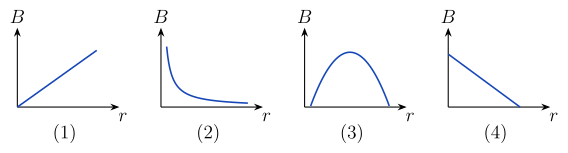 (A) (B) (C) (D)
›Reveal solutionSolution
Ampère's law gives B=μ0I/2πr, i.e. B∝1/r — a rectangular hyperbola.
Step 1 — Apply Ampère's circuital law.
Take a circular Amperian loop of radius r centred on the wire and lying in the plane perpendicular to it. By symmetry B has the same magnitude everywhere on that circle and is tangential to it, so
∮B⋅dl=B(2πr)=μ0Ienc=μ0I
B=2πrμ0I⟹B∝r1
(The direction is given by the right-hand thumb rule, but only the magnitude matters for the graph.)
Step 2 — Shape of B versus r.
- Monotonically decreasing, so any rising graph is out.
- B→∞ as r→0 (the curve hugs the B-axis) and B→0 only as r→∞ — so it approaches the r-axis asymptotically and never crosses it.
- This is a rectangular hyperbola (Br=const), concave up.
Step 3 — Eliminate the distractors. …
- COMEDK 2025Set 2025-E1 markMCQQ.A straight wire of mass 250 g and length 2.5 m carries a current of 4 A . It can be suspended in mid air by a uniform horizontal magnetic field of magnitude: (A) 0.145 T (B) 0.245 T (C) 0.625 T (D) 2.245 T
›Reveal solutionSolution
The magnetic force must balance the weight of the wire. Using F=BIL and mg=BIL, we solve for B and get B=0.245 T, so the correct option is (B).
Concept & Intuition
The wire is “suspended in mid air” — that means it’s not falling, so the net vertical force is zero. The only two vertical forces are its weight (downward) and the magnetic force (upward). For a current-carrying wire in a uniform magnetic field, the magnetic force is given by F=BILsinθ. Here the field is horizontal and the wire is straight; to get an upward force, the current direction must be perpendicular to the field. The problem states the field is “uniform horizontal” — so if the wire is horizontal and the current flows perpendicular to the field, the force is vertical. We set that equal to the weight.
Step-by-step
-
Identify the forces
Weight: W=mg, where m=250 g=0.250 kg, g=9.8 m/s2.
Magnetic force: Fm=BILsinθ. For maximum upward force, we take θ=90∘ so sinθ=1. Thus Fm=BIL.
-
Set up the equilibrium condition
Suspended means Fm=W:
BIL=mg
- Solve for B
B=ILmg
Substitute values: …
-
- COMEDK 2024Set 2024-A1 markMCQQ.A long horizontal wire P carries current of 50 A from left to right. It is rigidly fixed. Another fine wire Q is placed directly above and parallel to P. The mass of the wire is 'm' kg and carries a current of 'I' A. The direction of current in Q and position of wire Q from P so that the wire Q remains suspended are (A) Right to left, πmg50Iμ0 (B) Left to right, πmg25Iμ0 (C) Right to left, πmg25Iμ0 (D) Right to left, 4πmgIμ0
›Reveal solutionSolution
The wire Q stays suspended when the upward magnetic force from wire P exactly balances its weight. For parallel currents the force is attractive, so Q’s current must flow opposite to P’s (right to left), and the required separation is πmg25Iμ0. The correct option is (C).
Concept & Intuition
Two parallel current-carrying wires exert a magnetic force on each other: currents in the same direction attract, opposite directions repel. Here wire Q is above P and must be held up against gravity. The only upward force available is the magnetic force from P. Since gravity pulls Q downward, the magnetic force must be upward — that means the wires must attract each other. Attraction occurs when the currents are in the same direction. But careful: P’s current is left to right; if Q’s current is also left to right, they attract, pulling Q downward (toward P). That would add to gravity, not oppose it. So we need the opposite: Q’s current must be right to left, making the currents antiparallel, which gives a repulsive force — pushing Q upward. That repulsion can balance weight.
Now, the magnitude of the magnetic force per unit length between two long parallel wires is
Fmag=2πdμ0I1I2
where d is the separation. For a wire of mass m (presumably per unit length, or total mass — the problem’s phrasing implies m is the mass per unit length, as the force per unit length is what matters for suspension), the weight per unit length is mg. Setting repulsive force upward equal to weight downward gives the equilibrium separation.
Step-by-step solution
-
Identify the force direction
Wire P carries current 50A left to right. For wire Q to be repelled upward, its current must be opposite to P’s — i.e., right to left. This eliminates option (B) (which says left to right).
-
Write the magnetic force per unit length
For two long parallel wires with currents I1 and I2 separated by distance d, the force per unit length is
f=2πdμ0I1I2
Here I1=50A, I2=I (the current in Q). So
f=2πdμ0⋅50⋅I=2πd50μ0I=πd25μ0I
- Set up equilibrium …
-
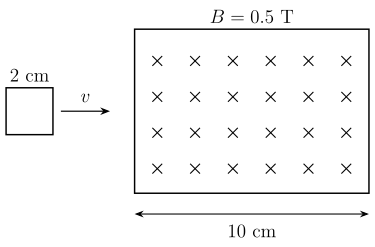
- KCET 2023Set A-31 markMCQQ.A square loop of side 2 cm enters a magnetic field with a constant speed of 2 cm s−1 as shown. The front edge enters the field at t=0s. Which of the following graph correctly depicts the induced emf in the loop ? (Take clockwise direction positive)
 (A) [FIGURE]
(B) [FIGURE]
(C) [FIGURE]
(D) [FIGURE]
(A) [FIGURE]
(B) [FIGURE]
(C) [FIGURE]
(D) [FIGURE]›Reveal solutionSolution
e=Blv is constant while a side cuts field lines, so the emf is a pair of rectangular pulses (entry and exit), of opposite sign, of magnitude 2×10⁻⁴ V and 1 s duration each; Lenz's law fixes the entry pulse as negative for the given sign convention.
Step 1 — Timeline of the motion.
Speed v=2 cm s−1, loop side l=2 cm, field region width =10 cm.
- Entry: the front edge is in the field but the rear edge is not, for the time the loop needs to advance its own length: t=2/2=1 s. So 0≤t≤1 s.
- Fully inside: front edge reaches the far boundary when it has travelled 10 cm, i.e. at t=10/2=5 s. So from t=1 s to t=5 s the loop is entirely inside.
- Exit: takes another 1 s, from t=5 s to t=6 s.
Step 2 — Magnitude of the emf.
While entering or leaving, only one side of length l cuts field lines (the other is outside the field), so
∣e∣=Blv=(0.5)(0.02 m)(0.02 m s−1)=2×10⁻⁴ V.
Because B, l and v are all constant, this emf is constant throughout each 1 s interval — the pulses are rectangular, not triangular. (Equivalently, Φ=Bl(vt) increases linearly, so e=−dΦ/dt is constant.)
Step 3 — When the loop is fully inside (1 s → 5 s).
The flux Φ=Bl2 is now constant (both the entering and leaving edges are inside the same uniform field), so dΦ/dt=0 and e=0.
Step 4 — Sign, by Lenz's law (clockwise taken positive). …
- COMEDK 2021Set 2021-B1 markMCQQ.A beam of electron is passes through crossed electric and magnetic field, E=9.6×10⁶ N/C and B=2.4 T. If the beam goes un deviated the velocity of electrons is (A) 4.0×10⁶ m/s (B) 9.6×10⁶ m/s (C) 2.0×10⁶ m/s (D) 4.8×10⁶ m/s
›Reveal solutionSolution
Undeviated motion requires qE=qvB, so v=E/B=9.6×106/2.4=4.0×106 m/s.
In crossed electric and magnetic fields, the beam passes straight through when the electric and magnetic forces cancel: …
🎓Unlock everything free for 14 days
- ✓Full step-by-step solutions
- ✓Concept-first explanations
- ✓Methods, shortcuts & mistakes
- ✓PYQ mapping + timed mock tests
Full access for 14 days. No credit card required.