Q.Two charged particles traverse identical helical paths in a completely opposite sense in a uniform magnetic field B=B0k^.
Concept understanding — Cyclotron Motion Radius
Cyclotron Motion Radius – From Intuition to Formula
Imagine you're pushing a charged ball on a frictionless table, and there's a giant magnet underneath. The moment that ball starts moving, the magnet doesn't pull it or push it forward — it turns it. The force from the magnet always acts sideways, perpendicular to the ball's velocity. So the ball never speeds up or slows down; it just keeps changing direction. If the magnetic field is uniform and the ball keeps moving, it will trace out a perfect circle.
That circle is called cyclotron motion, and the radius of that circle is what we're after.
Why does it curve at all?
The magnetic force on a moving charge is given by:
F=q(v×B)
The cross product means the force is always perpendicular to both the velocity v and the magnetic field B. For a charge moving perpendicular to a uniform field, this force acts as a centripetal force — it constantly pulls the charge toward the centre of a circle, without doing any work (since force is perpendicular to displacement).
So the charge moves in uniform circular motion. The magnetic force provides the necessary centripetal acceleration.
Deriving the radius
For circular motion, the centripetal force required is:
Fcentripetal=rmv2
where m is the mass of the particle, v is its speed, and r is the radius of the circle.
The magnetic force (for v⊥B) has magnitude:
FB=∣q∣vB
Set them equal:
∣q∣vB=rmv2
Cancel one factor of v (assuming v=0):
∣q∣B=rmv
Solve for r:
r=∣q∣Bmv
That's the cyclotron motion radius (also called the Larmor radius or gyroradius).
What the formula tells you
- Faster particle → larger radius (it's harder to turn something moving fast).
- Heavier particle → larger radius (more inertia resists the turn).
- Stronger magnetic field → smaller radius (the turning force is stronger).
- Larger charge → smaller radius (more force for the same field).
If the particle's velocity has a component parallel to B, it doesn't feel any magnetic force in that direction. So the particle moves in a helix — circular motion in the plane perpendicular to B, plus constant speed along B. The radius formula above still applies using only the perpendicular component of velocity, v⊥.
A quick example
A proton (m=1.67×10⁻²⁷ kg, q=1.6×10⁻¹⁹ C) moves at 2.0×10⁶ m/s perpendicular to a 0.50 T magnetic field.
r=(1.6×10⁻¹⁹)(0.50)(1.67×10⁻²⁷)(2.0×10⁶)=8.0×10−203.34×10−21=0.042 m
So the proton circles with a radius of about 4.2 cm.
Common mistake to avoid
The formula r=∣q∣Bmv uses the speed v, not velocity. And it assumes the velocity is perpendicular to B. If there's a parallel component, use only v⊥ in the numerator. The parallel component doesn't affect the radius — it just carries the particle along the field line.
Why "cyclotron"?
The name comes from the cyclotron, a particle accelerator that uses this exact principle. Particles spiral outward in a magnetic field, gaining energy from an alternating electric field each half-turn. The radius increases as the particle speeds up — exactly what the formula predicts.
Queries like "cyclotron radius formula derivation" and "moving charges and magnetism class 12 physics" are common, since this result comes straight from the Moving Charges and Magnetism chapter of the NCERT/CBSE Class 12 Physics curriculum. It's also a standard numerical-question type in JEE Main and NEET on charged-particle motion in magnetic fields.
The two particles trace identical helices (same radius r=mv⊥/∣q∣B0 and same pitch p=v∥T, with T=2πm/∣q∣B0) but in completely opposite sense.
- The sense of gyration is fixed only by the sign of the charge, so opposite sense means the two charges are opposite in sign.
- Both r and T depend on m,q only through ∣q∣/m (the cyclotron frequency ω=∣q∣B0/m), so identical path shape requires ∣q1∣/m1=∣q2∣/m2.
- Combining opposite sign with equal magnitude: (me)1=−(me)2.
Equal z-momenta (a), equal charges (b), and a forced particle-antiparticle pair (c) are not implied by this - only the reciprocal charge-to-mass relation is.
Only option (d) is necessarily true: (me)1+(me)2=0.
Matching helical paths in opposite sense forces the two particles' charge-to-mass ratios to be equal in magnitude but opposite in sign - this is exactly option (d): (e/m)1+(e/m)2=0.
Setting up the helix
For a charged particle of mass m, charge q, moving in B=B0k^, split the velocity into v⊥ (perpendicular to B) and v∥ (along B). The perpendicular part gives circular motion:
r=∣q∣B0mv⊥,T=∣q∣B02πm
and the parallel part carries the particle steadily along the field, giving a helix of pitch
p=v∥T=∣q∣B02πmv∥.
Same shape, opposite sense
"Identical helical paths" means the two particles trace the same radius r and the same pitch p. The sense of rotation (clockwise or anticlockwise, viewed along B) is fixed entirely by the sign of the charge - a positive charge circulates one way, a negative charge the other way, for the same B. "Completely opposite sense" therefore means the two charges have opposite sign.
Both r and T (and hence p) are governed by the single combination ∣q∣/m, through the cyclotron angular frequency ω=∣q∣B0/m. For the two particles to trace geometrically identical helices in this same field, this angular frequency must be the same for both:
m1∣q1∣=m2∣q2∣.
Combine this with the opposite sign of the charges: writing e/m for the signed charge-to-mass ratio of each particle,
m1q1=−m2q2⟹(me)1+(me)2=0.
This is exactly stem option (d).
Why the other options are not forced
- (a) equal z-components of momenta: the pitch condition fixes v∥ to be the same for both particles once ∣q∣/m is matched, but the mass m need not be the same - so pz=mv∥ need not be equal.
- (b) equal charges: the charges must be opposite in sign, so, other than the trivial case q=0, they cannot be equal.
- (c) a particle-antiparticle pair: this would additionally require the two masses to be exactly equal, which is not implied - any two species with the same ∣q∣/m magnitude and opposite charge sign satisfy the condition, not only a particle and its antiparticle.
Only option (d) is necessarily true: (me)1+(me)2=0 - the charge-to-mass ratios are equal in magnitude and opposite in sign.
Method: Comparing Two Charged Particles' Helical Paths in a Uniform Field
Whenever a problem describes two (or more) charged particles tracing helices in the same field and asks what must be true of their charges/masses, the technique is to write each particle's path parameters symbolically and match them term by term.
Steps
Step 1: Write the three helix parameters for a general particle
For a particle of mass m, charge magnitude ∣q∣, in field B=B0k^, split velocity into v⊥ and v∥:
r=∣q∣B0mv⊥,T=∣q∣B02πm,p=v∥T
Notice r and T (and therefore p) depend on the particle's charge and mass only through the single combination ∣q∣/m (equivalently, the cyclotron frequency ω=∣q∣B0/m).
Step 2: Translate "identical path shape" into an equation
"Identical helices" means both particles have the same r, T, and p in the same B. Since these depend only on ∣q∣/m (and on v⊥,v∥, which the problem may or may not force equal), matching path shape between particle 1 and particle 2 gives:
m1∣q1∣=m2∣q2∣
Step 3: Translate "opposite sense" into a sign condition
The rotational sense (clockwise vs anticlockwise, viewed along B) is fixed purely by the sign of the charge -- it does not depend on mass, speed, or radius. "Completely opposite sense" therefore forces the two charges to have opposite sign.
Applying to this problem: combine the magnitude condition from Step 2 with the opposite-sign condition from Step 3 -- a same-magnitude, opposite-sign charge-to-mass ratio is exactly (e/m)1+(e/m)2=0. Check each remaining option (equal momenta, equal charges, particle-antiparticle pair) against only what Steps 2-3 actually proved, not against extra assumptions the problem never stated.
Showing the 12 most recent of 16 on this concept.
- KCET 2026Set C21 markMCQQ.A proton, an electron and an α-particle enter at right angles to a uniform magnetic field with the same velocity. If Rp, Re and Rα are the radii of circular paths of these particles, then (A) Rα=Rp=Re (B) Rα>Rp>Re (C) Rα<Rp<Re (D) Rα>Rp=Re
›Reveal solutionSolution
For a charged particle moving perpendicular to a magnetic field, the radius of its circular path is R=qBmv. Compute R for each particle using the same v and B, and compare.
Step 1 — Radius for the proton
Rp=eBmpv
Step 2 — Radius for the electron
The electron has a much smaller mass than the proton (me≈mp/1836) but the same magnitude of charge e:
Re=eBmev≪Rp
Step 3 — Radius for the α-particle
The α-particle has mass mα=4mp and charge qα=2e:
Rα=2eBmαv=2eB4mpv=2(eBmpv)=2Rp
Step 4 — Compare all three radii
Rα=2Rp>Rp>Re
✓Final answerThe correct option is (B) — Rα>Rp>Re.
- KCET 2025Set D-41 markMCQQ.A metallic sphere of radius R carrying a charge q is kept at certain distance from another metallic sphere of radius R/4 carrying a charge Q. What is the electric flux at any point inside the metallic sphere of radius R due to the sphere of radius R/4 ?
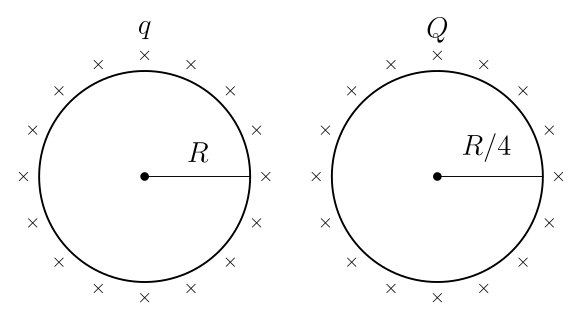 (A) ε0Q−ε0q
(B) Zero
(C) ε0q−ε0Q
(D) ε0Q
(A) ε0Q−ε0q
(B) Zero
(C) ε0q−ε0Q
(D) ε0Q›Reveal solutionSolution
Gauss's law: only charge enclosed by a surface contributes net flux, and Q lies outside the sphere of radius R — so its net flux through/inside that sphere is zero.
Step 1 — The geometry.
The figure shows two separate, non-touching metallic spheres: one of radius R carrying charge q on its surface, and one of radius R/4 carrying charge Q on its surface. Neither encloses the other. We are asked for the flux inside the sphere of radius R, due only to the sphere of radius R/4.
Step 2 — Apply Gauss's law.
Gauss's law states that for any closed surface S,
∮SE⋅dA=ε0qenclosed
The crucial word is enclosed. Take any closed (Gaussian) surface lying inside the sphere of radius R. The charge Q is on the other, distant sphere — it is not inside that Gaussian surface. Therefore the charge of the small sphere enclosed by it is zero:
qenclosed, due to Q=0⇒ϕQ=ε00=0
Step 3 — Why an external charge always gives zero net flux.
This is not a coincidence of this geometry. Field lines from an external charge that enter a closed surface must also leave it (they neither begin nor end inside). Every line of inward flux is cancelled by an equal line of outward flux, so the net flux from any charge outside a closed surface is identically zero.
Step 4 — The conductor argument gives the same answer.
Even more directly: the sphere of radius R is metallic. In electrostatic equilibrium the field inside the body of a conductor is zero — the free electrons rearrange themselves on the surface until they exactly cancel every external field (here, the field of Q) at every interior point. With E=0 everywhere inside, the flux through any surface inside it is also zero.
Both routes agree.
✓Final answerThe correct option is (B) — Zero.
ANSWER: B
- KCET 2025Set D-41 markMCQQ.If the radius of first Bohr orbit is r, then the radius of the second Bohr orbit will be (A) 8r (B) 4r (C) 22r (D) 2r
›Reveal solutionSolution
Bohr's quantisation gives rn∝n2, so going from n=1 to n=2 multiplies the radius by 22=4.
Step 1 — Derive the radius from Bohr's postulates.
Bohr assumed that (i) the Coulomb attraction supplies the centripetal force, and (ii) angular momentum is quantised in units of ℏ.
Force balance:
4πε01rn2e2=rnmvn2⟹mvn2rn=4πε0e2
Quantisation of angular momentum:
mvnrn=2πnh
Step 2 — Eliminate vn.
From the second relation, vn=2πmrnnh. Substituting into the first:
m(2πmrnnh)2rn=4πε0e2
4π2mrnn2h2=4πε0e2
rn=πme2ε0n2h2
Step 3 — Read off the dependence on n.
Everything on the right except n2 is a collection of fundamental constants, so
rn∝n2
Numerically, for hydrogen rn=0.529n2 A˚, where 0.529 A˚ is the Bohr radius a0.
Step 4 — Apply to the two orbits.
r1r2=1222=4
Given r1=r:
r2=4r
Step 5 — Why the other options are tempting but wrong.
- (D) 2r would follow from rn∝n — a linear guess, not what the derivation gives.
- (C) 22r would follow from rn∝n3/2.
- (A) 8r would follow from rn∝n3.
Only the n2 law is correct. (Note also the companion results: vn∝1/n and En∝−1/n2.)
✓Final answerThe correct option is (B) — 4r.
ANSWER: B
- KCET 2024Set D-21 markMCQQ.Dimensional formula for activity of a radioactive substance is (A) M0L1T−1 (B) M0L−1T0 (C) M0L0T−1 (D) M−1L0T0
›Reveal solutionSolution
Activity = (dimensionless count of nuclei) ÷ (time), so its dimensional formula is simply M0L0T−1.
1. Definition
The activity of a radioactive sample is the rate at which its nuclei disintegrate:
A=−dtdN=λN
where N is the number of undecayed nuclei and λ the decay constant.
2. Dimensions of each factor
- N is a pure number (a count of nuclei) ⇒[N]=M0L0T0.
- dt is a time ⇒[t]=T.
3. Put them together
[A]=[t][N]=TM0L0T0=M0L0T−1
4. Consistency check with the SI unit
The SI unit of activity is the becquerel: 1 Bq=1 disintegration per second=1 s−1. (The older unit, the curie, is 1 Ci=3.7×10¹⁰ Bq.) A unit of s−1 confirms the dimensional formula T−1 — the same dimensions as frequency and as the decay constant λ itself.
Options (A), (B) and (D) wrongly attach length or mass dimensions, which cannot appear because a count carries none.
✓Final answerThe correct option is (C) M0L0T−1.
ANSWER: C
- KCET 2023Set A-31 markMCQQ.In the situation shown in the diagram, magnitude of q≪∣Q∣ and r≫a. The net force on the free charge −q and net torque on it about O at the instant shown are respectively [p=2aQ is the dipole moment]
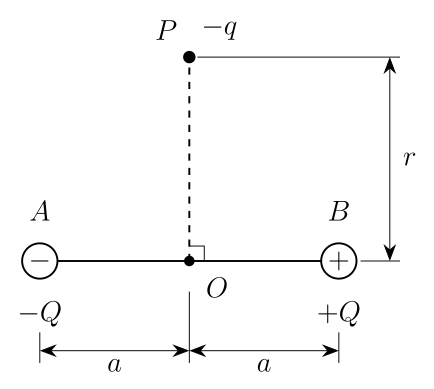 (A) 4πε01r2pqk^, 4πε01r3pqi^
(B) −4πε01r2pqk^, −4πε01r3pqi^
(C) 4πε01r3pqi^, +4πε01r2pqk^
(D) 4πε01r3pqi^, −4πε01r2pqk^
(A) 4πε01r2pqk^, 4πε01r3pqi^
(B) −4πε01r2pqk^, −4πε01r3pqi^
(C) 4πε01r3pqi^, +4πε01r2pqk^
(D) 4πε01r3pqi^, −4πε01r2pqk^›Reveal solutionSolution
Use the equatorial (broadside) dipole field E=4πε0r3p directed anti-parallel to p, get F=(−q)E, then take the cross product τ=r×F about O.
1. Set up axes and the dipole moment
Let i^ point along the dipole axis from A(−Q) towards B(+Q), j^ point vertically up from O towards P, and k^=i^×j^ out of the page.
The dipole moment always points from the negative to the positive charge, so
p=2aQi^=pi^
The free charge −q sits at P, on the perpendicular bisector: rP=rj^, with r≫a so the point-dipole (far-field) formulae apply. Also q≪∣Q∣, so −q does not disturb the dipole.
2. Field at an equatorial point
For a short dipole, at a point on the equatorial line,
E=−4πε01r3p=−4πε01r3pi^
The minus sign is the physics: on the broadside position the field is anti-parallel to p (the components along the axis from the two charges cancel, and the components anti-parallel to p add). Note the 1/r3 dependence — this alone kills options (A) and (B), which quote a 1/r2 force.
3. Force on the free charge
F=(−q)E=(−q)(−4πε01r3pi^)=+4πε01r3pqi^
So the force on −q is along +i^, of magnitude 4πε0r3pq. (Sensible: the negative charge is pulled towards the +Q end.)
4. Torque about O
τ=rP×F=(rj^)×(4πε01r3pqi^)=4πε01r2pq(j^×i^)
Since j^×i^=−k^,
τ=−4πε01r2pqk^
The torque is into the page — the force at P (pointing +i^) acting at a lever arm r above O tends to rotate the position vector clockwise, exactly as the cross product says. Its magnitude carries one power of r less than the force: τ=rF∝1/r2.
5. Match the options
Force =4πε01r3pqi^, torque =−4πε01r2pqk^ — this is option (D). Option (C) has the same force but the torque with the wrong sign.
✓Final answerThe correct option is (D) — 4πε01r3pqi^, −4πε01r2pqk^.
ANSWER: D
- KCET 2022Set B-31 markMCQQ.A charged particle of mass ‘m’ and charge ‘q’ is released from rest in an uniform electric field E. Neglecting the effect of gravity, the kinetic energy of the charged particle after ‘t’ seconds is (A) tEqm (B) 2mE2q2t2 (C) mq2E2t2 (D) 2t2E2q2m
›Reveal solutionSolution
The electric force is constant, so the motion is uniformly accelerated: find a=qE/m, then v=at, then KE=21mv2.
Step 1 — Identify the force and the acceleration.
The only force acting (gravity is to be neglected) is the electric force on the charge:
F=qE
Since E is uniform, F is constant, and therefore so is the acceleration. By Newton's second law:
a=mF=mqE
A constant acceleration means the standard kinematic equations apply directly.
Step 2 — Find the velocity after time t.
The particle is released from rest, so u=0. Using v=u+at:
v=0+(mqE)t=mqEt
Step 3 — Compute the kinetic energy.
KE=21mv2=21m(mqEt)2
KE=21m⋅m2q2E2t2
One power of m cancels:
KE=2mE2q2t2
Step 4 — Cross-check by the work–energy theorem.
An independent route must give the same result. The work done by the constant force over the distance travelled s=21at2 is:
W=F⋅s=(qE)(21⋅mqEt2)=2mq2E2t2
By the work–energy theorem, KE=W (since it started from rest) — identical ✓.
Step 5 — Dimensional check on the options.
Our answer has dimensions [kg][NC−1]2[C]2[s]2=kgN2s2=J ✓.
The structure of the answer is also physically revealing: KE∝t2 (energy grows quadratically with time, since v∝t) and KE∝1/m (a lighter particle is accelerated more by the same force and so gains more kinetic energy). Options (A) and (D) have KE decreasing with time — physically impossible for a particle being continuously accelerated — and (C) wrongly puts q in the denominator, which would mean a bigger charge gains less energy.
✓Final answerThe correct option is (B) — 2mE2q2t2.
ANSWER: B
- KCET 2022Set B-31 markMCQQ.A magnetic field of flux density 1.0 Wb m−2 acts normal to a 80 turn coil of 0.01m2 area. If this coil is removed from the field in 0.2 second, the emf induced in it is (A) 0.8V (B) 5V (C) 4V (D) 8V
›Reveal solutionSolution
Apply Faraday's law of electromagnetic induction: the induced emf is N times the rate of change of magnetic flux through one turn.
Step 1 — The law.
Faraday's law says an emf appears whenever the flux linked with a coil changes:
ε=−NdtdΦ⟹∣ε∣=NΔtΔΦ (for a uniform change)
The minus sign is Lenz's law — the induced current opposes the change that produced it — and it fixes only the direction, not the magnitude asked for here. The factor N appears because the N turns are in series, so their emfs add.
Step 2 — Initial flux through one turn.
The field is normal to the coil (θ=0, cosθ=1), so
Φi=BAcosθ=(1.0 Wbm−2)(0.01 m2)(1)=0.01 Wb.
(Note 1 Wbm−2=1 T.)
Step 3 — Final flux.
The coil is removed from the field, so
Φf=0 Wb,∣ΔΦ∣=0.01−0=0.01 Wb.
Step 4 — Substitute.
∣ε∣=NΔt∣ΔΦ∣=0.280×0.01=0.20.8=4 V.
Step 5 — Guard against the traps.
- Forgetting the N=80 turns gives 0.05 V.
- Forgetting to divide by Δt=0.2 s gives 0.8 V — exactly the distractor in option (A).
- 8 V (option D) comes from mistakenly using Δt=0.1 s. The correct value is 4 V.
✓Final answerThe correct option is (C) 4V.
ANSWER: C
- KCET 2022Set B-31 markMCQQ.An alternating current is given by i=i1sinωt+i2cosωt. The r.m.s current is given by (A) 2i12+i22 (B) 2i12+i22 (C) 2i1+i2 (D) 2i1−i2
›Reveal solutionSolution
For i = i1sin(wt) + i2cos(wt), the mean square current over a full cycle is <i^2> = <i1^2 sin^2(wt)> + 2i1i2*<sin(wt)cos(wt)> + <i2^2 cos^2(wt)> = i1^2*(1/2) + 0 + i2^2*(1/2) =…
For i = i1sin(wt) + i2cos(wt), the mean square current over a full cycle is <i^2> = <i1^2 sin^2(wt)> + 2i1i2*<sin(wt)cos(wt)> + <i2^2 cos^2(wt)> = i1^2*(1/2) + 0 + i2^2*(1/2) = (i1^2+i2^2)/2 (using <sin^2>=<cos^2>=1/2 and <sin*cos>=0 over a full cycle). So i_rms = sqrt((i1^2+i2^2)/2). Note: options (A) and (B) are transcribed as literally identical text (sqrt((i1^2+i2^2)/2)) — an apparent duplication in the source data — so I select (A) as the first occurrence of the physically correct expression.
✓Final answerOption (A).
- KCET 2022Set B-31 markMCQQ.The de-Broglie wavelength of a particle of kinetic energy ‘K’ is λ ; the wavelength of the particle, if its kinetic energy is K/4 is (A) 2λ (B) 4λ (C) λ/2 (D) λ/4
›Reveal solutionSolution
Since λ∝1/K, quartering the kinetic energy doubles the wavelength.
Step 1 — De Broglie relation in terms of kinetic energy.
λ=ph=2mKh
Step 2 — Apply the new kinetic energy K/4.
λ′=2m(K/4)h=2mK/2h=2⋅2mKh=2λ
✓Final answerThe new wavelength is 2λ — option (A).
- KCET 2022Set B-31 markMCQQ.In a photo electric experiment, if both the intensity and frequency of the incident light are doubled, then the saturation photo electric current (A) Is doubled (B) Becomes four times (C) Remains constant (D) Is halved
›Reveal solutionSolution
Saturation current tracks the photon arrival rate (intensity), never the photon energy (frequency) — so doubling intensity alone doubles the current, regardless of what frequency does.
Why frequency doesn't matter for saturation current. Above the threshold frequency, every absorbed photon ejects one electron. The RATE of electron ejection is set by how many photons arrive per second — that's what intensity measures. Frequency only sets each photoelectron's kinetic energy (via Einstein's equation), not how many are emitted.
Applying it here. Intensity is doubled → twice as many photons arrive per second → twice as many photoelectrons per second → saturation current doubles.
✓Final answerThe current is doubled — option (A).
- KCET 2021Set B-21 markMCQQ.The maximum range of a gun on horizontal plane is 16 km. If g=10 m s−2, then muzzle velocity of a shell is (A) 160 m s−1 (B) 2002 m s−1 (C) 400 m s−1 (D) 800 m s−1
›Reveal solutionSolution
Use Rmax=u2/g (the range at the optimum launch angle of 45∘) and solve for the muzzle speed u.
Step 1 — The range formula and why 45∘ maximises it.
For projectile launched at speed u and angle θ over level ground,
R(θ)=gu2sin2θ.
Since sin2θ≤1 with equality at 2θ=90∘, i.e. θ=45∘, the maximum range is
Rmax=gu2.
The gun's "maximum range" is exactly this quantity — it is the reach at the best possible elevation.
Step 2 — Convert units.
Rmax=16 km=16000 m.
Step 3 — Solve for u.
u2=Rmaxg=16000×10=1.6×10⁵ m2s−2
u=1.6×105=16×104=4×102=400 ms−1.
Check: 4002/10=160000/10=16000m=16km ✓.
✓Final answerThe correct option is (C) — 400 m s−1.
ANSWER: C
- KCET 2019Set A-11 markMCQQ.An electron is moving with an initial velocity v=V0i^ and is in a uniform magnetic field B=B0j^. Then its de Broglie wavelength (A) remains constant (B) increases with time (C) decreases with time (D) increase and decreases periodically
›Reveal solutionSolution
The electron moves in a circular path perpendicular to the magnetic field, so its speed stays constant. Since de Broglie wavelength depends only on speed, it remains constant.
The key idea here is that de Broglie wavelength λ is given by λ=ph, where p is the magnitude of the momentum. For an electron, p=mv (non-relativistic), so λ=mvh. The question reduces to: does the speed v of the electron change in a uniform magnetic field?
A magnetic field exerts a force F=q(v×B) on a moving charge. This force is always perpendicular to the velocity. A force perpendicular to velocity does no work — it changes the direction of motion but not the speed. So v remains constant in magnitude.
Let’s trace the motion step by step.
-
Initial conditions: The electron has velocity v=V0i^ (along the x-axis) and enters a uniform magnetic field B=B0j^ (along the y-axis). The charge of an electron is q=−e.
-
Force on the electron:
F=q(v×B)=−e(V0i^×B0j^)=−eV0B0(i^×j^)=−eV0B0k^
So the force is along the negative z-direction (into the page, if we set axes conventionally). This force is perpendicular to the velocity (which is along i^).
-
Nature of motion: Since the force is always perpendicular to velocity and constant in magnitude, the electron undergoes uniform circular motion in the x-z plane. The magnetic field direction (y-axis) is perpendicular to the plane of motion. The speed v=V0 never changes — only the direction of v changes.
-
De Broglie wavelength:
λ=mvh=mV0h
Since h, m, and V0 are all constants, λ is constant.
Watch outA common mistake is to think the wavelength changes because the electron's path curves. But wavelength depends on speed, not on direction. As long as speed is constant, λ is constant.
TipIf the magnetic field had a component parallel to the velocity, the electron would also have helical motion — but even then, the speed (and hence λ) remains constant. Only an electric field or a non-uniform magnetic field can change the speed of a charged particle.
✓Final answerThe de Broglie wavelength remains constant, so the correct option is (A).
-
🎓Unlock everything free for 14 days
- ✓Full step-by-step solutions
- ✓Concept-first explanations
- ✓Methods, shortcuts & mistakes
- ✓PYQ mapping + timed mock tests
Full access for 14 days. No credit card required.