Q.A compound microscope consists of an objective lens of focal length 2.0 cm and an eyepiece of focal length 6.25 cm separated by a distance of 15 cm. How far from the objective should an object be placed in order to obtain the final image at
🔒You're viewing a preview — the full solution, concept, methods & PYQ mapping are locked.
🔒 Start your 14-day free trial to unlock the full solution →Concept understanding — Microscope Magnification
Microscope Magnification
A compound microscope views very small, nearby objects using two lenses in sequence: the objective (near the object) and the eyepiece (near the eye). Its total magnifying power is the product of what each lens contributes.
How the two lenses work together
- The object sits just beyond the focus of the short-focal-length objective (fo), which forms a real, inverted, magnified image inside the tube.
- That real image falls just inside the focus of the eyepiece (fe), which acts as a simple magnifier, producing a large virtual, magnified final image for the eye.
Because each stage magnifies, the effects multiply:
M=mo×me
The objective's magnification
mo=uovo≈foL
where L is the tube length (roughly the distance between the objective's second focal point and the eyepiece's first focal point). The object sits close to fo, so this approximation holds for a well-designed microscope.
The eyepiece's magnification
The eyepiece behaves as a simple magnifier:
- Final image at the near point (D=25 cm, largest magnification):
me=1+feD
- Final image at infinity (relaxed eye, "normal adjustment"):
me=feD
Total magnifying power
Image at the near point: M=foL(1+feD)
Image at infinity: M=foL⋅feD
High magnification needs short fo and fe (both sit in denominators) and a large tube length L — this is why a microscope objective is always a very short-focus lens.
Worked example
Objective fo=1.0 cm, eyepiece fe=2.5 cm, tube length L=20 cm, near point D=25 cm. Find M with the final image at the near point.
mo=1.020=20,me=1+2.525=11
M=20×11=220 …
Why this formula?
Microscope Magnification: Why the Formula Holds
Let's build the understanding from first principles — not just memorizing formulas, but seeing why they work.
1. What Does "Magnification" Mean in a Microscope?
A microscope creates a larger apparent image of a tiny object. The total magnification is the product of two stages:
- Objective lens — creates a real, enlarged, inverted image of the specimen.
- Eyepiece (ocular) — acts as a simple magnifier to view that real image.
So:
Total magnification = (magnification by objective) × (magnification by eyepiece)
2. The Key Formula
For a compound microscope in normal adjustment (final image at infinity, relaxed eye):
M=Mo×Me=(foL)×(feD)
Where:
- fo = focal length of objective
- fe = focal length of eyepiece
- L = tube length (distance between second focal point of objective and first focal point of eyepiece)
- D = near point distance of the eye (usually 25 cm)
3. Derivation of Objective Magnification Mo
Step 1: How the objective works
The objective lens forms a real, inverted, enlarged image of the specimen. The specimen is placed just outside its focal point (fo).
Step 2: Using the lens formula
For a thin lens:
vo1−uo1=fo1
(Using sign convention: uo is negative, vo is positive)
Step 3: The tube length approximation
In a standard microscope, the specimen is placed very close to fo, so:
- uo≈−fo (object just beyond focal point)
- The image is formed at the first focal point of the eyepiece, which is at a distance L from the second focal point of the objective.
Thus:
vo≈fo+L
Step 4: Magnification formula
Lateral magnification by objective:
Mo=∣uo∣vo≈fofo+L=1+foL
Since L≫fo in practice, 1 is negligible:
Mo≈foL
Why this makes sense: A shorter fo means the objective is more "powerful" — it bends light more sharply, creating a larger image at the fixed tube length.
4. Derivation of Eyepiece Magnification Me
Step 1: The eyepiece as a simple magnifier
The eyepiece takes the real image from the objective and acts like a magnifying glass. For relaxed eye (final image at infinity), the real image must be placed at the focal point of the eyepiece.
Step 2: Angular magnification
Angular magnification is defined as:
Me=angle subtended by object at near pointangle subtended by image at eye
For a simple magnifier with image at infinity:
Me=feD
Where D=25 cm (standard near point). …
Concept: Microscope Magnification — The final image is formed by the eyepiece, so we first find the intermediate image distance for the eyepiece, then use that to find the object distance for the objective.
Step 1: Eyepiece for case (a) — final image at D=25 cm
For the eyepiece, fe=6.25 cm, ve=−25 cm (virtual image). Using lens formula:
ue1=ve1−fe1=−251−6.251=−0.04−0.16=−0.20
So ue=−5 cm. The intermediate image is 5 cm from the eyepiece on the objective side.
Step 2: Objective for case (a)
Tube length L=15 cm, so vo=L−∣ue∣=15−5=10 cm.
Objective fo=2.0 cm. Using lens formula:
uo1=vo1−fo1=101−21=0.1−0.5=−0.4
Thus uo=−2.5 cm. Object is 2.5 cm from objective.
Step 3: Magnifying power for case (a)
M=−uovo(1+feD)=−−2.510(1+6.2525)=4×(1+4)=20
Step 4: Case (b) — final image at infinity …
Treating the objective and eyepiece as two lenses in sequence and working back from the required final-image position: (a) for the final image at the near point (25 cm) the object must be 2.5 cm from the objective, giving magnifying power 20;
(b) for the final image at infinity the object must be 2770≈2.59 cm from the objective, giving magnifying power 13.5.
How a compound microscope works
The objective (fo=2.0 cm) forms a real, enlarged, inverted intermediate image; the eyepiece (fe=6.25 cm) then acts as a simple magnifier on that image. The lenses are fixed L=15 cm apart. We work backward from the eyepiece, since the required position of the final image fixes where the intermediate image must sit.
Case (a): final image at the least distance of distinct vision, ve=−25 cm
Eyepiece. Using ve1−ue1=fe1 with ve=−25 cm, fe=6.25 cm:
ue1=ve1−fe1=−251−6.251=−0.04−0.16=−0.20⇒ue=−5.0 cm.
So the intermediate image is 5.0 cm in front of the eyepiece, i.e. 15−5.0=10.0 cm from the objective, giving vo=+10.0 cm.
Objective. Using vo1−uo1=fo1 with vo=10.0 cm, fo=2.0 cm:
uo1=vo1−fo1=101−21=−0.4⇒uo=−2.5 cm.
The object is placed 2.5 cm from the objective (just beyond its focus fo=2.0 cm, as expected).
Magnifying power. …
Method: Two-Step Image Formation (Ray Tracing by Lens Equations)
This problem treats the compound microscope as two lenses in series — the objective forms a real, inverted, enlarged image, and the eyepiece then magnifies that image further. We apply the thin lens formula to each lens in turn, using the fixed separation between the lenses.
Step 1 – Understand the layout
- Objective: fo=2.0 cm
- Eyepiece: fe=6.25 cm
- Separation between lenses: L=15 cm
- Final image distance from eyepiece:
- Case (a): ve=−25 cm (least distance of distinct vision, virtual image)
- Case (b): ve=∞ (image at infinity)
We use the Cartesian sign convention with the lens formula v1−u1=f1. The image formed by the objective acts as the object for the eyepiece; the two are linked by
∣vo∣+∣ue∣=L
Step 2 – Eyepiece, Case (a): final image at 25 cm
For the eyepiece, ve=−25 cm and fe=+6.25 cm:
ue1=ve1−fe1=−251−6.251=−0.04−0.16=−0.20
ue=−5 cm
So the objective’s image lies 5 cm in front of the eyepiece — a real object placed just inside the eyepiece’s focal length, which is exactly what produces a magnified virtual image at 25 cm.
The image distance for the objective is therefore
vo=L−∣ue∣=15−5=10 cm
Step 3 – Objective, Case (a)
Lens formula for the objective (fo=2.0 cm, vo=+10 cm):
uo1=vo1−fo1=101−21=0.1−0.5=−0.4
uo=−2.5 cm
The object must be placed 2.5 cm in front of the objective.
Step 4 – Magnifying power, Case (a)
With the final image at the least distance of distinct vision D=25 cm:
M=∣uo∣vo(1+feD)
∣uo∣vo=2.510=4,1+feD=1+6.2525=1+4=5
M=4×5=20
Step 5 – Case (b): final image at infinity …
Common Mistakes & How to Avoid Them
Mistake 1: Confusing the separation distance with image distances
The error: Students often take the given 15 cm separation as vo or ue directly, without realising it is the distance between the two lenses (L=vo+ue).
How to avoid:
- Draw a clear ray diagram.
- Label the objective-to-eyepiece distance as L=vo+ue.
- Never substitute 15 cm for vo alone — it is the sum of two distances.
Mistake 2: Forgetting sign conventions for the eyepiece
The error: Treating the eyepiece as a converging lens but forgetting that the final image is virtual (on the same side as the object for the eyepiece). This leads to wrong signs in the lens formula.
How to avoid:
- For the eyepiece, the final image distance ve is negative (virtual image).
- Case (a): ve=−D=−25 cm
- Case (b): ve=−∞
- Use the lens formula with correct signs:
fe1=ve1−ue1
(where ue is negative because the object for eyepiece is real and on the opposite side).
Mistake 3: Using the wrong formula for magnifying power
The error: Mixing up the two cases — using the near-point formula when the final image is at infinity, or vice versa.
How to avoid:
- Final image at near point (D=25 cm):
M=Mo×Me=(−uovo)×(1+feD)
- Final image at infinity:
M=Mo×Me=(−uovo)×(feD)
- Memorise: the +1 appears only when the eye is accommodating (near point).
Mistake 4: Forgetting the negative sign in magnification
The error: Reporting magnifying power as a positive number without indicating that the image is inverted relative to the object.
How to avoid:
- The objective magnification Mo=−vo/uo is negative (real, inverted image).
- The eyepiece magnification Me is positive (virtual, erect relative to the intermediate image).
- The total magnification M=Mo×Me is negative, meaning the final image is inverted.
- In exam answers, state: “Magnifying power = ∣M∣ (magnitude)” or explicitly say “image is inverted.”
Mistake 5: Not checking if the intermediate image lies within the eyepiece focal length …
- COMEDK 2026Set 2026-A1 markMCQQ.The distance between the objective and eye piece of astronomical telescope in normal adjustment is 27 cm and its magnifying power is 8 . What is the focal length of the eye piece? (A) 12 cm (B) 3 cm (C) 6 cm (D) 24 cm
›Reveal solutionSolution
[!TLDR]
From fo+fe=27 and fo/fe=8, the eyepiece focal length is 3 cm — option (B).
Concept
For an astronomical telescope in normal adjustment, the objective and eyepiece are separated by L=fo+fe, and the magnifying power is m=fo/fe (CBSE/NCERT Class 12 Ray Optics).
Solution
Given L=fo+fe=27 cm and m=fefo=8, so fo=8fe. Substituting:
8fe+fe=27 ⇒ 9fe=27 ⇒ fe=3 cm. …
- COMEDK 2026Set 2026-M1 markMCQQ.An object is placed at an unknown distance from a convex objective lens of focal length 5 cm . The objective lens forms a real image which acts as an object for a convex eyepiece of focal length 6.25 cm . The distance between the objective and eyepiece is 20 cm . The microscope is adjusted so that the final image is formed at the least distance of distinct vision (25 cm). Which of the following is correct? A. Object distance =7.5 cm; Total magnification =10 B. Object distance = 10 cm ; Total magnification = 20 C. Object distance =5 cm; Total magnification =20 D. Object distance = 2.5 cm ; Total magnification = 10 (A) C (B) D (C) B (D) A
›Reveal solutionSolution
Working back from the eyepiece: object distance for the objective is 7.5 cm and the total magnification is 10 — matching the choice "Object distance =7.5 cm; Total magnification =10", listed as option (D).
Step 1 — Eyepiece (final image at D=25 cm).
The final virtual image is on the same side as the object, so ve=−25 cm, fe=6.25 cm.
ve1−ue1=fe1 ⇒ −251−ue1=6.251
ue1=−0.04−0.16=−0.20 ⇒ ue=−5 cm
So the intermediate image sits 5 cm in front of the eyepiece.
Step 2 — Locate the intermediate image relative to the objective.
The lenses are 20 cm apart, so the objective's real image is at
vo=20−5=15 cm.
Step 3 — Objective (find the object distance). …
- COMEDK 2025Set 2025-E1 markMCQQ.In the normal adjustment of an astronomical telescope, the objective and eyepiece are 36 cm apart. If the magnifying power of the telescope is 8 , find the focal lengths of the objective and eyepiece. (A) FO=28 cm,Fee=7 cm (B) F0=28 cm, Fe=4 cm (C) Fo=32 cm,Fee=4 cm (D) F0=4 cm, Fe=32 cm
›Reveal solutionSolution
For an astronomical telescope in normal adjustment, the tube length equals the sum of the focal lengths, and the magnifying power equals the ratio of the objective focal length to the eyepiece focal length. Solving these two equations gives fo=32 cm and fe=4 cm, which corresponds to option (C).
The key idea is that in normal adjustment, the telescope is set so that the final image is at infinity. This means the eyepiece is positioned so that the intermediate image formed by the objective lies exactly at the focal point of the eyepiece. Consequently, the distance between the objective and the eyepiece (the tube length) is simply the sum of their focal lengths:
L=fo+fe.
The magnifying power M of an astronomical telescope in normal adjustment is defined as the ratio of the angle subtended by the image to the angle subtended by the object, and it simplifies to
M=fefo.
We are given L=36 cm and M=8. So we have two equations in two unknowns — a straightforward system.
- Set up the equations From the magnifying power:
fefo=8⇒fo=8fe.
From the tube length:
fo+fe=36.
- Substitute and solve Replace fo in the second equation:
8fe+fe=36⇒9fe=36⇒fe=4 cm.
Then
fo=8×4=32 cm.
- Check against the options The pair (fo=32 cm,fe=4 cm) matches option (C). …
- COMEDK 2024Set 2024-E1 markMCQQ.A telescope has an objective of focal length 60 cm and eyepiece of focal length 5 cm. The telescope is focussed for least distance of distinct vision 300 cm away from the object. The magnification produced by the telescope at least distance of distinct vision is (A) +1.5 (B) +2 (C) −1.5 (D) −2
›Reveal solutionSolution
The objective forms a real image (m1=−41); the eyepiece throws the final image to the near point (m2=+6), giving a net magnification M=−1.5.
The telescope is used on a near object: the object sits 300cm from the objective, and the final image is formed at the least distance of distinct vision, D=25cm.
Objective (fo=60cm, u1=−300cm):
v11=fo1+u11=601−3001=3004⇒v1=+75cm
m1=u1v1=−30075=−41
Eyepiece (fe=5cm, final image v2=−25cm at the near point): …
- COMEDK 2024Set 2024-M1 markMCQQ.In the normal adjustment of an astronomical telescope, the objective and eyepiece are 32 cm apart. If the magnifying power of the telescope is 7, find the focal lengths of the objective and eyepiece. (A) fo=7 cm and fe=28 cm (B) fo=28 cm and fe=7 cm (C) fe=28 cm and fo=4 cm (D) fo=28 cm and fe=4 cm
›Reveal solutionSolution
In normal adjustment, the telescope length equals the sum of the focal lengths, and the magnifying power equals the ratio of the objective focal length to the eyepiece focal length. Solving these two equations gives fo=28 cm and fe=4 cm, so the correct option is (D).
Concept & Intuition
An astronomical telescope in normal adjustment means the final image is formed at infinity — the eyepiece is set so that the light rays emerging from it are parallel. This happens when the image formed by the objective lies exactly at the first focal point of the eyepiece. Consequently, the distance between the two lenses (the tube length) is simply the sum of their focal lengths:
L=fo+fe
The magnifying power (angular magnification) in this setting is given by the ratio of the objective’s focal length to the eyepiece’s focal length:
M=fefo
We are given L=32 cm and M=7. That gives us two equations in two unknowns — straightforward algebra.
Step-by-step solution
- Write the two conditions From normal adjustment:
fo+fe=32(1)
From magnifying power:
fefo=7(2)
- Express one variable in terms of the other From (2):
fo=7fe
- Substitute into the length equation
- COMEDK 2023Set 2023-E1 markMCQQ.A person has a normal near point 25 cm. What is the magnifying power of the simple microscope he used, if the focal length of the convex lens used is 10 cm and the final image is formed at the least distance of distinct vision? (A) 7 (B) 3.5 (C) 25 (D) 2.5
›Reveal solutionSolution
(The value D/f = 2.5 is the magnifying power for the image at INFINITY (relaxed eye), which is option (D) - not what is asked here.)
Concept: simple microscope (magnifying glass). When the final image is formed at the least distance of distinct vision D (image at the near point), the magnifying power is
M = 1 + D/f.
Given D = 25 cm, f = 10 cm:
M = 1 + 25/10 = 1 + 2.5 = 3.5. …
- KCET 2022Set B-31 markMCQQ.A convex lens of focal length ‘f’ is placed somewhere in between an object and a screen, the distance between the object and the screen is ‘x’. If the numerical value of the magnification produced by the lens is ‘m’, then the focal length of the lens is (A) m(m+1)2x (B) m(m−1)2x (C) (m+1)2mx (D) (m−1)2mx
›Reveal solutionSolution
Split the fixed object–screen distance x into u and v using the magnification ratio, then feed both into f=u+vuv.
1. Set up the geometry
The lens sits between the object and the screen, and it forms a real image on the screen. Working with numerical (unsigned) distances:
- object distance =u
- image distance =v
- they must add up to the object–screen separation:
u+v=x(1)
2. Use the magnification
For a thin lens the numerical magnification of a real image is
m=uv⟹v=mu(2)
3. Solve for u and v
Substituting (2) into (1):
u+mu=x⟹u(1+m)=x⟹u=m+1x
v=mu=m+1mx
4. Apply the lens formula
In magnitudes, the thin-lens relation for a real object and real image is
f1=u1+v1=uvu+v⟹f=u+vuv
Now substitute, noting the denominator u+v is just x:
f=x(m+1x)(m+1mx)=x(m+1)2mx2
∴f=(m+1)2mx
5. Sanity checks …
- COMEDK 2021Set 20211 markMCQQ.The magnifying power of a telescope is 9. When it is adjusted for parallel rays, the distance between the objective and eyepiece is 20 cm. The focal length of lenses are (A) 10 cm, 10 cm (B) 15 cm, 5 cm (C) 18 cm, 2 cm (D) 11 cm, 9 cm
›Reveal solutionSolution
Focal lengths: 18 cm (objective) and 2 cm (eyepiece).
Concept: astronomical telescope in normal adjustment (parallel rays / relaxed eye).
Magnifying power m = f_o/f_e = 9
Tube length L = f_o + f_e = 20 cm
Substituting f_o = 9 f_e: …
- KCET 2020Set A-11 markMCQQ.The following figure shows a beam of light converging at point P. When a concave lens of focal length 16 cm is introduced in the path of the beam at a place shown by dotted line such that OP becomes the axis of the lens, the beam converges at a distance x from the lens. The value of x will be equal to
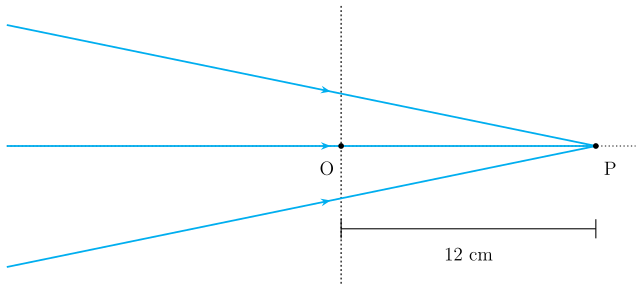 (A) 12 cm
(B) 24 cm
(C) 36 cm
(D) 48 cm
(A) 12 cm
(B) 24 cm
(C) 36 cm
(D) 48 cm›Reveal solutionSolution
A beam already converging towards a point beyond the lens means that point is a virtual object (u positive); apply v1−u1=f1 with u=+12 cm, f=−16 cm.
Step 1 — Read the geometry
From the figure: light converges towards P, and the concave lens is inserted at the dotted line through O, with OP=12 cm measured along the axis, on the far (outgoing) side of the lens.
Step 2 — Identify the virtual object
If the lens were absent, the rays would meet at P. Because the rays are already converging when they strike the lens, they never actually diverge from a real object point. The point P — where they would have met — acts as a virtual object.
In the Cartesian sign convention (light travelling left → right, distances measured from the optical centre, rightward positive):
u=+12 cm(virtual object, on the outgoing side)
f=−16 cm(concave / diverging lens)
The positive u is the whole trick of the question — a real object would give a negative u.
Step 3 — Apply the lens formula
v1−u1=f1 …
🎓Unlock everything free for 14 days
- ✓Full step-by-step solutions
- ✓Concept-first explanations
- ✓Methods, shortcuts & mistakes
- ✓PYQ mapping + timed mock tests
Full access for 14 days. No credit card required.