Question of 98
Q.(i) Define Lattice enthalpy.
(1)
(ii) Construct an enthalpy diagram for the determination of lattice enthalpy of sodium chloride (3)
Kerala DhseKerala DHSE Plus One Board 2024Subjective· 4mImportance★★★★★
0% · 0/98 Questions
You're viewing a preview — the full solution, concept, methods & PYQ mapping are locked.
Start your 14-day free trial to unlock the full solution →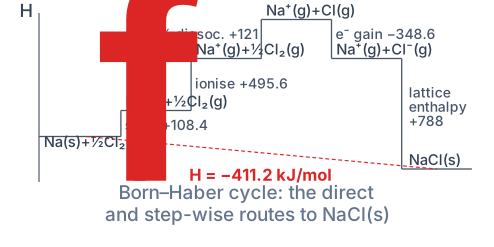
Lattice enthalpy of NaCl cannot be measured directly, so it is calculated indirectly using the Born–Haber cycle — an enthalpy-level diagram that connects the elements, gaseous atoms, gaseous ions, and the solid ionic compound through a series of known enthalpy changes (sublimation, ionisation, bond dissociation, electron gain, and formation), applying Hess's law.
- Definition of lattice enthalpy Lattice enthalpy (ΔlatticeH°) is defined as the enthalpy change that occurs when one mole of a solid ionic compound dissociates completely into its constituent ions in the gaseous state, e.g.: NaCl(s) → Na⁺(g) + Cl⁻(g), ΔlatticeH° = +788 kJ/mol (Equivalently, it can be defined as the enthalpy released when one mole of the solid ionic compound is formed from its gaseous ions, in which case the sign is reversed/negative — both conventions describe the same magnitude of lattice energy.)
- Enthalpy diagram (Born–Haber cycle) for lattice enthalpy of NaCl Since lattice enthalpy cannot be measured directly by experiment, it is determined indirectly by constructing an enthalpy-level (Born–Haber) cycle connecting Na(s) + ½Cl2(g) to NaCl(s) through several measurable intermediate steps, and applying Hess's Law (the total enthalpy change is independent of path). The diagram is drawn as a set of horizontal energy levels connected by vertical/diagonal arrows, each arrow labelled with one step and its enthalpy change:
- Sublimation of sodium: Na(s) → Na(g), ΔsubH° = +108.4 kJ/mol (energy absorbed to convert solid Na to gaseous Na)
- Ionisation of gaseous sodium: Na(g) → Na⁺(g) + e⁻, ΔiH° = +496 kJ/mol (first ionisation enthalpy of Na)
- Dissociation of chlorine gas: ½Cl2(g) → Cl(g), ½ΔdissH° = +121 kJ/mol (half the bond dissociation enthalpy of Cl2)
- Electron gain by gaseous chlorine atom: Cl(g) + e⁻ → Cl⁻(g), ΔegH° = −348.6 kJ/mol (electron gain enthalpy of Cl, energy released)
- Formation of the crystal lattice: Na⁺(g) + Cl⁻(g) → NaCl(s), ΔlatticeH° = ? (this is the unknown quantity we want; energy released when gaseous ions come together as a solid lattice)
- Overall/direct formation reaction: Na(s) + ½Cl2(g) → NaCl(s), ΔfH° = −411.2 kJ/mol (the standard enthalpy of formation of NaCl, known experimentally) …
Unlock everything free for 14 days
- Full step-by-step solutions
- Concept-first explanations
- Methods, shortcuts & mistakes
- PYQ mapping + timed mock tests
Full access for 14 days. No credit card required.