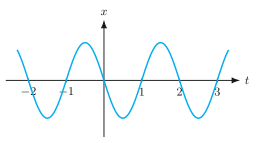
Q.Figure 2.13 gives the x-t plot of a particle executing one-dimensional simple harmonic motion. (You will learn about this motion in more detail in Chapter 13). Give the signs of position, velocity and acceleration variables of the particle at t=0.3 s, 1.2 s, −1.2 s.
🔒You're viewing a preview — the full solution, concept, methods & PYQ mapping are locked.
🔒 Start your 14-day free trial to unlock the full solution →Concept understanding — Simple Harmonic Motion
Simple Harmonic Motion: The Natural Rhythm of Things
Imagine a ball placed at the bottom of a perfectly smooth, U-shaped bowl. If you give it a gentle push, what happens? It rolls up one side, slows down, stops for an instant, then rolls back down, past the bottom, up the other side, stops, and returns. Left alone, it keeps doing this — back and forth, back and forth — in a steady, repeating rhythm.
That rhythm is the heart of Simple Harmonic Motion (SHM). It's the most fundamental kind of oscillatory (back-and-forth) motion in physics.
The Intuition: A Restoring Force That Fights Displacement
The key idea is this: the further you push the object from its resting (equilibrium) position, the stronger the force that tries to pull it back.
In the bowl, when the ball is at the bottom (equilibrium), gravity pulls straight down, and the bowl pushes straight up — no sideways force. But when you push the ball up the side, gravity now has a component that pulls it down the slope. The higher up the side you push it, the steeper the slope, and the stronger that pull-back force becomes.
This is a restoring force — it always points toward equilibrium. And crucially, in SHM, this restoring force is directly proportional to the displacement from equilibrium. Double the displacement, double the restoring force.
F=−kx
- F is the restoring force.
- x is the displacement from equilibrium.
- k is a positive constant (the "stiffness" of the system).
- The minus sign is crucial: it tells you the force is opposite to the displacement.
The Precise Statement
Simple Harmonic Motion is the motion of an object where the restoring force is directly proportional to the displacement from equilibrium and acts in the opposite direction.
That's it. That single condition — F=−kx — is the entire definition. Everything else (the sine waves, the formulas for period and frequency) follows mathematically from this one law.
What Does This Motion Look Like?
If you track the ball's position over time, you get a beautiful, smooth wave — a sine wave (or cosine wave). It's the same shape as the shadow of a spinning wheel cast on a wall.
The motion has three key descriptors:
- Amplitude (A): The maximum displacement from equilibrium. How far you initially pushed the ball up the side of the bowl.
- Period (T): The time it takes to complete one full back-and-forth cycle (e.g., from the leftmost point, back to the leftmost point).
- Frequency (f): How many cycles happen per second. f=1/T.
A remarkable fact: for a given system (fixed k and fixed mass m), the period and frequency do not depend on the amplitude. A big push and a tiny push take exactly the same time to complete one cycle. This is called isochronism — and it's why pendulums were used to keep time in clocks.
The Mathematical Description (Derived from F=−kx)
Using Newton's second law (F=ma) and the definition of acceleration (a=dt2d2x), the condition F=−kx becomes:
mdt2d2x=−kx
This is a differential equation. Its solution — the position as a function of time — is:
x(t)=Acos(ωt+ϕ)
Where:
- ω=mk is the angular frequency (radians per second). It tells you how fast the oscillation is.
- ϕ is the phase constant (determines where in the cycle you start measuring time). …
Model the curve as x(t)=−Asin(πt) (period 2s, amplitude A>0, crossing zero at every integer t and dipping negative just after t=0). Then v(t)=x˙=−Aπcos(πt) and a(t)=x¨=−π2x(t) — for SHM the acceleration is always directed opposite to the displacement, back towards the centre x=0.
At t=0.3s: the phase is π(0.3)=0.3π rad =54∘, which lies between 0∘ and 90∘ (the particle is in its first swing away from the origin, not yet at the far end). Here sin(0.3π)>0, so x=−Asin(0.3π)<0. Also cos(0.3π)>0, so v=−Aπcos(0.3π)<0 (still moving away from the origin, in the negative direction). Since x<0, a=−π2x>0 (accelerating back towards x=0).
At t=1.2s: the phase is 1.2π rad =216∘, which lies between 180∘ and 270∘ (third quadrant), where both sin and cos are negative. So x=−Asin(1.2π)=−A(negative)>0, v=−Aπcos(1.2π)=−Aπ(negative)>0, and since x>0, a=−π2x<0. …
The graph is x(t)=−Asin(πt) with amplitude A>0 and period 2s (it crosses zero at every integer t and dips negative just after t=0). Differentiating gives velocity and acceleration, and for SHM the acceleration always points opposite to the displacement. Evaluating the signs at the three instants gives (−,−,+), (+,+,−) and (−,+,+).
Setting up the motion
The curve is zero at t=0 and negative just after, so write
x(t)=−Asin(ωt),ω=T2π=2s2π=π rad s−1.
Then
v(t)=dtdx=−Aπcos(πt),a(t)=dtdv=Aπ2sin(πt)=−ω2x(t).
The last relation, a=−ω2x, is the defining property of SHM: acceleration is always opposite in sign to the position.
Evaluating the signs
At t=0.3s (0.3π=54∘):
- x=−Asin54∘=−0.81A<0 → negative
- v=−Aπcos54∘=−0.59Aπ<0 → negative
- a=−ω2x>0 → positive
At t=1.2s (1.2π=216∘):
- x=−Asin216∘=−A(−0.59)=+0.59A>0 → positive
- v=−Aπcos216∘=−Aπ(−0.81)=+0.81Aπ>0 → positive
- a=−ω2x<0 → negative …
Concept: Reading Signs Directly Off the Sketched Curve
Method: Direct Curve-Reading by Region (slope and concavity, no explicit trigonometric formula)
Rather than writing x(t)=−Asin(πt) and differentiating it twice, this method reads every sign directly off the described shape of the curve — using only two general facts valid for any smooth, periodic up-down curve: (i) inside any trough (a stretch between two zero-crossings that dips below the axis), the curve is concave up everywhere, and inside any crest, concave down everywhere;
(ii) within a trough or crest, the velocity sign flips exactly once, at the extremum itself — negative (falling) before it, positive (rising) after it, for a trough (and the reverse for a crest).
Setting up the regions from the description
- Trough (dips below axis): between t=0 and t=1 (bottom near t=0.5), and again between t=−2 and t=−1 (bottom near t=−1.5), by the stated period of 2 s.
- Crest (rises above axis): between t=−1 and t=0 (top near t=−0.5), and between t=1 and t=2 (top near t=1.5).
Evaluating each instant
-
t=0.3 s lies inside the trough (0,1), before its bottom at t=0.5: position is below the axis (x<0); the curve is still descending toward the bottom, so velocity is still falling (v<0); concavity is upward throughout this entire trough (a>0).
→ x<0, v<0, a>0
-
t=1.2 s lies inside the crest (1,2), before its top at t=1.5: position is above the axis (x>0); the curve is still rising toward the top, so velocity is still rising (v>0); concavity is downward throughout this entire crest (a<0).
→ x>0, v>0, a<0 …
Showing the 12 most recent of 21 on this concept.
- KEAM 2026Set eng-2026-04184 marksMCQQ.Which of the following equations represents a simple harmonic motion? (x is displacement and a is acceleration) (A) a=0.9x2 (B) a=−10x (C) a=100x3 (D) a=1.2x (E) a2=12x
›Reveal solutionSolution
Simple harmonic motion demands the acceleration be proportional to displacement and directed oppositely: a=−ω2x. The equation a=−10x is the only linear, restoring form.
The defining condition of SHM is
a=−ω2x
with ω2>0, so a must be (i) directly proportional to x (first power only) and (ii) of opposite sign.
- (A) a=0.9x2 — non-linear (quadratic). Not SHM.
- (B) a=−10x — linear, negative coefficient ⇒ω2=10. SHM. …
- KEAM 2026Set eng-2026-04194 marksMCQQ.If the instantaneous displacement of a wave is y=2(sin2πt+3cos2πt) cm, then the amplitude of the wave in cm, is (A) 4 (B) 3 (C) 5 (D) 2 (E) 6
›Reveal solutionSolution
Combine asinθ+bcosθ into a single sinusoid of amplitude a2+b2.
Given y=2sin2πt+23cos2πt, this is of the form asinθ+bcosθ with a=2 and b=23.
The resultant amplitude is …
- KEAM 2026Set eng-2026-04204 marksMCQQ.If the instantaneous displacements of any two particles executing S.H.M are given by x1=asinωt and x2=acosωt, then the phase difference between them is (A) 3π (B) 6π (C) 2π (D) 4π (E) 12π
›Reveal solutionSolution
Because cosωt=sin(ωt+π/2), the two motions differ in phase by π/2.
To compare phases, express both displacements in the same (sine) form. Using the identity cosθ=sin(θ+2π):
x2=acosωt=asin(ωt+2π).
Comparing the arguments with x1=asinωt, the phase of x2 exceeds that of x1 by …
- KEAM 2026Set eng-2026-04214 marksMCQQ.For a particle executing simple harmonic motion with amplitude A and time period T along x-axis, the time taken by the particle to move from x=0 to x=A is (A) 2T (B) 3T (C) 4T (D) 8T (E) 6T
›Reveal solutionSolution
Mean-to-extreme is one quarter cycle =T/4.
Write x=Asin(ωt) with ω=2π/T. At x=0, t=0; at x=A, sin(ωt)=1⇒ωt=π/2, so
t=ωπ/2=2π/Tπ/2=4T. …
- KEAM 2026Set eng-2026-04224 marksMCQQ.Which one of the following motions is not simple harmonic motion? (A) Rotation of earth about its axis (B) Small oscillations of a mass attached to a spring (C) Oscillation of mercury column in a U tube (D) Oscillation of a second's pendulum (E) The projection of uniform circular motion on the diameter of the circle
›Reveal solutionSolution
SHM requires an oscillatory, to-and-fro motion with restoring force ∝ displacement; steady rotation is none of these.
Rotation of the earth about its axis is uniform rotational motion — it is periodic but not oscillatory and has no linear restoring force, so it is not SHM. …
- KEAM 2026Set pha-2026-0418F4 marksMCQQ.The magnitude and direction of acceleration change in the case of an object (A) executing simple harmonic motion (B) in circular motion at constant speed (C) falling under gravity from lower altitudes (D) falling under gravity from higher altitudes (E) falling in a viscous liquid medium
›Reveal solutionSolution
Only in SHM do BOTH the magnitude and direction of acceleration change continuously.
In simple harmonic motion a=−ω2x, so the acceleration varies in magnitude (maximum at extremes, zero at mean position) and reverses direction as the body oscillates — both magnitude and direction change. In uniform circular motion the centripetal acceleration v2/r is constant in magnitude and only …
- KEAM 2026Set pha-2026-0419F4 marksMCQQ.The displacement and acceleration of a particle oscillating simple harmonically are respectively 3.0 m and 48.0 ms−2. The angular frequency of the particle is (in s−1) (A) 6 (B) 3 (C) 5 (D) 2 (E) 4
›Reveal solutionSolution
Using a=ω2x: ω=48/3=4 s−1.
For simple harmonic motion the magnitude of acceleration is related to displacement by
∣a∣=ω2x.
Solving for the angular frequency, …
- KEAM 2026Set pha-2026-0420F4 marksMCQQ.A particle executes SHM with a time period T. If its maximum acceleration is doubled keeping the amplitude constant, its new time period is (A) T (B) 2T (C) 2T (D) 2T (E) 2T
›Reveal solutionSolution
amax=ω2A; doubling it doubles ω2, so ω→2ω and T→T/2.
In SHM the maximum acceleration is amax=ω2A. With the amplitude A constant, doubling amax requires
ω′2=2ω2⇒ω′=2ω. …
- KEAM 2025Set eng-2025-04234 marksMCQQ.The distance travelled by a particle executing linear S.H.M. from its mean position in 2s is equal to 21 times its amplitude. Then its time period in seconds is (A) 10 (B) 8 (C) 9 (D) 12 (E) 16
›Reveal solutionSolution
The time period of the SHM is 16 seconds.
Concept and Intuition
Starting from the mean position, displacement follows x=Asin(ωt). Given x=A/2 at t=2s, we solve for ω and then the period.
Step-by-Step Solution
- x=Asin(ωt), with x=2A at t=2s.
- sin(2ω)=21⇒2ω=4π.
- ω=8π. …
- KEAM 2025Set eng-2025-04234 marksMCQQ.Time periods of pendulums A and B are T and 25T. If they start executing S.H.M. at the same time from the mean position, the phase difference between them after the bigger pendulum has completed one oscillation is (A) π/4 (B) (π/2) (C) π/8 (D) π/16 (E) π
›Reveal solutionSolution
After the bigger pendulum completes one oscillation, the phase difference is π.
Concept and Intuition
In the time the larger pendulum (period 5T/2) finishes one oscillation, the smaller pendulum (period T) completes 2.5 oscillations. Phase difference is 2π times the difference in the number of oscillations, reduced modulo 2π.
Step-by-Step Solution
- Time elapsed =25T.
- Oscillations of A (period T): T5T/2=2.5; phase =2.5×2π=5π. …
- KEAM 2025Set eng-2025-04294 marksMCQQ.A particle is executing simple harmonic motion with A and B as its extreme positions and O as its mean position. If a and v represent the acceleration and velocity, then (A) at A, a=0 (B) at B, a=0 (C) at O, a is maximum (D) at O, a and v are maximum (E) at O, a=0
›Reveal solutionSolution
a=−ω2x, so at O (x=0) acceleration is zero; at the extremes it is maximum.
SHM relations. For displacement x from the mean position,
a=−ω2x,v=ωA2−x2. …
- KEAM 2025Set eng-2025-04294 marksMCQQ.The equation for the displacement x (in m) of a particle executing simple harmonic motion in SI unit is x(t)=5cos4πt. Its displacement after 3 s is (A) 2 m (B) 5 m (C) 3 m (D) 4 m (E) 10 m
›Reveal solutionSolution
Substitute t=3 s into x(t)=5cos4πt. Since 4π×3=12π is a whole multiple of 2π, the cosine equals 1 and x=5 m. …
🎓Unlock everything free for 14 days
- ✓Full step-by-step solutions
- ✓Concept-first explanations
- ✓Methods, shortcuts & mistakes
- ✓PYQ mapping + timed mock tests
Full access for 14 days. No credit card required.