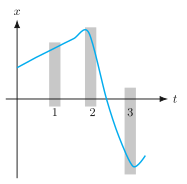
Q.Figure 2.14 gives the x-t plot of a particle in one-dimensional motion. Three different equal intervals of time are shown. In which interval is the average speed greatest, and in which is it the least? Give the sign of average velocity for each interval.
Figure 2.14
Kerala DhseTextbookSubjective· 3mImportance★★★★★est
Imagine you're walking home from school. You take a shortcut through a park, then stop to buy a snack, then realise you forgot something and run back a bit, then finally walk home. By the time you reach your front door, you've walked a total of 2 km — but your house is only 500 metres from school in a straight line.
That difference — between the total ground you covered and how far you actually ended up from where you started — is the entire point of speed vs velocity.
The Precise Definitions
Average speed is a measure of how fast something is moving overall. It cares only about the total distance travelled, not the direction.
Average speed=Total time takenTotal distance travelled
Average velocity is a measure of how fast and in what direction something is moving overall. It cares about the net displacement — the straight-line distance from start to finish, with a direction.
Average velocity=Total time takenDisplacement
Note
Displacement is the straight-line distance from the starting point to the ending point, with a direction. Distance is the total length of the actual path travelled, with no direction.
The Key Difference in One Sentence
Speed is a scalar (just a number, like 5 km/h). Velocity is a vector (a number and a direction, like 5 km/h north).
That one word — direction — changes everything.
A Concrete Example
You walk 3 km east, then 4 km north. The whole trip takes 1 hour.
Total distance travelled = 3 + 4 = 7 km
Displacement = straight line from start to finish = 32+42=5 km, northeast
Now compute:
Average speed=1 h7 km=7 km/h
Average velocity=1 h5 km, northeast=5 km/h, northeast
Watch out
A common mistake: students think average velocity is just "speed with direction". It's not. It's displacement divided by time, not distance divided by time. If you walk in a circle and return to your starting point, your displacement is zero — so your average velocity is zero, even though your average speed is positive.
When Are They Equal?
Only when the motion is in a straight line without changing direction. If you walk 2 km east in a straight line, then distance = displacement, so average speed = magnitude of average velocity.
But the moment you turn, or stop, or go backwards — they diverge.
Why This Matters for Exams
In Indian board exams (CBSE, ICSE, state boards), you will be asked to:
Distinguish between speed and velocity (scalar vs vector)
Calculate average speed and average velocity from given data …
Average speed follows the steepness of the x-t curve: steepest in the sharp fall (interval 3), flattest near the peak (interval 2). Average velocity is positive while x rises and negative while it falls.
Interval 3 is the steepest, so the average speed is greatest there; interval 2 is nearly flat near the maximum, so the average speed is least there. The particle moves toward +x in intervals 1 and 2 (positive average velocity) and toward −x in interval 3 (negat …
On an x-t graph the magnitude of the slope is the average speed and its sign is the sign of the average velocity. Interval 3 (the steep fall) has the largest slope magnitude, so the greatest average speed; interval 2 (near the flat maximum) has the smallest slope magnitude, so the least average speed. The velocity is positive where x increases (intervals 1 and 2) and negative where x decreases (interval 3).
Concept
Over an interval,
average velocity=ΔtΔx,average speed=Δtpath length.
For motion along a line without reversal within an interval, the average speed equals the magnitude of the average velocity, i.e. the magnitude of the chord's slope on the x-t graph. The three intervals are equal in duration (Δt the same), so comparing average speeds just means comparing how much x changes.
Comparing the intervals
Interval 1 (gentle rise):x increases by a moderate amount, so a moderate positive slope. Average velocity >0. …
Concept: Cross-Checking a Graph-Reading with an Explicit Numeric Model
Method: Build One Concrete, Consistent x(t) and Compute the Three Average Velocities Directly
Comparing chord slopes "by eye" is the natural first pass, but it can be checked rigorously by constructing one explicit set of numbers consistent with the described shape (positive, rising gently to a rounded max, then falling steeply through zero) and simply computing each average velocity from the definition — the numbers below are only one example, but any numeric assignment matching the qualitative shape must give the same ranking, because that ranking follows from the shape, not the specific values chosen.
Steps
Assign consistent values at four equally spaced instants, matching "gentle rise, rounded near-flat maximum, then a steep fall through zero":
t
0
2
4
6
x
0
8
9
−3
(Interval 1 =[0,2]: gentle rise. Interval 2 =[2,4]: near the rounded max, x barely changes. Interval 3 =[4,6]: steep fall, crossing x=0.)
Compute the average velocity in each interval directly from vˉ=Δx/Δt:
vˉ1=28−0=+4,vˉ2=29−8=+0.5,vˉ3=2−3−9=−6(units: same as x/t)
Compare magnitudes (average speed):∣vˉ2∣=0.5 is the smallest, ∣vˉ3∣=6 is the largest. This matches the qualitative reading: near the rounded top the curve is nearly flat (small Δx over the interval), while the steep fall through zero produces the largest change in x over an equal time.
Read the signs directly from the same table:vˉ1>0, vˉ2>0 (both are rises, even though interval 2's rise is tiny), vˉ3<0 (a fall).
Same / Similar Concept — real previous-year questions on the same or a closely similar concept, not this exact question.
KEAM 2026Set eng-2026-04174 marksMCQ
Q.A car travels half the distance with a velocity of 20km h−1 and another half distance with a velocity of 30km h−1 along a straight road. The average velocity of the car in km h−1 is
(A) 35
(B) 25
(C) 48
(D) 50
(E) 24
›Reveal solutionSolution
Equal distances ⇒ harmonic mean of the two speeds.
Let each half be distance d. Total distance =2d; total time =20d+30d. …
Q.A particle moves along a semi circular path of radius r in time t with constant speed, then its
(A) average speed is 2tπr
(B) average velocity is tr
(C) displacement is 2πr
(D) distance travelled is 2r
(E) average acceleration is t22πr
›Reveal solutionSolution
Distance over a semicircle is πr giving speed πr/t; the velocity direction reverses, so ∣Δv∣=2v and average acceleration =2πr/t2.
Distance travelled =πr, so speed v=tπr (rules out A, and the distance/displacement options C, D).
Displacement = diameter =2r, so average velocity =t2r (rules out B). …
Q.A bus covers half of the total distance with a speed of 30 kmh−1 and other half with a speed of 60 kmh−1. The average speed during the total journey is
(A) 35 kmh−1
(B) 40 kmh−1
(C) 45 kmh−1
(D) 42 kmh−1
(E) 50 kmh−1
›Reveal solutionSolution
Equal half-distances ⇒ average speed = harmonic mean =40kmh−1.
Let total distance be 2d. Time for first half =d/30, for second half =d/60. Average speed =d/30+d/602d=1/30+1/602=3/602=32×60=40kmh−1. E …
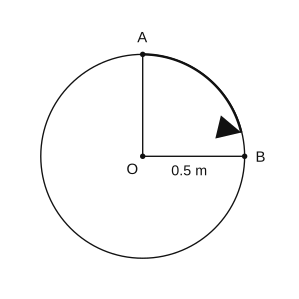
Q.A ball moves in a circle of radius 0.5 m from A to B in 2 s. The average velocity of the ball is (in ms−1)
(A) 0.25
(B) 0.5
(C) 0.75
(D) 1.5
(E) 1.25
›Reveal solutionSolution
Average velocity uses straight-line displacement (the chord AB), not arc length.
With A at the top and B at the right end of the quarter arc, the displacement is the chord joining them:
Q.If a moving body changes its position from x1 to x2 in a time interval Δt , then Δtx2−x1 is defined as
(A) average acceleration
(B) average velocity
(C) instantaneous acceleration
(D) instantaneous velocity
(E) average displacement
›Reveal solutionSolution
Average velocity =timedisplacement=Δtx2−x1.
Instantaneous velocity is the limit limΔt→0ΔtΔx; acceleration involves change in velocity per time. The given ratio over …
Q.A person travels in a car from p to q with uniform speed u and returns to p with uniform speed v. The average speed for his round trip is
(A) 2u+v
(B) u+vuv
(C) uv
(D) u+v2uv
(E) u+vuv
›Reveal solutionSolution
For equal-distance legs the average speed is the harmonic mean u+v2uv.
Let the one-way distance be d. Time going out =d/u, time returning =d/v. Total distance =2d, total time =d/u+d/v. Hence …
Q.A car is moving with an initial speed of 5 m/s. A constant braking force is applied and the car is brought to rest in a distance of 10m. What is the average speed of the car during the deceleration process?
(A) 1 m/s
(B) 2.5 m/s
(C) 4 m/s
(D) 5 m/s
(E) 7 m/s
›Reveal solutionSolution
For uniform deceleration the average speed is (5+0)/2=2.5 m/s.
Concept and Intuition
A constant force produces constant (uniform) acceleration, and for uniformly changing velocity the time-averaged speed equals the arithmetic mean of the initial and final speeds. The stopping distance is not even needed for the average speed.