Question of 35
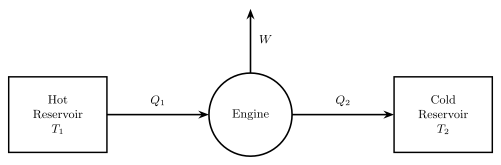
Q.Observe the given figure.
(a) Is this a heat engine or refrigerator ?
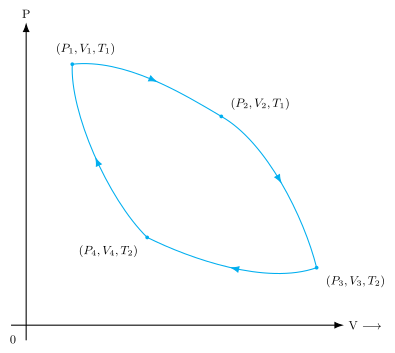
(b) Write the 4 steps of operation in the Carnot cycle.
Kerala DhseKerala DHSE Plus One Board 2020Subjective· 3mImportance★★★★★
0% · 0/35 Questions
You're viewing a preview — the full solution, concept, methods & PYQ mapping are locked.
Start your 14-day free trial to unlock the full solution →The diagram (heat Q1 in from the hot reservoir, work W out, heat Q2 out to the cold reservoir) represents a heat engine; a Carnot engine operates this cycle through four reversible steps: isothermal expansion, adiabatic expansion, isothermal compression, adiabatic compression.
- Heat engine or refrigerator? In the figure, heat Q1 flows IN from the hot reservoir (T1) into the engine, part of it is converted to useful work W (delivered out), and the remaining heat Q2 is rejected OUT to the cold reservoir (T2). This is the defining energy flow of a heat engine (Q1 = W + Q2), which absorbs heat from a hot source and converts part of it into work while rejecting the rest to a cold sink. (A refrigerator would instead have work W done ON the system to pump heat from the cold reservoir to the hot one — the opposite direction.)
- The four steps of the Carnot cycle (for a Carnot heat engine using an ideal gas as the working substance):
- Isothermal expansion at temperature T1: the gas is placed in contact with the hot reservoir and allowed to expand slowly, absorbing heat Q1 from the reservoir at constant temperature T1, doing work on the surroundings.
- Adiabatic expansion: the gas is thermally isolated and allowed to expand further with no heat exchange; it does work at the expense of its internal energy, so its temperature falls from T1 to T2. …
Unlock everything free for 14 days
- Full step-by-step solutions
- Concept-first explanations
- Methods, shortcuts & mistakes
- PYQ mapping + timed mock tests
Full access for 14 days. No credit card required.