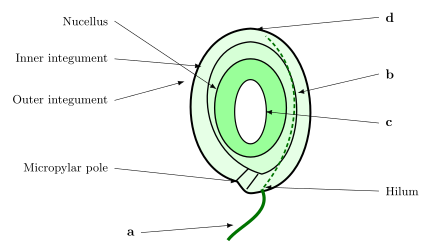
Q.Observe the given figure of ovule and label the parts (a), (b),
You're viewing a preview — the full solution, concept, methods & PYQ mapping are locked.
Start your 14-day free trial to unlock the full solution →In this labelled diagram of an anatropous ovule, (a) is the funicle, (b) is the raphe (the fused, ridge-like extension of the funicle along the ovule body), (c) is the embryo sac inside the nucellus, and (d) is the chalaza at the base.
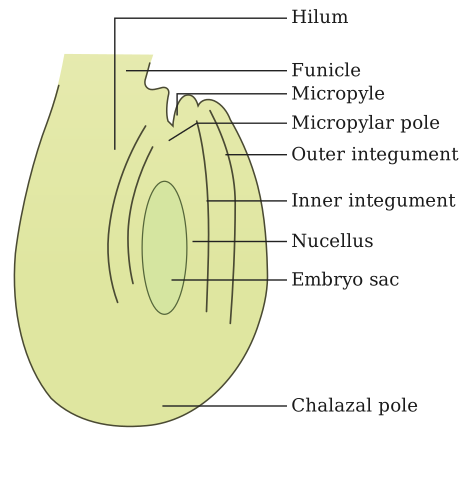
In an anatropous ovule, the body of the ovule turns through about 180° during development so that it becomes inverted with respect to its stalk (funicle). Because of this inversion, the funicle becomes fused along the side of the ovule body, forming a ridge called the raphe, and as a result the micropyle ends up lying close to the funicle/hilum, while the chalaza (the basal region where the integuments, nucellus and funicle meet) lies at the opposite end.
Reading the figure from the hilum downward:
- Hilum — the point of attachment of the ovule (via the funicle) to the placenta, given in the figure.
- (a) Funicle — the stalk that attaches the ovule to the placenta; it originates right at the hilum.
- (b) Raphe — the ridge formed by the fusion of the funicle along the body of the anatropous ovule, running from the hilum region towards the chalaza. …
Unlock everything free for 14 days
- Full step-by-step solutions
- Concept-first explanations
- Methods, shortcuts & mistakes
- PYQ mapping + timed mock tests
Full access for 14 days. No credit card required.