Q.An ether is given as CH3-CH(CH3)-O-CH3, that is a methoxy group (-O-CH3) attached to the central carbon of a propane skeleton (isopropyl methyl ether). What is its IUPAC name?
🔒You're viewing a preview — the full solution, concept, methods & PYQ mapping are locked.
🔒 Start your 14-day free trial to unlock the full solution →Concept understanding — IUPAC Nomenclature
IUPAC Nomenclature (Organic Compounds)
IUPAC nomenclature is a systematic way to name a compound so that its name alone tells you its exact structure, with no ambiguity. Every organic name follows the same underlying recipe, whatever the functional group.
The Recipe
-
Identify the principal characteristic group. If the molecule has a functional group senior enough to be named as a suffix (carboxylic acid > ester > amide > nitrile > aldehyde > ketone > alcohol > amine, and so on down the seniority order), that group decides the suffix and must be included in the parent chain. A halogen is never senior enough to be a suffix — it is always named as a prefix ("halo-"), whatever else is present.
-
Choose the parent chain. The parent is the longest continuous carbon chain that contains the principal characteristic group (if there is one). Among chains of the same length, the one with the most substituents wins.
-
Number the chain. Number from whichever end gives the LOWEST LOCANT to the principal characteristic group first. If there is no principal group (e.g. a simple haloalkane, or an alkene with a halogen substituent), lowest locant goes to the site of unsaturation (double/triple bond) first, then to substituents as a set.
Watch outWhen two numbering directions give the SAME locant for the principal group/unsaturation (a genuine tie), the tie-break is the lowest locant SET for the substituents as a group — compare the two sets at their first point of difference. Only if the sets are themselves tied does the alphabetically-first substituent get the lower number.
-
Name and cite the substituents as prefixes, in alphabetical order (ignoring multiplying prefixes like di-/tri- but not ignoring structural prefixes like iso-/cyclo-), each with its own locant.
-
Assemble the name: locants + substituent prefixes (alphabetical) + parent chain name + suffix (if any).
Worked Example
CH3−CH(Cl)−CH(CH3)−CH2−CH3: the longest chain is 5 carbons (pentane), no principal characteristic group (just a halogen substituent), so number for the lowest locant set. From the left: Cl at C2, methyl at C3 → set {2,3}. From the right: methyl at C3, Cl at C4 → set {3,4}. {2,3} is lower, so numbering from the left wins: 2-chloro-3-methylpentane. …
Why this formula?
IUPAC Nomenclature: Why the Rules Work the Way They Do
IUPAC nomenclature is not a single formula, but a system of rules designed to give every organic compound a unique, unambiguous name. The "why" behind these rules lies in clarity, consistency, and communication — ensuring that a chemist in Tokyo and one in Toronto draw the same structure from the same name.
1. The Core Principle: The Longest Carbon Chain
Rule: Identify the longest continuous chain of carbon atoms. This becomes the parent chain (e.g., pentane, hexane).
Why?
- The longest chain represents the backbone of the molecule.
- It gives the most stable, fundamental name — shorter chains would be branches, not the main structure.
- Example: In a molecule with 5 carbons in a row and a 2-carbon branch, calling it "pentane" (not "ethane") tells you the core skeleton is 5 carbons long.
Key idea: The parent chain is the maximum continuous path — not necessarily the one that looks "straight" on paper.
2. Numbering: Lowest Locants (The "First Point of Difference" Rule)
Rule: Number the parent chain so that substituents get the smallest possible numbers. When there's a tie, compare the first point of difference.
Why?
- This ensures reproducibility — two chemists will always number the same way.
- It avoids ambiguity: "2-methylpentane" is unambiguous; "3-methylpentane" would be a different compound.
- The first point of difference rule: If you have substituents at positions 2,4 and 3,5, choose 2,4 because 2 < 3 (the first number is smaller).
Example:
- For a methyl group on carbon 2 vs. carbon 4 of a 5-carbon chain:
- 2-methylpentane (correct)
- 4-methylpentane (wrong — higher number)
3. Alphabetical Order of Substituents
Rule: List substituents in alphabetical order (ignoring prefixes like di-, tri-, sec-, tert- but not iso-).
Why?
- Alphabetical order is a universal sorting convention — no need to remember priority based on size or complexity.
- It makes names searchable and predictable.
- Example: "3-ethyl-2-methylpentane" (e before m) — not "2-methyl-3-ethylpentane".
Exception: Prefixes like iso- and neo- are considered part of the name (e.g., isopropyl comes before methyl because "i" < "m").
4. Multiple Bonds: The "Lowest Locant" Rule for Alkenes/Alkynes
Rule: Number the chain so that the double or triple bond gets the lowest possible number, even if it means giving a substituent a higher number.
Why?
- The functional group (alkene/alkyne) is more important than alkyl substituents.
- The bond position defines the compound's reactivity and geometry.
- Example: In pent-2-ene (not pent-3-ene), the double bond is between carbons 2 and 3 — the lower number (2) is used.
Priority order:
- Principal functional group (e.g., -OH, -COOH, C=C)
- Multiple bonds
- Substituents (alkyl, halo, etc.)
5. The "Suffix" and "Prefix" System …
In substitutive IUPAC naming of ethers, the larger alkyl group is treated as the parent hydrocarbon and the smaller -OR group becomes an alkoxy substituent. Here the isopropyl (three-carbon) part is the pa …
Ethers are named substitutively by treating the smaller -OR group as an alkoxy substituent on the parent chain formed by the larger alkyl group. Here the larger group is propane and the substituent is methoxy at C-2, so the name is 2-methoxypropane.
Concept
For R-O-R', the IUPAC substitutive rule takes the larger/longer alkyl group as the parent hydrocarbon; the remaining -O-R' group is named as an alkoxy prefix.
Steps
- Split the ether: the two groups on oxygen are isopropyl, (CH3)2CH-, and methyl, CH3-.
- Larger group = isopropyl (three carbons) -> parent hydrocarbon propane.
- The other group is -O-CH3 = methoxy, attached to the central (C-2) carbon of propane.
- Name -> 2-methoxypropane. …
Method: Larger-Group-as-Parent Method for Naming a Simple Ether
Core Concept
IUPAC substitutive naming of an ether R-O-R' always makes the LARGER alkyl/aryl group the parent hydrocarbon, and the smaller -O-R' fragment becomes an "alkoxy" substituent prefix on that parent — functional-class names like "isopropyl methyl ether" are the older, non-substitutive naming style and are not the IUPAC substitutive answer.
Steps
- Split the ether at the oxygen into its two attached groups.
- Count the carbons in each group to determine which is larger.
- Assign the LARGER group as the parent chain (name it as the corresponding alkane).
- Name the smaller group, together with the oxygen, as an alkoxy prefix (methoxy for -OCH3, ethoxy for -OC2H5, etc.).
- Number the parent chain to give the alkoxy substituent the lowest possible locant, and assemble the final substitutive name.
- Reject any option that treats the smaller fragment's chain as the parent, or that gives a functional-class (non-substitutive) name instead of the requested IUPAC name. …
- KEAM 2026Set eng-2026-04174 marksMCQQ.The IUPAC name of mesityl oxide is (A) 2-Methylpent-2-en-3-one (B) 3-Methylpent-2-en-4-one (C) 4-Methylpent-2-en-3-one (D) 4-Methylpent-3-en-2-one (E) 2-Methylpent-3-en-4-one
›Reveal solutionSolution
The structure (CH3)2C=CH−CO−CH3 names as 4-methylpent-3-en-2-one.
Mesityl oxide has the structure (CH3)2C=CH−CO−CH3.
The longest chain containing the carbonyl is five carbons (pent-). Numbering to give the ketone the lowest locant, start from the methyl next to the C=O:
- C1: CH3
- C2: C=O (ketone → -2-one) …
- KEAM 2026Set eng-2026-04194 marksMCQQ.IUPAC name of (CH3)3C-CH2Br is (A) 1-Bromotrimethylpropane (B) neo-pentylbromide (C) 1-Bromo-2,2-dimethylpropane (D) 2,2-dimethylethylenediamine (E) 3-bromo-2,2-dimethylpropane
›Reveal solutionSolution
The five-carbon skeleton is propane with two methyls on C-2 and Br on C-1: 1-bromo-2,2-dimethylpropane.
Structure. (CH3)3C-CH2Br = a central carbon bearing three methyls and a CH2Br. The longest chain is propane (3 C); numbering to give Br the lowest locant puts CH2Br as C-1, the quaternary carbon as C-2 car …
- KEAM 2026Set pha-2026-0418F4 marksMCQQ.The IUPAC name of the following alkane is CH3−CH2−CH(C2H5)−CH2−CH(CH3)−CH2−CH3 (A) 3-methyl-5-ethylheptane (B) 3,5-diethylhexane (C) 4,6-diethylhexane (D) 3-ethyl-5-methylheptane (E) 3-ethyl-5,6-dimethylhexane
›Reveal solutionSolution
Longest chain = 7 C (heptane), ethyl at C3, methyl at C5.
The structure CH3−CH2−CH(C2H5)−CH2−CH(CH3)−CH2−CH3 has a 7-carbon parent chain. Numbering to give the lowest locants (tie {3,5} both ways) gives the lower number to the first-cited substituent alphabetically (ethyl before methyl), so ethyl = 3, methy …
- KEAM 2026Set pha-2026-0420F4 marksMCQQ.The IUPAC name of the following compound is (A) 2-Methylpent-2-en-2-one (B) 3-Methylpent-2-en-2-one (C) 4-Methylpent-2-en-3-one (D) 4-Methylpent-3-en-2-one (E) 1,1-Dimethylbuten-2-one
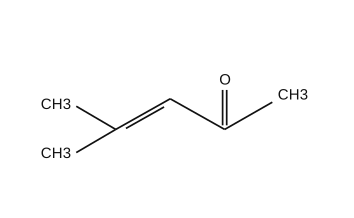
›Reveal solutionSolution
Numbering from the carbonyl end (mesityl oxide) gives 4-methylpent-3-en-2-one.
The structure is CH3−CO−CH=C(CH3)−CH3 (mesityl oxide). Choosing the longest chain containing the carbonyl (the principal group) and numbering to give the ketone the lowest locant:
- C1 = CH3, C2 = C=O (the 2-one), C3 = CH, C4 = C, C5 = CH3. …
- KEAM 2025Set eng-2025-04234 marksMCQQ.The IUPAC name of phenyl isopentyl ether is (A) 3-Methtylbutoxybenzene (B) 2-Methylbutoxybenzene (C) 2-Methylphenoxybutane (D) 4-Methylbutoxybenzene (E) 1-Methylbutoxybenzene
›Reveal solutionSolution
Phenyl isopentyl ether is named 3-methylbutoxybenzene.
Concept and Intuition
Ethers are named as (alkoxy)benzene when one group is phenyl. Isopentyl (isoamyl) is the 3-methylbutyl group, (CH3)2CH-CH2-CH2-. Attaching it via oxygen to benzene gives 3-methylbutoxybenzene.
Step-by-Step Solution
- Isopentyl = isoamyl = 3-methylbutyl = (CH3)2CHCH2CH2-.
- As an -O- substituent it becomes 3-methylbutoxy.
- On benzene → 3-methylbutoxybenzene. …
- KEAM 2025Set eng-2025-04254 marksMCQQ.The IUPAC name of the compound HOCH2(CH2)3CH2COCH3 is (A) 7-Hydroxyheptan-2-one (B) 2-Oxoheptan-7-ol (C) 1-Hydroxyheptan-2-one (D) 5-Oxoheptan-2-ol (E) 6-Hydroxyheptan-3-one
›Reveal solutionSolution
The molecule is a seven-carbon chain bearing a ketone and an alcohol. The ketone (higher priority) gets the suffix '-one' with the lowest locant, and −OH becomes the 'hydroxy' prefix: 7-hydroxyheptan-2-one.
Expanding HOCH2(CH2)3CH2COCH3 gives a continuous chain of 7 carbons:
HO−CH2−CH2−CH2−CH2−CH2−CO−CH3
Priority: the ketone (C=O) outranks the alcohol, so it defines the suffix and gets the lower locant. Numbering from the methyl-ketone end: …
- KEAM 2025Set eng-2025-04264 marksMCQQ.The IUPAC name of allylamine is (A) But-2-en-1-amine (B) But-1-en-2-amine (C) Prop-2-en-1-amine (D) Prop-1-en-2-amine (E) 2-Amino 1-propene
›Reveal solutionSolution
Allylamine is a 3-carbon chain with a C=C at position 2 and –NH2 at C1: prop-2-en-1-amine.
Allylamine is CH2=CH−CH2−NH2. Numbering to give the amine the lowest locant: C1 bears the –NH2, and the double bond starts at C2. The three-carbon parent is 'prop', the double …
- KEAM 2025Set pha-2025-0424F4 marksMCQQ.The hydrocarbon with molecular formula C20H42 is (A) Didodecane (B) Didecane (C) Dodidecane (D) Didocene (E) Eicosane
›Reveal solutionSolution
C20H42 fits the alkane formula CnH2n+2 with n=20; the straight-chain C20 alkane is named eicosane.
Derivation: Alkanes obey CnH2n+2. Setting 2n+2=42 gives n=20, so the molecule is a 20-carbon alkane. …
- KEAM 2025Set pha-2025-0424A4 marksMCQQ.Phenetole is (A) Ethoxybenzene (B) Methoxyethane (C) Methoxybenzene (D) 1-Methoxypropane (E) 2-Methoxypropane
›Reveal solutionSolution
Phenetole = ethyl phenyl ether =C6H5OC2H5= ethoxybenzene.
By analogy, anisole is methoxybenzene (C6H5OCH3); phenetole is its ethyl homologue, ethoxybenzene. Methoxyethane and 1-/2-methoxypropane are aliphatic eth …
- KEAM 2024Set eng-2024-06074 marksMCQQ.The IUPAC name of HOCH2(CH2)3CH2COCH3 (A) 2-oxo-heptan-7-ol (B) 7-hydroxyheptan-2-one (C) hydroxyheptan-6-one (D) 2-oxo-heptan-7-ol (E) hydroxy pentyl methyl ketone
›Reveal solutionSolution
[!TLDR]
The compound is a 7-carbon ketone with a terminal OH; naming the ketone as the senior group gives 7-hydroxyheptan-2-one.
Concept
When a molecule contains more than one functional group, the principal characteristic group (chosen by IUPAC seniority) takes the suffix and the lowest locant; others become prefixes. Ketones rank above alcohols in this order — a standard NCERT/CBSE nomenclature rule.
Solution
Expand the structure:
HO-CH2-CH2-CH2-CH2-CH2-CO-CH3
Counting carbons gives a chain of 7 (heptane skeleton). The functional groups are a ketone (C=O) and a hydroxyl (-OH).
Since a ketone is senior to an alcohol, the suffix is -one and the OH becomes a hydroxy prefix. Number the chain to give the ketone the lowest locant: …
- KEAM 2022Set eng-2022-P1-A14 marksMCQQ.Resorcinol is (A) Benzene-1, 3-diol (B) Benzene-1, 4-diol (C) Benzene-1, 2-diol (D) 3-Methylphenol (E) 4-Methylphenol
›Reveal solutionSolution
Resorcinol is benzene-1,3-diol.
Concept and Intuition
Resorcinol is a common dihydroxybenzene isomer; the three isomers are catechol (1,2), resorcinol (1,3) and hydroquinone (1,4).
Step-by-Step Solution
- Resorcinol has two -OH groups on a benzene ring.
- They occupy the meta (1,3) positions.
- Therefore resorcinol = benzene-1,3-diol. …
- KEAM 2022Set eng-2022-P1-A14 marksMCQQ.Which one of the following represents valeraldehyde? (A) CH3CH2CH2CH2CHO (B) CH3CH(CH3)CH2CHO (C) CH3CH(OCH3)CHO (D) (CH3)2CHCHO (E) CH3CH2CH(CH3)CHO
›Reveal solutionSolution
Valeraldehyde is pentanal, CH3CH2CH2CH2CHO.
Concept and Intuition
The common name valeraldehyde denotes the straight-chain five-carbon aldehyde, pentanal.
Step-by-Step Solution
- Valer- corresponds to a five-carbon (valeric acid, pentanoic acid) chain.
- The -aldehyde suffix places -CHO at the chain end.
- Straight-chain pentanal = CH3CH2CH2CH2CHO. …
🎓Unlock everything free for 14 days
- ✓Full step-by-step solutions
- ✓Concept-first explanations
- ✓Methods, shortcuts & mistakes
- ✓PYQ mapping + timed mock tests
Full access for 14 days. No credit card required.