Q.Which of the following compounds will have the highest melting point and why?
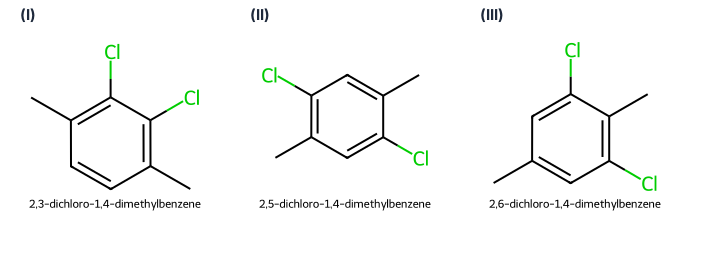
(I) 2,3-dichloro-1,4-dimethylbenzene (the two Cl atoms on adjacent carbons)
(II) 2,5-dichloro-1,4-dimethylbenzene (the two Cl atoms para to each other — fully symmetrical)
(III) 2,6-dichloro-1,4-dimethylbenzene (the two Cl atoms flanking the same )
You're viewing a preview — the full solution, concept, methods & PYQ mapping are locked.
Start your 14-day free trial to unlock the full solution →
The melting point of an organic solid depends on how efficiently molecules pack in the crystal lattice. Symmetrical molecules pack more tightly, raising the melting point. Here, compound (II) is the most symmetrical and will have the highest melting point.
Why symmetry controls melting point
Melting is the process where a crystal lattice breaks down into a disordered liquid. The stronger the intermolecular forces and the better the molecules fit together in the solid, the more energy (heat) is needed to melt them. For non-polar or weakly polar molecules like these dichloro-dimethylbenzenes, the dominant forces are London dispersion forces. These forces depend on surface contact — the more closely and extensively molecules can nestle together, the stronger the overall attraction.
Symmetry is the key. A highly symmetrical molecule packs into a crystal with fewer voids and more uniform contacts. Think of stacking identical bricks versus stacking oddly shaped stones: the bricks form a denser, more stable pile. The same principle applies here.
All three compounds are isomers with the same molecular formula, so their electron counts and polarizabilities are similar. The difference in melting point comes almost entirely from packing efficiency.
Step-by-step analysis
1. Identify the molecular structures
All three have two methyl groups fixed at positions 1 and 4 (para to each other). The only variation is where the two chlorine atoms sit on the remaining four ring carbons (positions 2, 3, 5, 6).
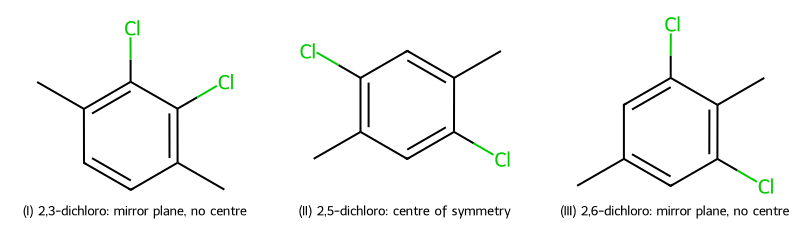
- (I) 2,3-dichloro-1,4-dimethylbenzene: Cl atoms on adjacent carbons (2 and 3). This puts both Cl atoms on the same side of the ring — a crowded arrangement (though the molecule still keeps one mirror plane, between the two Cl atoms).
- (II) 2,5-dichloro-1,4-dimethylbenzene: Cl atoms at positions 2 and 5, which are para to each other. The molecule has a centre of symmetry: a 180° rotation about the centre gives the same arrangement. This is the most symmetrical isomer.
- (III) 2,6-dichloro-1,4-dimethylbenzene: Cl atoms at positions 2 and 6, which are meta to each other and flank one of the methyl groups. The molecule has a plane of symmetry (through the 1-4 axis) but no centre of symmetry.
2. Rank the symmetry
A molecule with a centre of symmetry (inversion centre) often packs into a more ordered, higher-melting crystal than one with only a plane of symmetry. The centre of symmetry forces the molecule to be "balanced" — no dipole moment, and a shape that fits neatly into a lattice.
- (II) has a centre of symmetry (inversion centre) — clearly the most symmetrical of the three.
- (III) has one mirror plane (through the C1–C4 axis, mapping the two flanking Cl atoms onto each other) but no centre of symmetry. …
Unlock everything free for 14 days
- Full step-by-step solutions
- Concept-first explanations
- Methods, shortcuts & mistakes
- PYQ mapping + timed mock tests
Full access for 14 days. No credit card required.