Q.Which of the following compounds would undergo reaction faster and why?
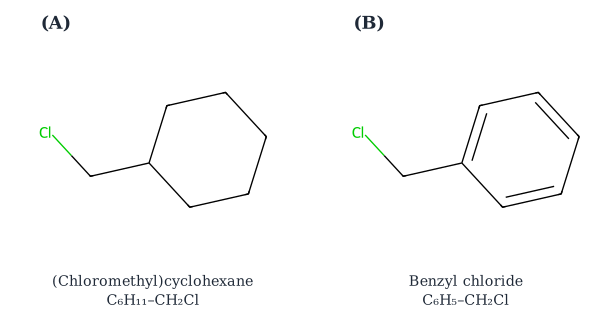
(B) (chloromethyl)benzene (benzyl chloride, )
You're viewing a preview — the full solution, concept, methods & PYQ mapping are locked.
Start your 14-day free trial to unlock the full solution →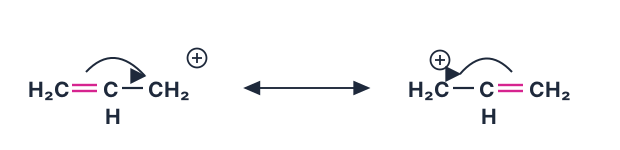
The key idea is that reactions depend on carbocation stability. Benzyl chloride forms a resonance-stabilized benzyl carbocation, making it much more reactive than (chloromethyl)cyclohexane, which forms a less stable primary carbocation. Therefore, (B) benzyl chloride reacts faster.
Why This Approach Works
The mechanism is a two-step process: first, the leaving group (chloride) departs, forming a carbocation intermediate; second, the nucleophile attacks this carbocation. The rate-determining step is the first step — carbocation formation. So, the faster the carbocation forms and the more stable it is, the faster the reaction proceeds.
This means we don't need to think about nucleophile strength or steric hindrance at the transition state (which matters in ). Instead, we compare the stability of the carbocations that would form from each compound.
Step-by-Step Reasoning
-
Identify the leaving group and the carbon it's attached to.
Both compounds have a chlorine atom as the leaving group. In (A), the chlorine is on a primary carbon (a group attached to a cyclohexane ring). In (B), the chlorine is on a benzylic carbon (the carbon directly attached to the benzene ring).
-
Consider the carbocation formed after leaves.
For (A): The carbocation is — a primary carbocation. Primary carbocations are highly unstable because they have only one alkyl group donating electron density via hyperconjugation and the inductive effect.
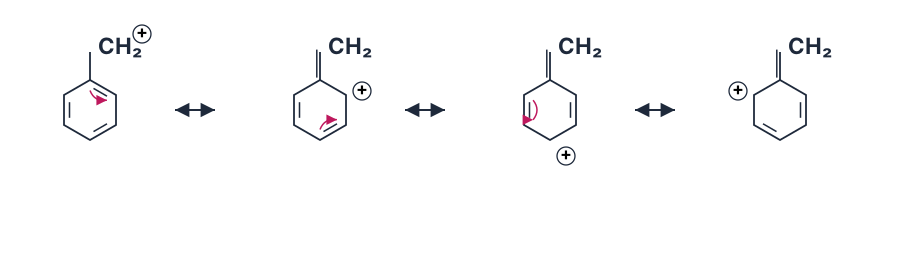
For (B): The carbocation is — a benzylic carbocation. Here, the positive charge can be delocalized into the benzene ring's system.
-
Analyze the stabilization in the benzylic carbocation.
The benzene ring has three resonance structures that spread the positive charge onto the ortho and para positions of the ring. This delocalization dramatically lowers the energy of the carbocation, making it much more stable than any simple primary carbocation.
Resonance stabilization of benzyl carbocation:
-
Compare the rates directly. …
Unlock everything free for 14 days
- Full step-by-step solutions
- Concept-first explanations
- Methods, shortcuts & mistakes
- PYQ mapping + timed mock tests
Full access for 14 days. No credit card required.