Question of 73
Q.Diagrammatic representation of an experiment is given below.
(a) Who conducted this experiment?
(b) What was the aim of this experiment?
Kerala DhseKerala DHSE Plus Two Board 2026Subjective· 2mImportance★★★★★
0% · 0/73 Questions
You're viewing a preview — the full solution, concept, methods & PYQ mapping are locked.
Start your 14-day free trial to unlock the full solution →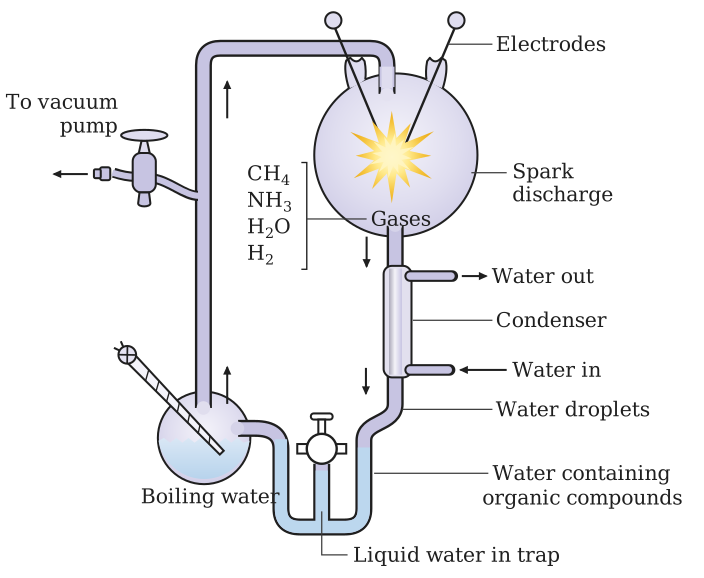
The apparatus shown is the classic Miller-Urey experiment, which simulated early-Earth atmospheric conditions to show that simple organic molecules (amino acids) can form spontaneously from inorganic gases, supporting Oparin and Haldane's theory of chemical evolution.
- This experiment was conducted by Stanley L. Miller and Harold C. Urey in 1953.
- Aim of the experiment: To recreate, in laboratory conditions, the reducing atmosphere believed to have existed on the primitive Earth — a closed flask containing gases such as CH₄ (methane), NH₃ (ammonia), H₂ (hydrogen) and water vapour (H₂O) — and subject this mixture to an electric spark discharge (simulating lightning/UV radiation as an energy source), while continuously condensing and collecting the products. Miller and Urey wanted to test the Oparin-Haldane hypothesis that, under such primitive-Earth conditions, simple inorganic and organic molecules could spontaneously combine to form complex organic molecules …
Unlock everything free for 14 days
- Full step-by-step solutions
- Concept-first explanations
- Methods, shortcuts & mistakes
- PYQ mapping + timed mock tests
Full access for 14 days. No credit card required.