Q.Draw Urey and Miller's experimental setup and label it.
You're viewing a preview — the full solution, concept, methods & PYQ mapping are locked.
Start your 14-day free trial to unlock the full solution →The Urey-Miller experiment simulated primitive Earth's early atmosphere (a mixture of methane CH4, ammonia NH3, hydrogen H2 and water vapour H2O) inside a closed glass apparatus, subjected it to electric spark dischar...
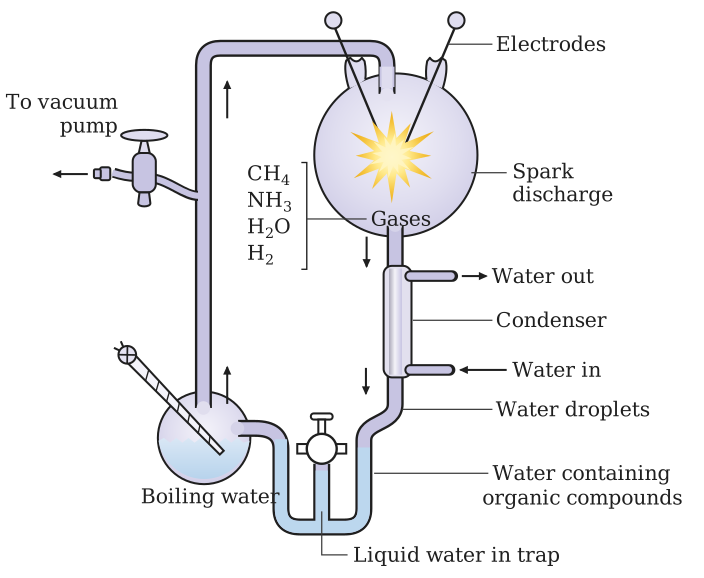
The Urey-Miller apparatus simulated early-Earth conditions (CH4+NH3+H2+H2O, spark discharge) and produced amino acids, supporting chemical-origin-of-life theory.
In 1953, Stanley Miller (working with Harold Urey) designed a laboratory apparatus to experimentally test Alexander Oparin's and J.B.S. Haldane's hypothesis that life originated through gradual chemical evolution from simple inorganic molecules present in Earth's primitive (reducing) atmosphere. The apparatus consisted of a closed system of connected glass flasks and tubing: a large spherical flask at the top contained a mixture of gases believed to represent the early Earth's atmosphere — methane (CH4), ammonia (NH3), hydrogen (H2) and water vapour (H2O) — and a pair of electrodes inside this flask produced continuous electric spark discharges (simulating lightning/electrical storms of the primitive Earth) through the gas mixture. Below, a smaller flask of boiling water supplied water vapour into the gas mixture and simulated the heat of the primitive ocean/atmosphere; the gas mixture, after being sparked, passed through a condenser, where it was cooled and condensed back into liquid water, which collected in a U-shaped trap that could be sampled, and the water was continuously recirculated (boiled again) to repeat the cycle. …
Unlock everything free for 14 days
- Full step-by-step solutions
- Concept-first explanations
- Methods, shortcuts & mistakes
- PYQ mapping + timed mock tests
Full access for 14 days. No credit card required.