Q.What is P-N junction diode? Explain its use as a full wave rectifier with diagram. OR C, Si and Ge have same lattice structure. Why is C insulator while Si and Ge are semiconductors?
You're viewing a preview — the full solution, concept, methods & PYQ mapping are locked.
Start your 14-day free trial to unlock the full solution →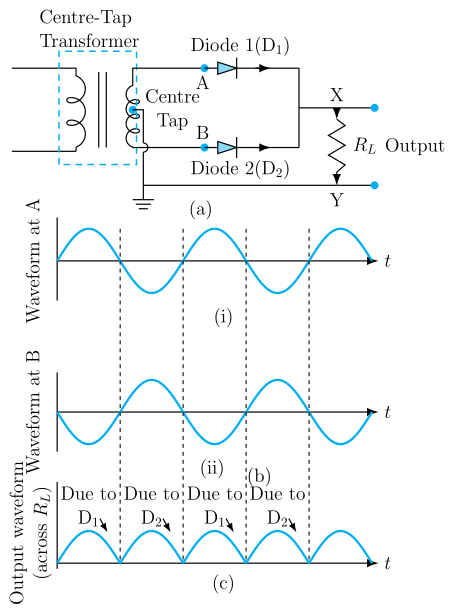
A p-n junction diode's one-way conduction is used, with two diodes and a centre-tapped transformer, to rectify both half-cycles of AC; C is an insulator (large energy gap) while Si and Ge are semiconductors (small energy gap), despite having the same crystal lattice.
P-N junction diode as a full-wave rectifier:
A p-n junction diode is a two-terminal semiconductor device formed by joining a p-type semiconductor with an n-type semiconductor. It conducts easily when forward biased (p-side connected to the positive terminal) — offering low resistance — and blocks current when reverse biased — offering very high resistance. This one-way (unidirectional) conduction property makes it useful as a rectifier, converting AC to DC.
Full-wave rectifier circuit: uses a centre-tapped transformer secondary (ends labelled, say, top and bottom, with the centre tap as the common/ground reference) and two diodes D1 and D2, with a load resistor connected between the centre tap and the common junction of the diodes' outputs.
Working:
- During the first half-cycle of the AC input, suppose the TOP end of the secondary becomes positive. This forward-biases D1 (which conducts), while D2 is reverse-biased (does not conduct). Current flows through D1 and .
- During the second half-cycle, polarity reverses: the BOTTOM end becomes positive, forward-biasing D2 (which now conducts) while D1 is reverse-biased. Current again flows through , in the SAME direction as before (because of how the centre-tap circuit is connected).
Thus, current flows through the load in the same direction during BOTH halves of the input AC cycle, producing a continuous pulsating unidirectional (DC-like) output — hence the name "full-wave" rectifier, as opposed to a half-wave rectifier which uses only one diode and conducts for only one half of each cycle.
(OR) Why is Carbon an insulator while Si and Ge are semiconductors, despite the same lattice structure? …
Unlock everything free for 14 days
- Full step-by-step solutions
- Concept-first explanations
- Methods, shortcuts & mistakes
- PYQ mapping + timed mock tests
Full access for 14 days. No credit card required.