Q.How is the p-n junction diode used as the full wave rectifier? Explain its working by drawing simple circuit. OR Describe in brief, the -scattering experiment. Write down about the atomic-structure from the observation obtained from the experiment.
You're viewing a preview — the full solution, concept, methods & PYQ mapping are locked.
Start your 14-day free trial to unlock the full solution →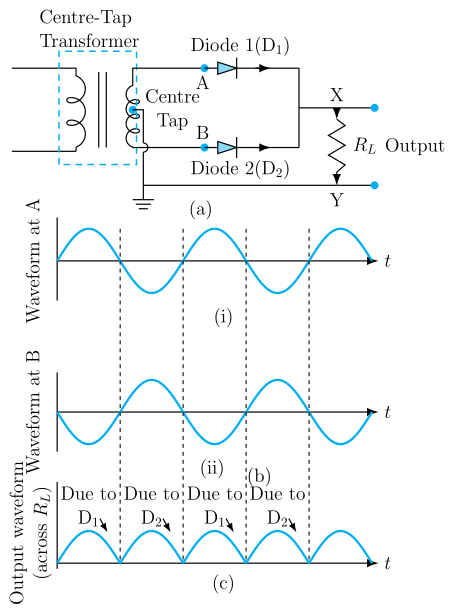
Two p-n junction diodes with a centre-tapped transformer conduct on alternate half-cycles, sending current through the load in one direction throughout, so both halves of the AC are rectified. (This question has an OR alternative on the -scattering experiment; the main rectifier part is answered here.)
Rectification. A p-n junction diode conducts only when forward biased. In a full-wave rectifier this one-way property is exploited on both half-cycles of the AC input.
Centre-tapped full-wave rectifier — construction. A transformer with a centre-tapped secondary feeds two diodes and . The two ends of the secondary go to the anodes of and ; their cathodes join and connect to the load , whose other end returns to the centre tap.
Working.
- Positive half-cycle: end A is positive → is forward biased and conducts, while is reverse biased (off). Current flows through from top to bottom.
- Negative half-cycle: end B becomes positive → conducts, off. Current again flows through in the same direction. …
Unlock everything free for 14 days
- Full step-by-step solutions
- Concept-first explanations
- Methods, shortcuts & mistakes
- PYQ mapping + timed mock tests
Full access for 14 days. No credit card required.