Mathematics and Statistics · Ch 3 — Complex Numbers
Argand Diagram, Argument and Polar Form
Argand Diagram, Argument and Polar Form
A complex number can be pictured as a point (or an arrow from the origin) in a plane, which gives it a length and a direction — the modulus and the argument.
The Argand diagram
The complex number is represented by the point in a coordinate plane whose horizontal axis is the real axis and vertical axis the imaginary axis. This picture is called the Argand diagram. The distance of the point from the origin is exactly the modulus .
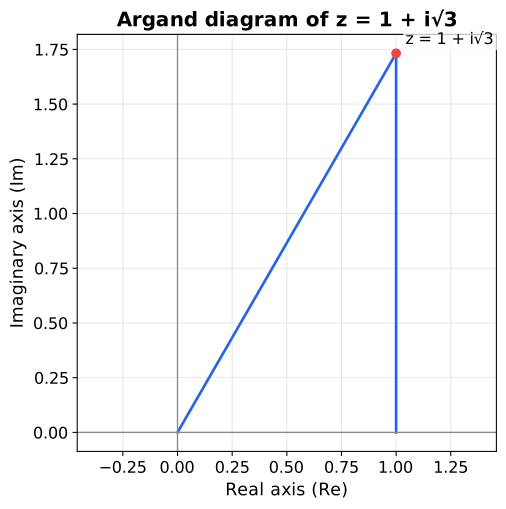
For example, is plotted as the point ; the arrow from the origin to that point has length and makes an angle with the positive real axis, while the dashed vertical drops back to to show the real part .
The argument
Argument
The argument of a non-zero is the angle that the segment from the origin to makes with the positive real axis, measured anticlockwise. It satisfies
where . The value in the range is called the principal argument.
The quadrant decides the argument — alone is not enough
has two solutions a half-turn apart, so always locate the point first. Use the reference angle and then:
- Quadrant I ():
- Quadrant II ():
- Quadrant III (): …
The plane in which is plotted as the point ; horizontal axis = real axis, vertical axi …
The angle from the positive real axis to the point , with . The principal value lies in ; the q …
where and $\theta …