Mathematics and Statistics · Ch 2 — Functions
From Relations to Functions — Definition, Domain, Codomain and Range
From Relations to Functions — Definition, Domain, Codomain and Range
In an earlier chapter a relation from a set to a set was defined as any subset of the Cartesian product — that is, any chosen collection of ordered pairs with and . A function is a relation that obeys one extra, very strict rule, and it is this rule that makes a function so useful for describing dependable, predictable relationships.
A relation from a set to a set is called a function (or a mapping) if every element of is related to exactly one element of — never left unpaired, and never paired with two different elements. We write , and if is associated with under we write and call the image of , and a pre-image of .
Two conditions together define a function, and both must hold:
- Existence — every element of must have an image (no element of is left out).
- Uniqueness — no element of may have two or more different images.
Three sets accompany every function :
- The domain is the set itself — every element of must have an image, with no exceptions.
- The codomain is the set — the set from which images are drawn, whether or not every element of is actually used.
- The range (or image set) is the subset of made up only of those elements that are actually an image of some element of , i.e. . The range is always a subset of the codomain, and the two are equal only in a special case (the "onto" functions of Section 2).
When a function is described only by a rule such as with no domain stated explicitly, we take the domain to be the largest set of real numbers for which the rule gives a genuine real value — this is the natural domain. For example, has natural domain , because the rule fails only where the denominator is zero.
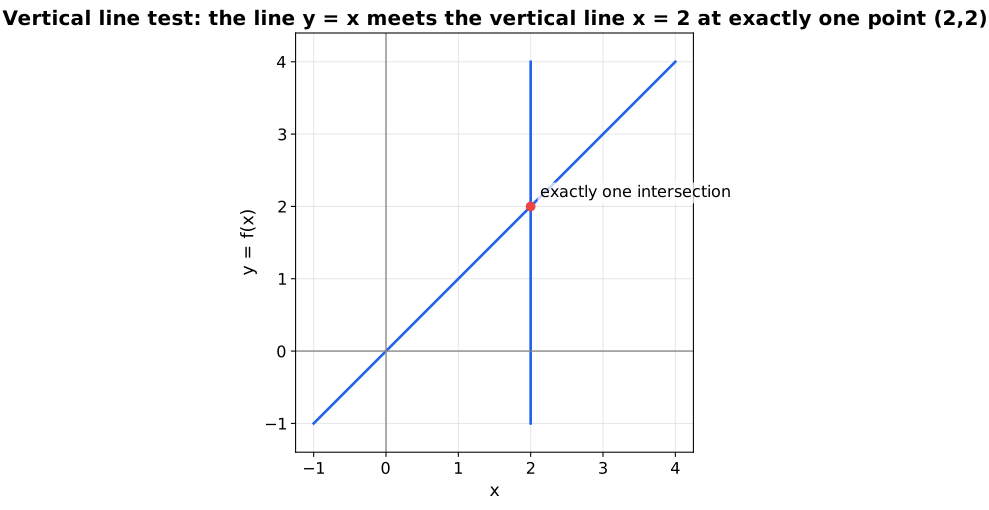
A quick graphical way to test whether a curve drawn in the -plane represents as a function of is the vertical line test: the curve is a function of if and only if every vertical line meets it in at most one point. A circle fails this test — a vertical line through it meets it twice — and so a circle is not the graph of a function of .
The whole of this chapter in the Maharashtra Std XI Mathematics and Statistics (Commerce) syllabus builds on this single definition — every later type of function, and every graph, is just a different way a rule can assign to each input exactly one output.
A relation from set to set , written , in which every element of is associated with exactly one element of . The unique element associated with is written and called the image of .
For : the domain is (every element must have an image); the codomain is (the set images are drawn from); the range is , the set of values actually taken as an image. The range may equal the codomain or be a proper subset of it.
When a function is given only by a rule , its natural domain is the largest set of real for which is a genuine real number — e.g. denominators must be non-zero and even roots must be of non-negative quantities.
A curve in the -plane represents as a function of if and only if no vertical line meets the curve at more than one point.