Mathematics and Statistics · Ch 1 — Sets and Relations
Operations on Sets
Operations on Sets
Sets can be combined to form new sets. These operations are best pictured with a Venn diagram, in which the universal set is drawn as a rectangle and the sets inside it as circles; overlapping circles show elements shared between sets.
Union. The union is the set of elements in , or in , or in both:
Intersection. The intersection is the set of elements common to both:
If , the sets have no element in common and are called disjoint.
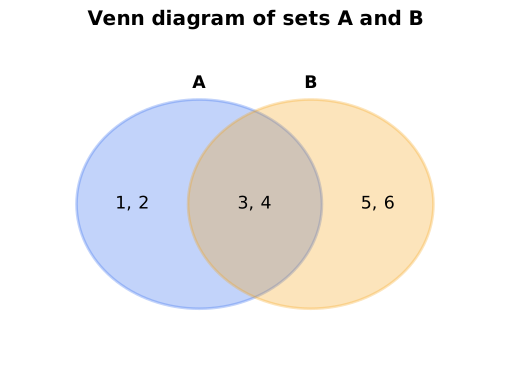
Difference. The difference (also written ) is the set of elements in but not in :
In general .
Complement. Relative to a universal set , the complement (or ) is the set of all elements of that are not in :
Key algebraic laws of sets (all provable from the definitions, and easy to check on a Venn diagram):
Laws of set operations
- Commutative: , and .
- Associative: ; similarly for .
- Distributive: ; and .
- De Morgan's laws: , and . …
The set of all elements belonging to or ( …
The set of elements common to both and . If empty, the sets a …
The set of elements in but not in ; in general $A - B …
The set of all elements of the universal set that are …
, correcting for double-counting …