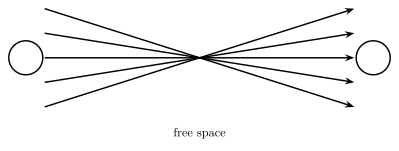
Q.A circular magnet is made with its north pole at the centre, separated from the surrounding circular south pole by an air gap. Draw the magnetic field lines in the gap. [The magnet is hypothetical.] Draw a diagram to illustrate the magnetic lines of force between the south poles of two such magnets.
You're viewing a preview — the full solution, concept, methods & PYQ mapping are locked.
Start your 14-day free trial to unlock the full solution →No diagram can be rendered here, so both parts are described in words. Part 1: since the N pole is a small circle at the very centre and the S pole is a larger concentric circle surrounding it, the whole arrangement has perfect radial (rotational) symmetry, so every field line in the air gap must run straight along a radius, pointing outward from the central N pole to the surrounding S pole -- a uniform RADIAL field pattern, exactly the kind of field deliberately engineered (with curved pole pieces and a soft-iron core) inside a moving-coil galvanometer to keep the coil's plane always parallel to the field. Part 2: when the S poles of two identical such magnets are brought to face each other, the field lines converge INTO an S pole from every direction (the mirror image of diverging OUT of an N pole), so lines from the region between the two magnets curve in towards each magnet's own S pole; directly on the line joining the two magnets' centres there is therefore a NEUTRAL POINT (at the mid-point, for two identical magnets) where the two magnets' fields -- each pointing back toward its own S pole, i.e. in opposite senses along that connecting …
Unlock everything free for 14 days
- Full step-by-step solutions
- Concept-first explanations
- Methods, shortcuts & mistakes
- PYQ mapping + timed mock tests
Full access for 14 days. No credit card required.