Chemistry · Ch 11 — Alcohols, Phenols and Ethers
Introduction
Introduction
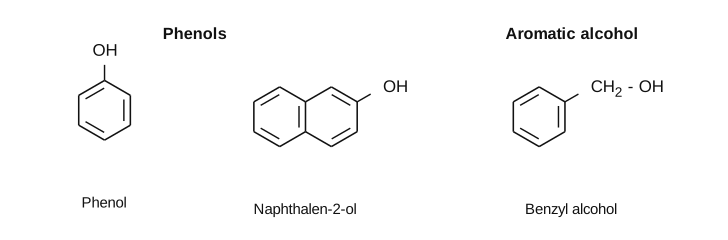
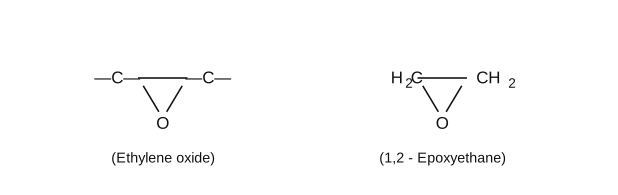
Alcohols are organic compounds whose molecules carry a hydroxyl group, -OH, attached to a saturated (sp3-hybridised) carbon atom. A hydroxyl group can also be present on an aromatic ring system, and this gives rise to two structurally distinct families: phenols, in which the -OH group is bonded DIRECTLY to a carbon of the benzene ring itself, and aromatic alcohols, in which the -OH group instead sits on a saturated side-chain carbon that is attached to the ring (e.g. the -CH2-OH of benzyl alcohol) rather than on the ring carbon. This one structural difference -- ring-bonded versus side-chain-bonded -OH -- is what separates the strongly acidic behaviour of phenols (covered in section 11.4.4) from the neutral behaviour of ordinary alcohols. Ethers form a related but distinct family: they are organic oxides in which an oxygen atom bridges two carbon-containing groups, which may be two alkyl groups (R-O-R'), one alkyl and one aryl group (R-O-Ar), or two aryl groups (Ar-O-Ar'). Ethers are conceptually related to alcohols as their formal anhydrides -- two molecules of alcohol losing one molecule of water between them gives an ether. A special structural subtype worth noting up front is the epoxide, a cyclic ether in which the ether oxygen is part of a strained three-membered ring, the simplest example being ethylene oxide (also named 1,2-epoxyethane); epoxides turn out to be useful synthetic intermediates and are referenced again in the preparation-of-alcohols section (11.4.1) as a route to primary alcohols via Grignard-reagent addition.
Drawn by us to help you understand the concept clearly, and verified to make sure it's accurate. For exams, practice from your textbook's own diagram.
What this figure shows. Two related benzene-ring structures side by side to contrast the two aromatic hydroxy-compound families: phenol itself, drawn as a benzene ring with a single -OH group attached directly to a ring carbon; and an aromatic alcohol (benzyl alcohol type), drawn as a benzene ring carrying a -CH2-OH side chain, where the hydroxyl group sits on the sp3 side-chain carbon rather than on the ring carbon itself. The distinction being illustrated is purely structural: in phenol the O is bonded straight to an aromatic (sp2) ring carbon, while in the aromatic alcohol the O is bonded to a saturated (sp3) carbon that is itself attached to the ring.
11.1-intro-a: Phenol vs. aromatic alcohol.
Drawn by us to help you understand the concept clearly, and verified to make sure it's accurate. For exams, practice from your textbook's own diagram.
What this figure shows. Shows the three general connectivity patterns an ether's oxygen can take -- R-O-R' (oxygen bridging two alkyl groups), R-O-Ar (oxygen bridging one alkyl and one aryl group), and Ar-O-Ar' (oxygen bridging two aryl groups) -- and separately shows epoxide as a special cyclic ether in which the ether oxygen is part of a strained three-membered ring, illustrated by ethylene oxide (also named 1,2-epoxyethane): a three-membered ring made of two CH2 carbons and one oxygen, each ring carbon bonded to the oxygen and to the other carbon.
11.1-intro-b: Ethers and epoxides (general structure).