Chemistry · Ch 4 — Chemical Thermodynamics
Entropy
Entropy
To know what entropy is, consider the following processes:
i. In the solid state, the water molecules in ice are arranged in a definite order.
ii. When ice melts, this highly crystalline arrangement of water molecules collapses; the molecules become free in the liquid state. An ordered state thus tends to become a more disordered state.
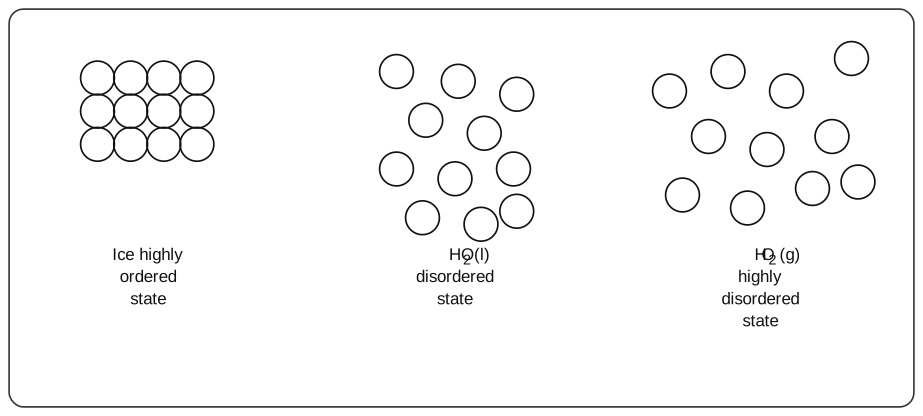
iii. When liquid water vaporises, the gaseous water molecules move freely and randomly in the available space. A less disordered state becomes highly disordered, as shown in Fig. 4.10.
Drawn by us to help you understand the concept clearly, and verified to make sure it's accurate. For exams, practice from your textbook's own diagram.
What this figure shows. Three panels of open circles inside one rounded box. In the first, the circles pack into a tight, ordered grid — Ice, highly ordered state. In the second, they scatter loosely — HO(), disordered state. In the third, only a few circles drift far apart — HO (g), highly disordered state. Disorder — and with it entropy — grows from solid to liquid to gas. *(This is the second figure the book numbers 'Fig. 4.10' — its phase-enthalpy diag …
During the melting of ice or the vaporisation of liquid water, the disorder — or randomness — increases. The disorder or randomness is measured by entropy, denoted by . The greater the disorder of a system, the larger is its entropy. The melting of ice and the vaporisation of liquid water show that disorder, and hence the entropy of a substance, increases as it passes from solid to liquid to gas.
In both processes the entropy change . Look at the following processes:
i. Dissolution of solid I in water :
(ordered state disordered state). When solid iodine dissolves in water, the I molecules move randomly. Thus the disorder — and hence the entropy — of the system increases, or is positive for the dissolution process.
ii. Dissociation of the H molecule into atoms :
One mole of H gas is converted into two H atoms. Larger disorder is associated with the separated H atoms than with the H molecule. Thus disorder — and hence entropy — increases, or is positive.
Quantitative definition of entropy
Entropy is a measure of molecular disorder, or randomness. An entropy change of a system is equal to the amount of heat transferred to it in a reversible manner () divided by the temperature in kelvin, , at which the transfer takes place. Thus,
is thus expressed in J K.
Entropy, or its change , is a state function, and depends on the initial and final states of the system — not on the path connecting the two states. …