A combined question spanning thermodynamic definitions, IF7's hybridisation/geometry, Henry's law with a molality calculation (or, in the OR branch, carbon-reduction metallurgy, sulphur oxoacid structures, and rate-law reasoning for a second-order reaction).
(i)(a) Enthalpy of atomization (ΔaH): the enthalpy change accompanying the complete conversion of 1 mole of a substance into gaseous atoms, breaking all the bonds present; it is always positive (endothermic), since energy must be supplied to break bonds. E.g. CH4(g)→C(g)+4H(g).
(i)(b) Enthalpy of vaporization (ΔvapH): the enthalpy change when 1 mole of a liquid is converted completely into its vapour at its boiling point, at constant temperature and pressure; also always positive, since energy is needed to overcome intermolecular forces of attraction in the liquid.
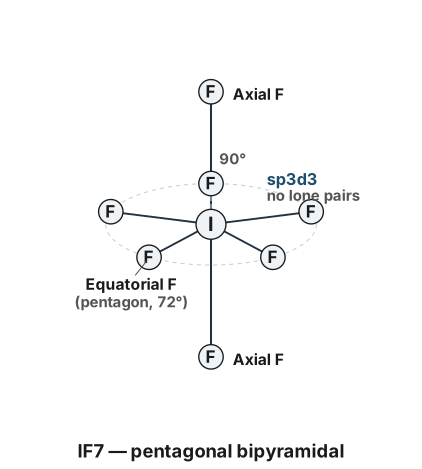
(ii) IF7: iodine heptafluoride has iodine as the central atom surrounded by 7 fluorine atoms with no lone pairs. Geometry: pentagonal bipyramidal — 5 F atoms arranged in an equatorial pentagon around the central I, with the remaining 2 F atoms occupying the axial positions above and below the plane. Hybridisation: sp3d3 (using the 5s, three 5p, and three 5d orbitals of iodine to accommodate 7 bond pairs).
(iii)(a) Henry's law: at a constant temperature, the solubility (mole fraction) of a gas in a liquid is directly proportional to the partial pressure of that gas in equilibrium with the solution: p=KHx, where KH is the Henry's law constant (specific to the gas-solvent pair and temperature) and x is the mole fraction of the dissolved gas.
(iii)(b) Molality of urea solution: moles of urea =60 gmol−122.22 g=0.3703 mol. Molality =mass of solvent in kgmoles of solute=0.3000.3703≈1.234 molkg−1.
OR — (i) Action of carbon on metal oxides:
- In the blast furnace, carbon (via the CO it generates: 2C+O2→2CO) reduces Fe2O3 to metallic iron: Fe2O3+3CO→2Fe+3CO2.
- In the vertical retort furnace, carbon directly reduces zinc oxide (around 1673 K) to metallic zinc, which distils off as vapour and is condensed: ZnO+C→Zn+CO.
…