Chemistry · Ch 15 — Introduction to Polymer Chemistry
Classification of polymers on the basis of mode of polymerization
Classification of polymers on the basis of mode of polymerization
Polymerization is the fundamental process that converts small, low molecular mass monomers carrying reactive functional groups into a single high molecular mass polymer molecule, joined together through covalent bonds, usually driven by high temperature and/or pressure and/or a catalyst. Depending on the type of chemical reaction taking place between the monomers, there are three distinct modes. Addition (or chain-growth) polymerization simply adds monomer molecules to a growing chain, one after another, without losing any small molecule in the process -- so the repeating unit of the polymer has exactly the same elemental composition as the original monomer. It happens with monomers that carry a C=C double bond (hence it is also called vinyl polymerization, since most such monomers are vinyl-type, e.g. vinyl chloride CH2=CHCl or acrylonitrile CH2=CHCN); polyethylene from ethylene is the best-known example. The free-radical mechanism, involving initiation, propagation and termination, is the most common route (detailed as a separate note under this section). Condensation (or step-growth) polymerization instead builds the chain through a series of condensation reactions between polyfunctional monomers, each step eliminating a small molecule such as water, HCl, methanol or ammonia -- so unlike an addition polymer, the repeating unit's elemental composition is NOT the same as that of the starting monomers. The formation of terylene from ethylene glycol and terephthalic acid (with loss of water at each ester linkage) is the standard example. Ring-opening polymerization is the third mode: cyclic monomers such as lactams, cyclic ethers and lactones (catalyzed by a strong acid or base) open their ring and add on, one monomer unit at a time, to the growing chain -- the polymerization of epsilon-caprolactam to nylon 6 (see section 15.3.5) is the standard example. Its repeating unit keeps the sa …
Drawn by us to help you understand the concept clearly, and verified to make sure it's accurate. For exams, practice from your textbook's own diagram.
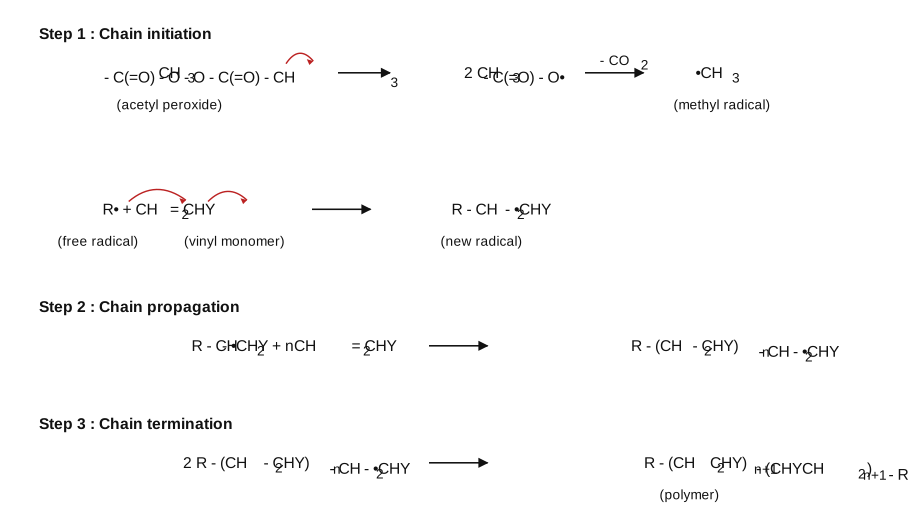
Worked out. Addition (vinyl) polymerization of monomers containing a C=C double bond most commonly proceeds by a free-radical chain mechanism in three steps. Step 1, chain initiation: an initiator/catalyst such as benzoyl peroxide, acetyl peroxide or tert-butyl peroxide decomposes to generate a free radical (e.g. acetyl peroxide -> 2 CH3-C(=O)-O* -> methyl radical + CO2), which adds across a vinyl monomer CH2=CHY to give a new, bigger radical R-CH2-CHY*. Step 2, chain propagation: this radical repeatedly adds to further monomer molecules in rapid succession, R-CH2-CHY* + n CH2=CHY -> R-(CH2-CHY)n-CH2-CHY*, building a very large radical very quickly. Step 3, chain termination: growth eventually stops, most commonly when two growing chain radicals combine with each other, joining two long radical chains into one dead polymer …
Drawn by us to help you understand the concept clearly, and verified to make sure it's accurate. For exams, practice from your textbook's own diagram.
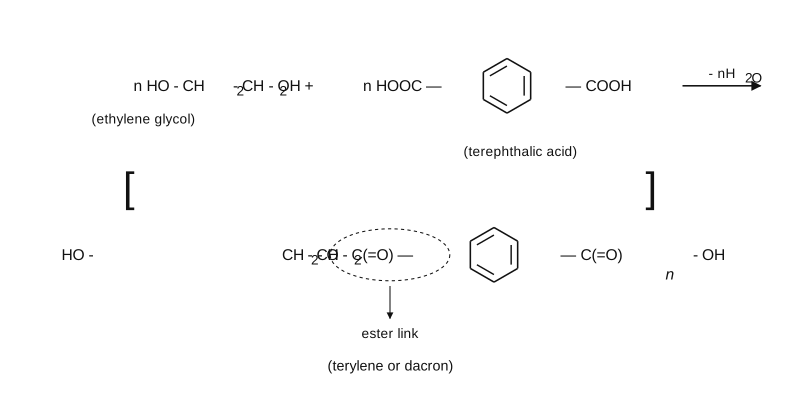
Condensation in action. Ethylene glycol's -OH and terephthalic acid's -COOH react with loss of nH2O; the dotted ellipse marks the ester link that joins the units. Because a small molecule departs at every step, the repeat unit's composition differs from the monomers' — the defining mark of condensation (step grow …
![Fig. 15.2.3c — Ring-opening polymerization of epsilon-caprolactam: the seven-membered lactam ring opens to the nylon 6 repeat unit -[NH-(CH2)5-CO]n-.](/figures/mh-chem-introduction-to-polymer-chemistry/caprolactam-ring-opening-nylon-6-uncaptioned-p325-331.svg)
Drawn by us to help you understand the concept clearly, and verified to make sure it's accurate. For exams, practice from your textbook's own diagram.
Ring opening, the third mode. The seven-membered epsilon-caprolactam ring (Greek position letters as the book prints them) opens at the N-CO bond; the freed chain joins end-to-end into -[NH-(CH2)5-CO]n-, nylon 6. No molecule is lost — unlike condensation — yet no C=C addition happens either, which is why the bo …