Chemistry · Ch 1 — Solid State
Close packed structures
Close packed structures
The three-dimensional close packed structure is best understood by building it up in stages: first a single row of spheres, then a layer, then a stack of layers.
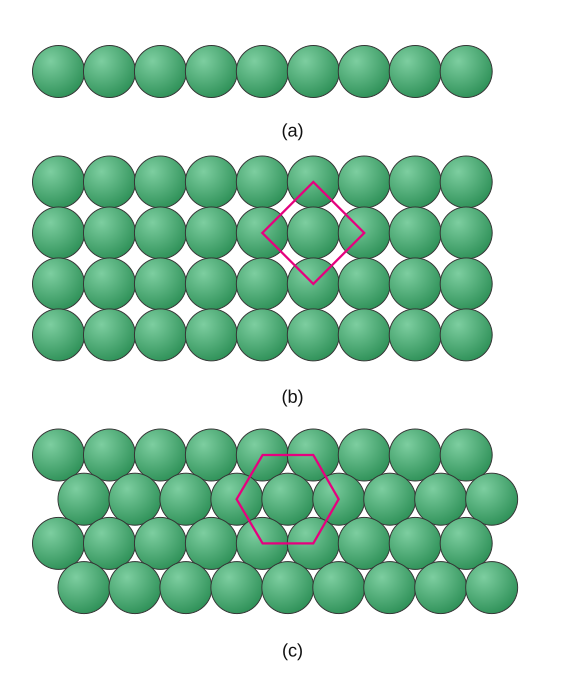
a. Close packing in one dimension : A row of spheres touching one another edge to edge is the only way to close-pack spheres in one dimension. Each sphere is in contact with two neighbours, so its coordination number is 2.
b. Close packing in two dimensions : A two-dimensional close packed layer is obtained by stacking close packed rows one against another, and there are two distinct ways of doing it:
i. Square close packing : Successive rows are placed so that their spheres align both horizontally and vertically -- every row a repeat of the first, giving an AAAA... type arrangement. Each sphere touches 4 neighbouring spheres, so the 2-D coordination number is 4, and joining the centres of those four neighbours traces a square -- hence the name square close packing.
ii. Hexagonal close packing : Successive rows are staggered, each sphere nestling into the depression between two spheres of the row below. Alternate rows repeat, giving an ABAB... type arrangement. Each sphere touches 6 neighbouring spheres, so the 2-D coordination number is 6, and joining their centres traces a regular hexagon. Hexagonal packing leaves less empty space than square packing -- it is the more efficient of the two two-dimensional packings.
Drawn by us to help you understand the concept clearly, and verified to make sure it's accurate. For exams, practice from your textbook's own diagram.
What this figure shows. Three panels labelled (a), (b), (c). (a) One-dimensional close packing: a single straight row of identical spheres touching edge to edge. (b) Square close packing in two dimensions: several such rows stacked so the spheres align vertically (an AAAA pattern); a square outline joins the centres of four touching spheres, marking the 2-D coordination number of 4. (c) Hexagonal close packing in two dimensions: rows staggered so each sphere nestles into the depression of the row below (an ABAB pattern); a hexagon outline joins the centres of the six spheres surrounding one central sphere, marking the 2-D coordination number of 6. …
c. Close packing in three dimensions : Three-dimensional structures arise by stacking the two-dimensional layers on top of one another, and what results depends on which kind of layer is stacked, and how.
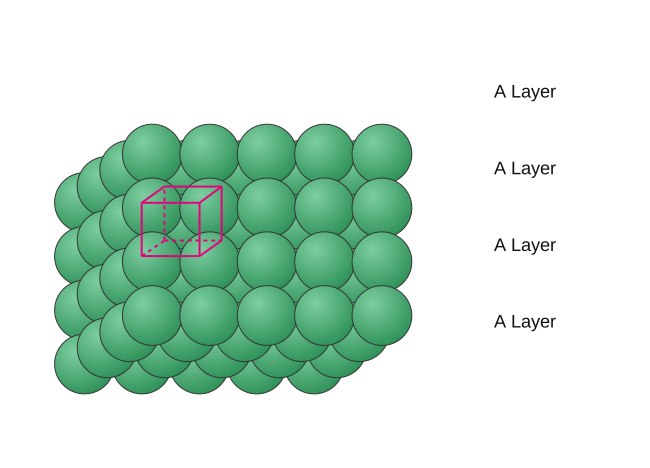
i. Stacking of square close packed layers: Placing square close packed layers exactly one above the other -- every sphere directly over a sphere of the layer below -- repeats the same layer throughout, an AAAA... pattern. The structure generated is the simple cubic structure, whose unit cell is the primitive (simple) cubic cell. Polonium is the only metal that crystallises in this structure.
Drawn by us to help you understand the concept clearly, and verified to make sure it's accurate. For exams, practice from your textbook's own diagram.
What this figure shows. A 3-D perspective stack of four square close-packed layers of spheres, each sphere sitting exactly above the sphere below it, with the four layers labelled 'A Layer' one under the other -- the AAAA stacking. A cube outline (hidden edges dotted) is drawn through eight adjacent sphere centres at the top of the stack, showing that this stacking generates the simple (primitive …
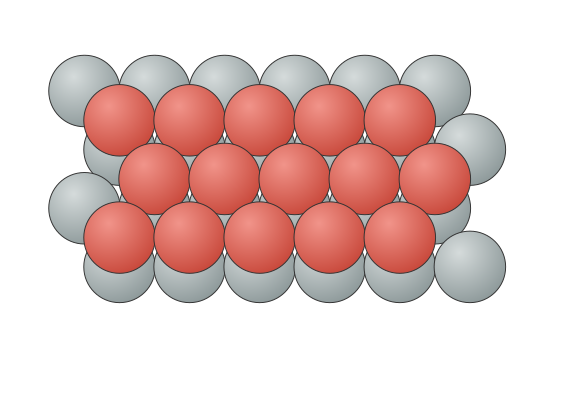
ii. Stacking of two hexagonal close packed layers : A closer-packed three-dimensional structure starts from hexagonal close packed layers. The spheres of the second layer are placed in the depressions of the first layer; calling the first layer A, the differently placed second layer is called B. Only half of the triangular depressions of the A layer can hold spheres of the B layer -- the sphere resting in a depression touches the three spheres around it, blocking the neighbouring depressions.
Drawn by us to help you understand the concept clearly, and verified to make sure it's accurate. For exams, practice from your textbook's own diagram.
What this figure shows. Two overlaid hexagonal close-packed layers of spheres distinguished by colour: the lower (first, 'A') layer in grey and the upper (second, 'B') layer in red-orange, with every upper sphere nestled into a triangular depression between three lower spheres -- illustrating how the second layer sits in the depressions of the first rather than di …
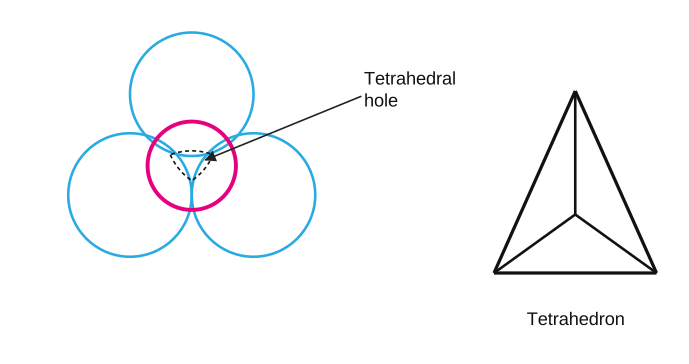
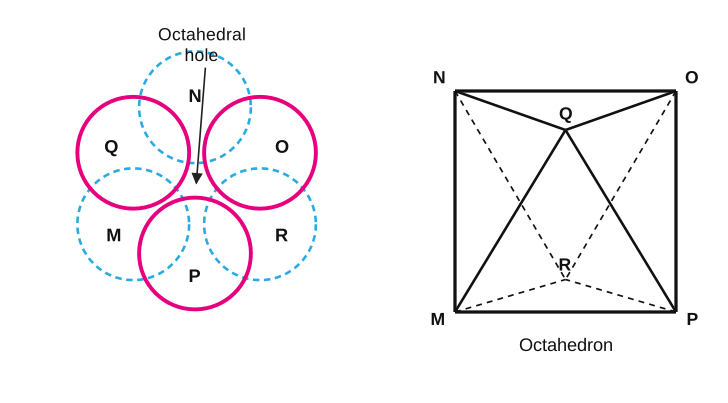
The depressions of the A layer that ARE covered by B-layer spheres become tetrahedral voids: each is surrounded by four spheres whose centres, when joined, form a tetrahedron (Fig. 1.6). The depressions that remain uncovered combine with the triangular depressions of the B layer above them to form octahedral voids: each is surrounded by six spheres whose centres, when joined, form an octahedron (Fig. 1.7).
Drawn by us to help you understand the concept clearly, and verified to make sure it's accurate. For exams, practice from your textbook's own diagram.
What this figure shows. Two sub-drawings. Left: three outline circles (spheres of the lower layer) arranged in a touching triangle, with a fourth, bold-outlined sphere resting in the depression between them; a leader line labels the enclosed gap 'Tetrahedral hole'. Right: a plain line drawing of a tetrahedron, labelled 'Tetrahedron' -- the solid obtained by joining the centres of the four spheres, whi …
Drawn by us to help you understand the concept clearly, and verified to make sure it's accurate. For exams, practice from your textbook's own diagram.
What this figure shows. Two sub-drawings. Left: six outline circles -- three bold-outlined spheres of one layer interleaved with three dashed-outlined spheres of the adjacent layer, individually labelled N, Q, O, M, R and P -- forming two staggered triangles that enclose a central gap, labelled 'Octahedral hole' by a leader line. Right: a line drawing of an octahedron with its vertices labelled with the same six letters (hidden edges dashed), showing the solid obtained by joining the six sphere centres. (The book's caption under the s …
Remember...
The triangular depressions of the A layer and the B layer do not overlap -- their apices point in opposite directions. The depressions in which the second-layer spheres rest are the tetrahedral voids, while the depressions in which no sphere rests are the octahedral voids.
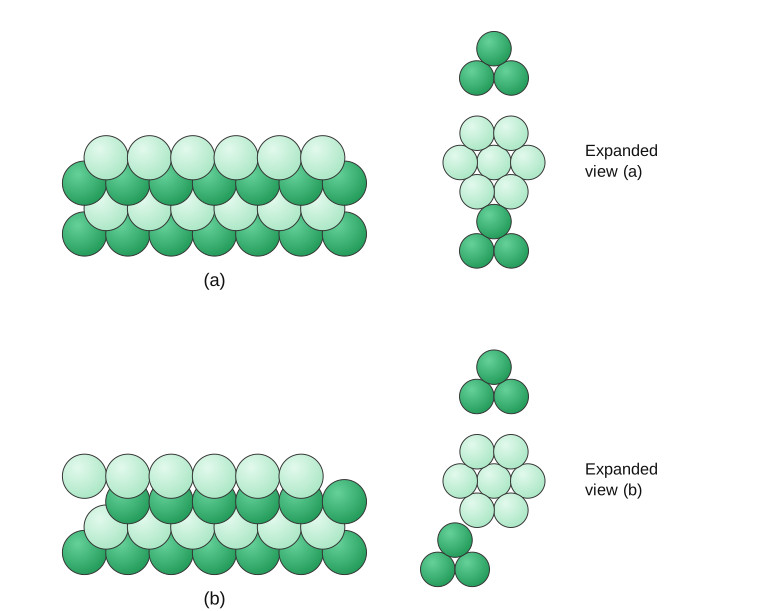
iii. Placing third hexagonal close packed layer : There are two distinct ways of placing a third hexagonal close packed layer on the two-layer AB stack: …
Drawn by us to help you understand the concept clearly, and verified to make sure it's accurate. For exams, practice from your textbook's own diagram.
What this figure shows. Four sub-drawings in one box. (a) A perspective stack of two-tone spheres in the ABAB arrangement (third layer aligned with the first) -- the hexagonal close packed (hcp) structure -- with 'Expanded view (a)' showing the same layers pulled apart as separate clusters. (b) A similar stack in the ABCABC arrangement (third layer over the octahedral voids, aligned with neither of the first two) -- the cubic close packed (ccp) structure -- with 'Expanded view (b)' showing i …