Mathematics · Ch 13 — Differential Equations
Surface Area
Surface Area
Knowledge of a differential equation can also be used to solve problems involving surface area, where a rate of change of volume is described as being proportional to the wetted (or exposed) surface area of a solid at that instant.
A solved example works through this in detail: water is poured into a vessel shaped like an inverted right circular cone of semi-vertical angle 45°, in such a way that the rate of change of volume at any moment is proportional to the area of the curved surface that is wet at that moment. Initially the vessel is filled to a height of 2 cm, and after 2 seconds the height is 10 cm; the goal is to show that after 3.5 seconds from the start, the height will be 16 cm.
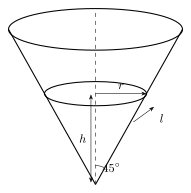
Let h be the height of water at time t, r the radius of the water's surface, and l the slant height of the wetted curved surface, all at time t.
Drawn by us to help you understand the concept clearly, and verified to make sure it's accurate. For exams, practice from your textbook's own diagram.
What this figure shows. An inverted right circular cone (apex pointing down, semi-vertical angle 45°) shown with water filling it to a height h from the apex. The figure marks the current water height h, the radius r of the water's circular surface at that height, and the slant length l of the wetted curved surface running from the apex up to the rim of the water surface — the three quantities the worked Example 5 relates via tan45° = r/h (so r = h) and l² = r² + h² = 2h², used to express the wetted curved-surface area as √2·π·h² before setting up the rate equation dv/dt ∝ (curved surface area) that t …
The area of the curved surface at that moment is πrl. Since the semi-vertical angle is 45°, tan45° = r/h = 1, so r = h; and l² = r² + h² = 2h², so l = √2·h. So the wetted curved-surface area is πrl = π·h·√2h = √2·π·h². Since the rate of change of volume v is proportional to this area, dv/dt ∝ √2·π·h², i.e. dv/dt = c·√2π·h² for a constant c; writing k = c√2π, this is dv/dt = k·h². …