Mathematics · Ch 13 — Differential Equations
Formation of Differential Equation
Formation of Differential Equation
A differential equation does not only arise by someone writing one down directly — very often it arises because a FAMILY of curves (or a physical relationship) is known, written with one or more ARBITRARY CONSTANTS, and the goal is to find the equation that every member of that family satisfies, with the constants eliminated. This is done by differentiating the given relation as many times as there are arbitrary constants, and then eliminating the constants algebraically between the original relation and its derivative(s).
With ONE constant, a single differentiation is usually enough: differentiate, solve the resulting equation for the constant, and substitute that expression straight back into the original relation.
With TWO constants, two differentiations are needed. A common pattern is: differentiate once (this equation may still contain both constants, or just one, depending on how they entered); differentiate a second time (this often isolates a relation in only one of the constants, or purely in the derivatives); then combine the two derivative-relations (typically by solving each for the same constant, or a common combination, and equating) to eliminate both constants at once, leaving a differential equation whose order matches the number of constants eliminated.
Five solved examples cover the main patterns:
- y = 4ax — one constant a. Differentiating: dy/dx = 4a. Substituting 4a = dy/dx back into y = 4ax gives y = x(dy/dx).
- y = Ae^(3x) + Be^(−3x) — two constants A, B. Differentiating twice gives d²y/dx² = 9(Ae^(3x)+Be^(−3x)) = 9y directly, using the original relation to recognise the bracket — so d²y/dx² = 9y.
- y = (c₁ + c₂x)eˣ — two constants c₁, c₂. Differentiating: dy/dx = (c₁+c₂x)eˣ + c₂eˣ = y + c₂eˣ, so c₂eˣ = dy/dx − y. Differentiating again: d²y/dx² = dy/dx + c₂eˣ = dy/dx + (dy/dx − y), giving d²y/dx² − 2(dy/dx) + y = 0.
- y = c² + c/x — one constant c. Differentiating: dy/dx = −c/x², so c = −x²(dy/dx). Substituting back into y = c² + c/x gives y = x⁴(dy/dx)² − x(dy/dx).
- y = c₁e^(3x) + c₂e^(2x) — two constants. Differentiating twice gives three equations in c₁e^(3x) and c₂e^(2x) (the original relation, its first derivative, and its second derivative); treating these as a linear system and requiring it to be consistent (its determinant to vanish, exactly the technique used in Example 1(ix) of the previous section) leads to d²y/dx² − 5(dy/dx) + 6y = 0. Two further worked examples turn genuine word descriptions directly into a differential equation: Example 2 — a radioactive substance's mass m decays at a rate proportional to its current mass: since the rate of decay is dm/dt, and dm/dt ∝ m, this is dm/dt = mk where k < 0 (negative, since the mass is decreasing) — the required differential equation, with no further elimination needed since the physical law is already stated as a rate. Example 3 — the family of circles lying above the X-axis and touching it at the origin: with centre C(a,b) (b < 0, so the circle sits above the axis touching it below at the origin) and radius |b|, the circle's equation is x² + (y−b)² = b², which simplifies to x² + y² − 2by = 0. Differentiating: 2x + 2y(dy/dx) − 2b(dy/dx) = 0, giving x² − y² = 2xy(dy/dx) after eliminating b using the original relation (b = y + x(dy/dx)/1... more directly, from x + (y−b)(dy/dx) = 0 one gets b = y + x/(dy/dx), and substituting this back into the circle's equation and simplifying yields (x²−y²)(dy/dx) = 2xy, the required differential equation for this one-parameter family. …
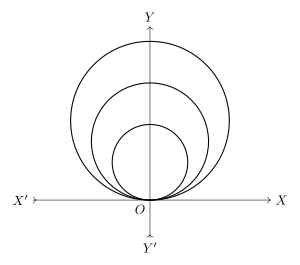
Drawn by us to help you understand the concept clearly, and verified to make sure it's accurate. For exams, practice from your textbook's own diagram.
What this figure shows. A circle of centre C(a, b), with b < 0, drawn resting above the X-axis and touching it exactly at the origin. The figure marks the centre C(a, b), the origin as the point of tangency, and the radius (equal to |b|, the distance from the centre down to the X-axis) as a dashed segment from C straight down to the origin. This is the geometric picture behind the worked Example 3 of this section, which forms the differential equation (x² − y²) dy/dx = 2xy satisfied by every member of this on …