Mathematics · Ch 8 — Differentiation
Geometrical Meaning of Derivative
Geometrical Meaning of Derivative
The derivative also has a purely geometric meaning, quite apart from any algebraic formula. Take a curve and a fixed point on it at , so . Pick a second point on the same curve a little to the right, at for small , so . The straight line joining and is called a secant line, and its slope is Now imagine shrinking toward : the point slides back along the curve toward , and the secant line's direction keeps rotating. In the limit, merges into and the secant becomes the tangent line to the curve at . Since the slope of the tangent at is exactly . The same limiting slope is reached whether approaches from the right () or from the left, using a point instead. This is the geometrical meaning of the derivative: at any point on the curve , the value is the slope of the tangent line to the curve at that point. …
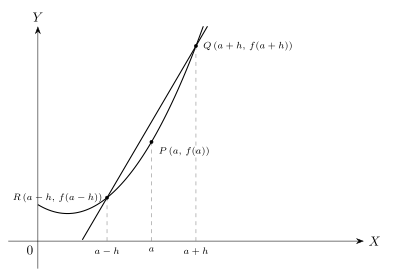
Drawn by us to help you understand the concept clearly, and verified to make sure it's accurate. For exams, practice from your textbook's own diagram.
What this figure shows. A sketch of the curve y = f(x) with a fixed point P at x = a and a second point Q at x = a + h a little to the right of P on the same curve. The straight secant line joining P and Q is drawn, and as h is imagined shrinking toward zero, Q slides back along the curve toward P and the secant line's direction rotates until, in the limit, it coincides with the tangent line to the curve at P — illustrating why the limiting slope of the secant eq …