Mathematics · Ch 6 — Line and Plane
Distance of a Point from a Plane
Distance of a Point from a Plane
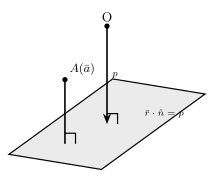
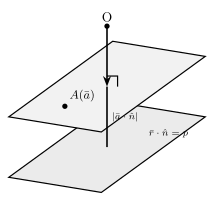
The distance of the origin from a plane already written in normal form is simply — this is the very meaning of the normal form (Fig. 6.13). To find the distance of an arbitrary point from the plane , construct the plane through parallel to the given one: a parallel plane shares the same normal , so its equation is . Since this new plane is itself already in normal form, the distance of the origin from it is, by the same normal-form fact, simply (Fig. 6.14 pictures the two parallel planes together — the original at distance from , and the one through at distance from ). The distance from to the original plane is then the difference of these two origin-distances, made non-negative:
This formula only works once the plane's equation is genuinely in normal form (unit normal, non-negative ) — a plane given as with not a unit vector must first be divided through by before this formula can be used.
Worked example. Find the distance of the point from the plane .
Here and , so , giving .
The normal form of the given plane is , so . …
Drawn by us to help you understand the concept clearly, and verified to make sure it's accurate. For exams, practice from your textbook's own diagram.
What this figure shows. Fig. 6.13 shows the geometric meaning of the normal-form constant p: the plane r·n̂ = p drawn as a shaded parallelogram, with the origin O and an arbitrary point A(ā) both marked above it. A perpendicular dropped from O down to the plane is labelled p, which is exactly the distance-of-the-origin meaning of p in the normal form r·n̂ = p. A second perpendicular of unlabelled length drops from A to the same plane; comparing where this second perpendicular lands against where O's perpendicular lands is the geometric idea that the point-distance formula later turns into algebra — the point A does not, in gen …
Drawn by us to help you understand the concept clearly, and verified to make sure it's accurate. For exams, practice from your textbook's own diagram.
What this figure shows. Fig. 6.14 stacks two parallel planes to show why the point-to-plane distance is a difference of two origin-distances: the plane through A(ā) on top and the original plane r·n̂ = p below. The upper plane, drawn through A(ā), is labelled r·n̂ = ā·n̂, while the lower plane is the original r·n̂ = p. A perpendicular dropped from the origin O up to the plane through A is marked |ā·n̂|, showing that this quantity is itself just another origin-to-plane distance of the same normal-form kind, only measured to the shifted parallel plane instead of the original one — which is exactly why the final distance for …