Mathematics · Ch 6 — Line and Plane
Distance of a point from a line
Distance of a point from a line
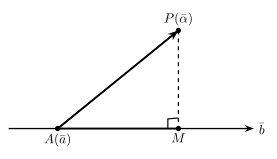
Theorem 6.5 (distance of a point from a line). Given a line and any point with position vector , we want a formula for the perpendicular distance of from the line, without having to construct the actual foot of the perpendicular by hand every time. Let be the known base point of the line (position vector ), and let be the foot of the perpendicular dropped from onto the line — so is the point on the line closest to , and is perpendicular to the line. Because lies on the line, the segment is exactly the projection of onto the line's direction; and since the line runs parallel to , this is the same as the projection of onto itself. Using the standard formula for the scalar projection of one vector onto another, Now triangle is right-angled at (since is perpendicular to the line, and lies along the line), so Pythagoras' theorem gives . Since , this becomes and taking the square root gives the required distance: In words: the squared distance from A to P splits, via Pythagoras, into a part running along the line (the squared projection, which measures how far along the line the foot of the perpendicular sits) and a part running perpendicular to the line (the actual distance we want) — so subtracting the along-line part from the full squared distance isolates exactly the perpendicular part. This one formula works whether the point is given directly with a position vector, or the line is given in Cartesian symmetric form (in which case it is easiest to first find the actual coordinates of the foot of the perpendicular M by demanding that be perpendicular to the line's direction, as the second worked example below does).
Worked examples.
Ex.(12). Find the length of the perpendicular from to the line . This length is exactly the distance of P from the line, so Theorem 6.5 applies directly with , , and . First, , so Next, the dot product with : , and . Substituting into Theorem 6.5's formula: (Here , which is why the projection term simplifies so cleanly to .) …
Drawn by us to help you understand the concept clearly, and verified to make sure it's accurate. For exams, practice from your textbook's own diagram.
What this figure shows. Fig. 6.3 (printed page 201) illustrates the right-angled triangle used to prove Theorem 6.5. A point is drawn above a horizontal line that represents , with the fixed point marked at its base and an arrow labelled showing the line's direction running to the right. A second point M is marked on the line directly below P, with a small square drawn at M to show that PM is perpendicular to the line — M is the foot of the perpendicular dropped from P. The segment AM is the projection of onto the line, so triangle AMP is right-angled at M, and this right angle is …