Mathematics · Ch 6 — Line and Plane
Skew lines
Skew lines
When two lines lie in space, there are exactly three possible relationships between them. If the two lines meet at a common point, the shortest distance between them is zero. If the two lines are parallel to each other, the shortest distance between them equals the perpendicular distance between them (measured along the common perpendicular to both). But two lines in space need not intersect and need not be parallel -- such a pair of lines, which neither intersects each other nor is parallel to the other, is called a pair of skew lines.
A defining feature of skew lines is that they are non-coplanar -- there is no single plane that contains both of them. This is worth contrasting with lines drawn in one plane: any two lines lying in the same plane must either intersect (if they are not parallel) or be parallel (if they never meet); a plane simply has no room for two lines to 'miss' each other without being parallel. It is only in three-dimensional space that two lines can avoid each other while still not running parallel, because the extra dimension lets them pass at different 'heights' relative to one another.
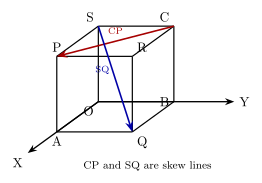
Figure 6.5 illustrates this with a parallelepiped-shaped solid having vertices O, A, B, C, P, Q, R, S. The face-diagonal line CP crosses diagonally across the rear face CSPR, while the face-diagonal line SQ crosses diagonally across the adjacent face SAQP. Since these two diagonals lie in two different faces of the solid that are not parallel to each other, CP and SQ never meet and are also not parallel to each other -- so CP and SQ are skew lines. …
Drawn by us to help you understand the concept clearly, and verified to make sure it's accurate. For exams, practice from your textbook's own diagram.
What this figure shows. Fig. 6.5 shows a parallelepiped-shaped solid with vertices O, A, B, C, P, Q, R, S and the co-ordinate axes X and Y drawn from O. Two face-diagonals are marked: line CP runs diagonally across the rear face CSPR, and line SQ runs diagonally across the adjacent face SAQP. Because CP and SQ lie in two different, non-parallel faces of the solid, they neither meet nor run parallel to each other -- they are skew lines, and the figure is used to show that skew lines are necessar …