Physics · Ch 1 — Rotational Dynamics
Expression for Torque in Terms of Moment of Inertia
Expression for Torque in Terms of Moment of Inertia
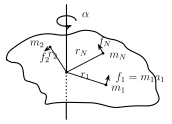
Drawn by us to help you understand the concept clearly, and verified to make sure it's accurate. For exams, practice from your textbook's own diagram.
What this figure shows. A rigid, irregularly-shaped object (drawn just as in Fig. 1.12) rotating about an axis through a marked point, perpendicular to the page, but now with a constant ANGULAR ACCELERATION instead of a constant angular speed. The object again consists of N discrete particles at perpendicular distances from the axis, but this time each particle's TANGENTIAL acceleration () and the corresponding tangential force () driving it are the quantities of interest, since it is these tangential forces (each acting at its own perpendicular distance ) whose com …
Just as angular momentum turned out to be (the rotational analogue of ), the same style of argument gives the rotational analogue of Newton's second law, . Consider once more a rigid object of N particles at perpendicular distances from a fixed axis, now rotating with a common ANGULAR ACCELERATION (rather than a constant ). Every particle then has its own TANGENTIAL (linear) acceleration , and hence experiences its own tangential force . Since this force is tangential, its own perpendicular distance from the axis is simply (the same distance used for the acceleration), so the TORQUE this one particle's tangential force contributes is If the rotation is confined to a single plane, every particle's torque contribution points along the same direction (the axis), so -- exactly as for angular momentum -- these torque magnitudes simply add: So the net torque on a rigid body equals the direct rotational analogue of , with I once again replacing mass -- confirming, from yet another direction, exactly why moment of inertia is the correct rotational stand-in for mass. Table 2 collects this and …