Physics · Ch 1 — Rotational Dynamics
Moment of Inertia as an Analogous Quantity for Mass
Moment of Inertia as an Analogous Quantity for Mass
Sections 1.2 to 1.4 treated every rotating or revolving object as a single point particle. But a REAL rigid object -- a door, a flywheel, a disc -- consists of countless particles, all rotating together about the same axis with the SAME angular speed , but each at its OWN distance from the axis, and hence each with its own different LINEAR speed . To extend the translational dynamics already built (force, momentum, kinetic energy, all built around the quantity 'mass') into a rotational dynamics, we need to find the rotational quantity that plays the role mass m plays translationally.
Everyday experience already hints at what this quantity must involve: opening a door needs an effort that depends not just on how heavy the door is, but crucially on HOW FAR from the hinge (the axis) you push -- pushing near the hinge takes much more effort than pushing at the door's outer edge for the same intended effect. So whatever quantity replaces mass rotationally must depend not only on how much mass is present, but on HOW that mass is distributed relative to the axis of rotation.
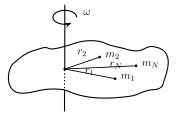
Drawn by us to help you understand the concept clearly, and verified to make sure it's accurate. For exams, practice from your textbook's own diagram.
What this figure shows. A rigid, irregularly-shaped object rotating with a constant angular speed about a fixed axis drawn perpendicular to the plane of the page, passing through a marked point on the object. The object is depicted as consisting of N discrete point masses scattered at various positions within its outline, each connected by a straight radial line (its own perpendicular distance ) from the axis of rotation out to that particle's location. The figure establishes that although all N particles share the SAME angular speed (since the object is rigid), each has a DIFFERENT linear speed because their distances …
To pin this down exactly, consider a rigid object built (for simplicity) of N discrete particles of masses at respective perpendicular distances from a fixed axis, all rotating together with common angular speed . Particle i, moving with linear speed , has translational kinetic energy . Summing over every particle gives the object's total (rotational) kinetic energy: where For this to look exactly like the familiar translational form with standing in for v, the quantity must be standing in for m -- and indeed I is defined to be exactly this: the rotational inertia, or moment of inertia (M.I.), of the object about the given axis. As anticipated from the door example, I depends on BOTH the individual masses present AND on how they are distributed (their distances ) about that particular axis -- change the axis, and (unless there is enough symmetry) I generally changes too, even though the object and its total mass have not changed at all. …