Physics · Ch 6 — Superposition of Waves
Analytical method to determine beat frequency
Analytical method to determine beat frequency
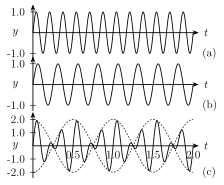
Consider two sound waves of the SAME amplitude a but slightly different frequencies and , assumed (for simplicity) to arrive exactly in phase with each other at a chosen listening point x = 0: and . By the principle of superposition, ; applying the sum-to-product identity (Eq. 6.37) and rearranging gives , where is the MEAN of the two original frequencies (Eq. 6.38). Writing the bracketed, slowly-varying factor as an amplitude , the resultant is itself a progressive wave oscillating at the mean frequency n, but with an amplitude A that itself varies periodically and comparatively SLOWLY with time (since is small).
Since the ear's perceived loudness (intensity) tracks the square of this amplitude, maximum loudness (WAXING) occurs whenever , i.e. ; working through the successive instants at which this condition is met shows that consecutive waxings are spaced exactly apart in time. Minimum loudness (WANING, ) occurs when the same cosine factor is zero, and working through those instants shows consecutive wanings are ALSO spaced exactly apart -- as expected, since waxing and waning alternate at the same regular rate. The BEAT FREQUENCY -- the number of loud maxima heard per second -- is therefore simply the reciprocal of this spacing: (Eq. 6.39), the (positive) difference between the two original frequencies. …
Drawn by us to help you understand the concept clearly, and verified to make sure it's accurate. For exams, practice from your textbook's own diagram.
What this figure shows. Three graphs of displacement against time. (a) and (b) are two harmonic waves of nearly equal frequencies and equal amplitude. (c) Their superposition: the resultant amplitude rises and falls (waxing and waning) periodically — the loudness of the sound goes up and down. One waxing and the next waning make one beat; the number o …