Physics · Ch 6 — Superposition of Waves
Equation of Stationary Wave on a Stretched String
Equation of Stationary Wave on a Stretched String
To derive the exact resultant displacement, consider two simple harmonic progressive waves of EQUAL amplitude a and wavelength , travelling along the x-axis in OPPOSITE directions: (Eq. 6.10, travelling in the direction) and (Eq. 6.11, travelling in the direction). By the principle of superposition, the resultant is ; using the sum-to-product identity gives (Eq. 6.12). Writing the position-dependent factor as an amplitude, , this is simply (using ).
This is the equation of a STATIONARY wave. Crucially, x and t appear SEPARATELY in this equation -- x only inside the amplitude term A, never combined with t as the single argument that characterises a genuinely travelling (progressive) disturbance -- so this wave is NOT progressive: it does not travel to the left or the right. Every point on the string instead oscillates with the SAME angular frequency (matching each of the two interfering progressive waves), but with an AMPLITUDE that varies PERIODICALLY with position x -- different particles genuinely have different, but individually fixed, amplitudes of oscillation.
A NODE is a point of minimum (zero) amplitude: setting requires , i.e. , giving node positions , or in general for . Successive nodes are therefore spaced apart. An ANTINODE is a point of MAXIMUM amplitude, : this requires , giving , i.e. antinode positions , or for -- successive antinodes are ALSO spaced apart, and since nodes and antinodes alternate, the spacing between any node and its NEAREST antinode is exactly . …
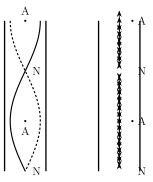
Drawn by us to help you understand the concept clearly, and verified to make sure it's accurate. For exams, practice from your textbook's own diagram.
What this figure shows. A longitudinal stationary wave (for example, a sound wave in a pipe) is customarily drawn as transverse-looking loops (left), but the particles of the medium actually oscillate ALONG the length of the pipe, not across it (right, vertical double arrows). A = antinode …