Physics · Ch 6 — Superposition of Waves
Formation of Stationary Waves
Formation of Stationary Waves
Imagine a string stretched between two fixed points; if it is pulled aside at the middle and released, it settles into a recognisable, fixed pattern of oscillation known as a stationary wave. What actually happens is that releasing the string launches two progressive waves travelling away from the pluck point in OPPOSITE directions; each of these reaches a fixed end, reflects (with the -radian phase change of section 6.3.1, since a fixed end is a denser-medium boundary), and travels back. The original outgoing waves and their own reflections continuously overlap and interfere along the whole string, and the STEADY, resulting interference pattern is the stationary wave -- an alternating series of loops, with the string's two fixed ends (and the points between adjacent loops) always at rest, while every OTHER point within a loop genuinely keeps oscillating up and down about its own mean position, with an amplitude that depends on WHERE it sits along the string (worked out precisely in section 6.5.2). The key qualitative difference from an ordinary progressive wave is that this loop PATTERN itself does not travel bodily along the string -- it stays fixed in place, even though the string's own material at every non-fixed point is still very much in motion. …
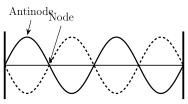
Drawn by us to help you understand the concept clearly, and verified to make sure it's accurate. For exams, practice from your textbook's own diagram.
What this figure shows. Two identical progressive waves travelling in opposite directions on a string superpose to give a stationary wave. Some points never move (nodes); midway between them the string oscillates with maximum amplitude (antinodes). The solid and dashed curves are the two extreme positions of the string during one vibration …