Physics · Ch 6 — Superposition of Waves
Reflection of a Longitudinal Wave
Reflection of a Longitudinal Wave
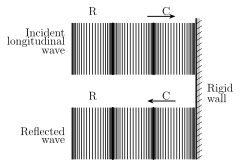
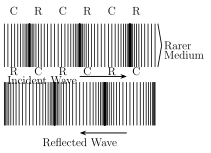
The same reflection rules apply to a LONGITUDINAL wave, expressed in terms of pressure regions instead of crest/trough shape -- a compression (a locally high-pressure region) plays the role of a crest, and a rarefaction (a locally low-pressure region) plays the role of a trough.
When a longitudinal wave travels from a RARER medium to a DENSER medium, the particles of the rarer medium do not have enough energy to compress the denser medium beyond a point, so by Newton's third law an equal and opposite reaction compresses the rarer medium's own particles further instead -- the net effect is that a compression is reflected as a compression, and a rarefaction as a rarefaction: there is NO change of pressure phase on rarer-to-denser reflection. …
Drawn by us to help you understand the concept clearly, and verified to make sure it's accurate. For exams, practice from your textbook's own diagram.
What this figure shows. A longitudinal wave (drawn as vertical lines — closely spaced for a compression C, widely spaced for a rarefaction R) travels toward a rigid wall. On reflection a compression comes back as a compression and a rarefaction as a rarefaction: there is NO change of pressure phase on reflection from a denser medium, because the …
Drawn by us to help you understand the concept clearly, and verified to make sure it's accurate. For exams, practice from your textbook's own diagram.
What this figure shows. A longitudinal wave (incident pattern C R C R …) reaches the boundary of a rarer medium; the reflected wave has the pattern reversed (R C R C …). A compression is reflected as a rarefaction and a rarefaction as a compression — a pressure-phase chan …