Physics · Ch 6 — Superposition of Waves
Reflection of a Transverse Wave
Reflection of a Transverse Wave
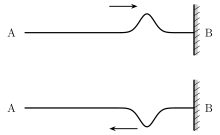
Consider a long, light string with one end (B) attached to a perfectly rigid support, representing the boundary between a rarer medium (the light string itself) and a denser medium (the immovable support). Giving the free end (A) a jerk sends a single crest travelling towards B. As the crest reaches B, it tries to pull point B upward -- but B, being rigidly fixed, cannot move; by Newton's third law, an equal and opposite reaction then acts back on the string, pulling it DOWNWARD instead. The observed result is that the crest returns from the fixed end as a TROUGH: reflection at a rigid support (a denser medium) inverts the wave. Since a crest and a trough of the same wave differ in phase by exactly radians, we say reflection from a fixed end (denser medium) introduces a phase change of radians.
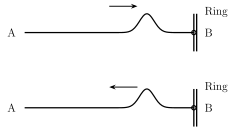
Now suppose instead the string's end B is attached to a light ring that can slide freely, without friction, along a vertical rod -- this end is effectively free to move, representing a boundary with a RARER medium. When the crest reaches the ring, it genuinely pulls the ring upward with it, and the pulse is observed to reflect back still as a CREST, with no inversion -- reflection from a free (rarer-medium) end introduces NO phase change. …
Drawn by us to help you understand the concept clearly, and verified to make sure it's accurate. For exams, practice from your textbook's own diagram.
What this figure shows. A crest travelling along a light string AB toward a rigid support at B (the string is the rarer medium, the rigid support the denser medium). On reaching the fixed end the crest is reflected back as a TROUGH — an inversion — because the rigid support cannot move and, by Newton's third law, pulls the string the opposite way. So reflection from a …
Drawn by us to help you understand the concept clearly, and verified to make sure it's accurate. For exams, practice from your textbook's own diagram.
What this figure shows. A crest travelling along a string whose end B is attached to a light ring that slides freely on a frictionless rod (the free end behaves as a rarer medium). On reaching the free end the crest is reflected back as a CREST — no inversion — because the ring is free to move up. So reflection f …
Drawn by us to help you understand the concept clearly, and verified to make sure it's accurate. For exams, practice from your textbook's own diagram.
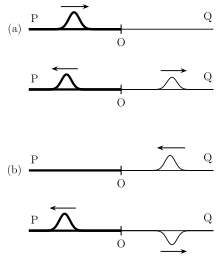
What this figure shows. A heavy string P and a light string Q are joined at O. (a) A crest travelling on the heavy string (denser medium) toward O is reflected as a trough — an inversion, phase change π. (b) A crest travelling on the light string (rarer medium) toward O is reflected as a crest — no inversion, no phase change. The reflecte …