Physics · Ch 6 — Superposition of Waves
Superposition of Two Wave Pulses of Equal Amplitude and Opposite Phases Moving towards Each Other
Superposition of Two Wave Pulses of Equal Amplitude and Opposite Phases Moving towards Each Other
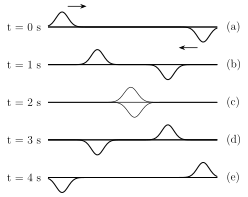
Now consider two wave pulses of the SAME (equal) amplitude but OPPOSITE phase -- for instance, one an upward crest and the other an equal-sized downward trough -- again launched from opposite ends of a string towards each other. As before, each propagates independently while separated. But now, as they overlap, the resultant displacement at each point is the sum of one POSITIVE and one equal-magnitude NEGATIVE displacement, which cancel exactly. At the instant of perfect overlap, the resultant displacement is ZERO everywhere along the overlapping region -- this is DESTRUCTIVE interference, the wave energy momentarily appearing to vanish from view even though it is still present (carried, at that instant, entirely as kinetic energy of the medium rather than as visible displacement). Just as in the same-phase case, once the two pulses have cross …
Drawn by us to help you understand the concept clearly, and verified to make sure it's accurate. For exams, practice from your textbook's own diagram.
What this figure shows. Five successive snapshots (t = 0 to 4 s) of a crest and an equal trough travelling toward each other. When they exactly overlap (at t = 2 s) the resultant displacement (full line) is ZERO everywhere — the individual displacements (dashed lines), differing in phase by 180°, cancel — destructive inte …