Physics · Ch 6 — Superposition of Waves
Superposition of Two Wave Pulses of Equal Amplitude and Same Phase Moving towards Each Other
Superposition of Two Wave Pulses of Equal Amplitude and Same Phase Moving towards Each Other
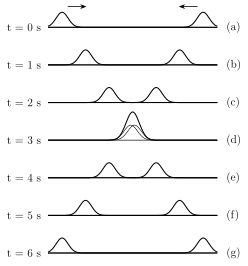
Consider two wave pulses of EQUAL amplitude and the SAME phase (i.e. the same shape and orientation, e.g. both upward crests), launched from opposite ends of a string and approaching each other. While the two pulses are still well-separated, each simply propagates on its own, unaffected by the other. As they begin to overlap, the principle of superposition says the resultant displacement at every point of overlap is the algebraic SUM of the two individual (dashed, in a diagram) displacements at that point -- since both are positive (upward) here, this sum is always larger in magnitude than either pulse alone, reaching its greatest height at the instant the two pulses are exactly coincident. This is CONSTRUCTIVE interference. Once the pulses have fully crossed and separated again, each one is found to have emerged completely UNCHANGED in its own individual shape, exactly as if the other pulse had never cross …
Drawn by us to help you understand the concept clearly, and verified to make sure it's accurate. For exams, practice from your textbook's own diagram.
What this figure shows. Seven successive snapshots (t = 0 to 6 s) of two equal crests travelling toward each other. As they cross (around t = 3 s) the resultant displacement (full line) is the SUM of the individual displacements (dashed lines) — a taller crest — constructive interference. After crossing, eac …