Physics · Ch 4 — Thermodynamics
Zeroth Law of Thermodynamics
Zeroth Law of Thermodynamics
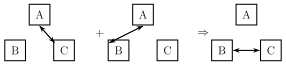
The Zeroth Law of Thermodynamics states: if two systems are each in thermal equilibrium with a third system, they are also in thermal equilibrium with each other. In symbols, if system A is in thermal equilibrium with system C, and system B is also in thermal equilibrium with system C, then A and B must be in thermal equilibrium with each other too — and all three systems, A, B and C, must then be at the same temperature.
The law is called 'zeroth' for a slightly unusual historical reason: it was only formally stated after the First and Second Laws of thermodynamics had already been named and numbered, even though logically it comes first (you need the concept of thermal equilibrium before you can meaningfully define temperature at all). Rather than renumber the older, already-established First and Second Laws, physicists simply called this newer, logically-prior law the 'Zeroth' Law. …
Drawn by us to help you understand the concept clearly, and verified to make sure it's accurate. For exams, practice from your textbook's own diagram.
What this figure shows. The Zeroth law as a schematic: a double-headed arrow marks thermal equilibrium between two systems. A is in equilibrium with C and with B; the law then guarantees B and C are in equilibrium with each other, so A, B and C are all at the same temperature. This is what lets a thermometer (one 'system') measure th …
Drawn by us to help you understand the concept clearly, and verified to make sure it's accurate. For exams, practice from your textbook's own diagram.
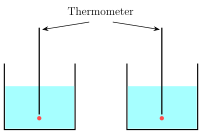
What this figure shows. Two beakers of liquid, each with a thermometer dipped in it. A thermometer works by coming into thermal equilibrium with the liquid (Zeroth law) and then reading its own temperature, which equals the liquid's. Comparing the two readings lets us compare the temperatures of …