Physics · Ch 4 — Thermodynamics
First Law of Thermodynamics
First Law of Thermodynamics
During the mid-nineteenth century, James Joule demonstrated experimentally that mechanical work and the heat produced by that work are equivalent quantities — related by , where is called the mechanical equivalent of heat. This equivalence is the experimental seed from which the First Law of Thermodynamics grows: it turns the earlier, qualitative observation (heating and doing work both change internal energy) into a precise, quantitative relationship.
Deriving the work-done formula. Consider the gas-in-cylinder system from Section 4.4.4, with cross-sectional piston area and gas pressure . The gas exerts a total outward force on the piston. If the piston moves through an infinitesimal distance , the infinitesimal work done by this force is . But is exactly the infinitesimal change in the cylinder's volume, — so
For a finite change from an initial volume to a final volume , the total work done by the gas is the sum (integral) of all these infinitesimal contributions:
During expansion, the gas molecules striking the outward-moving piston lose momentum to it, exerting an outward pressure that pushes the piston through a finite distance — the gas does positive work on its surroundings. During compression, the reverse happens: molecules striking the inward-moving piston gain momentum from it, so the gas does negative work (equivalently, the surroundings do positive work on the gas).
Combining heat and work: the First Law. Suppose heat is added to the system and the system does no work during the process — its internal energy simply increases by the full amount of heat added, . Now suppose instead the system does some work to expand its volume, with no heat added at all — the system must draw the energy for this work from its own internal energy, so its internal energy decreases: . In general, both effects act together, and combining them gives the mathematical statement of the First Law of Thermodynamics:
Rearranged, this is equally often written as
In words: the change in a system's internal energy equals the heat supplied to it minus the work done by it on its surroundings — or, equivalently, the heat supplied to a system is partly used to raise its internal energy and partly used to do work on its surroundings.
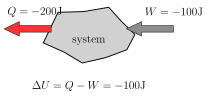
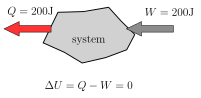
Both and can independently be positive, negative, or zero, so can be positive (heat added exceeds work done, internal energy rises), negative (work done exceeds heat added, internal energy falls), or zero (heat added exactly balances work done — this special case, as we will see, is exactly what characterises an isothermal process for an ideal gas, in Section 4.7.3.2). …
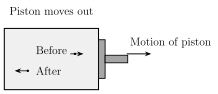
Drawn by us to help you understand the concept clearly, and verified to make sure it's accurate. For exams, practice from your textbook's own diagram.
What this figure shows. 'Piston moves out': gas molecules strike the piston, lose momentum to it and push it outward through a finite distance (Before→After). Because the gas increases its volume, …
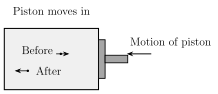
Drawn by us to help you understand the concept clearly, and verified to make sure it's accurate. For exams, practice from your textbook's own diagram.
What this figure shows. 'Piston moves in': the piston is pushed inward so the gas volume decreases; the molecules striking it gain momentum from the piston. Because the volume decreases, the gas does NEGATIVE work on the piston …
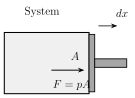
Drawn by us to help you understand the concept clearly, and verified to make sure it's accurate. For exams, practice from your textbook's own diagram.
What this figure shows. The gas at pressure p pushes on a piston of cross-sectional area A with force F = pA. When the piston moves out a small distance dx, the work done is dW = F dx = pA dx = p dV, since A dx = dV. Integrating gives the wo …
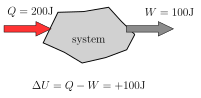
Drawn by us to help you understand the concept clearly, and verified to make sure it's accurate. For exams, practice from your textbook's own diagram.
What this figure shows. Energy bookkeeping for the first law ΔU = Q − W. Here Q = 200 J flows into the system and the system does W = 100 J of work, so ΔU = 200 − 100 = +100 J: the internal energy increases becaus …
Drawn by us to help you understand the concept clearly, and verified to make sure it's accurate. For exams, practice from your textbook's own diagram.
What this figure shows. With the arrow senses as printed, the first law gives ΔU = Q − W = −100 J for this case: the system loses internal energy because the work done by it exceeds the heat add …
Drawn by us to help you understand the concept clearly, and verified to make sure it's accurate. For exams, practice from your textbook's own diagram.
What this figure shows. Here the heat added to the system and the work done by it are equal, so ΔU = Q − W = 0: the internal energy stays constant. All the heat supplied is converted into work — the signature of …
Can you recall? (James Joule). During the middle of the nineteenth century James Joule showed that the mechanical work done and the heat produced while doing that work are equivalent — this equivalence is the mechanical equivalent of heat. The relation between the mechanical work W and the corresponding heat produced H is W = J × H, where the constant J is the mechanical equivalent of heat. This equival …