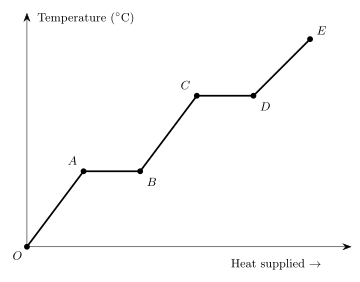
Q.The mass m of a substance undergoes a change from one state to another on application of heat of quantity Q given by Q = mL. What does L represent? Which parts of the following graph does L represent?
You're viewing a preview — the full solution, concept, methods & PYQ mapping are locked.
Start your 14-day free trial to unlock the full solution →L in Q=mL is the specific latent heat — the heat needed per unit mass to change the state (phase) of a substance without changing its temperature — and it is represented by the FLAT segment of the temperature-vs-heat graph (segment C to D), where heat is absorbed with no temperature rise.
The relation Q = mL defines the specific latent heat L: it is the amount of heat energy Q that must be supplied to (or removed from) a unit mass of a substance to bring about a complete change of its physical state (e.g. solid to liquid, or liquid to gas) WITHOUT any change in temperature.
On a graph of temperature versus heat supplied to a substance (starting as a solid, being heated until it becomes liquid, then gas):
- The sloped (rising) portions of the curve (O to A, A to B, B to C, and D to E) represent stages where the substance's temperature is actually increasing as heat is added — this heat goes into raising temperature, governed by specific heat capacity (Q = mc Delta T), NOT latent heat. …
Unlock everything free for 14 days
- Full step-by-step solutions
- Concept-first explanations
- Methods, shortcuts & mistakes
- PYQ mapping + timed mock tests
Full access for 14 days. No credit card required.