Q.During summers in India, one of the most common practice to keep cool is to make ice balls of crushed ice, dip it in flavoured sugar syrup and sip it. For this a stick is inserted into crushed ice and is squeezed in the palm to make it into the ball. Equivalently in winter, in those areas where it snows, people make snow balls and throw around. Explain the formation of ball out of crushed ice or snow in the light of P-T diagram of water.
You're viewing a preview — the full solution, concept, methods & PYQ mapping are locked.
Start your 14-day free trial to unlock the full solution →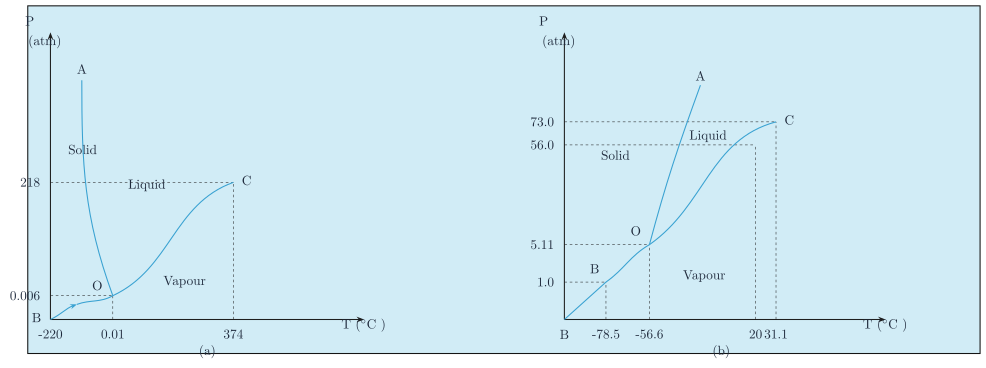
Water's P-T phase diagram has a negative-slope melting curve (unlike most substances), so squeezing crushed ice raises local pressure, momentarily melts a thin film of water at contact points, which then refreezes when the pressure is released — binding the crushed ice into a solid ball.
Most substances have a melting curve (solid-liquid phase boundary) on their P-T (pressure-temperature) diagram that slopes UPWARD to the right — meaning an increase in pressure RAISES the melting point (the solid becomes more stable, harder to melt, under higher pressure), because most solids are DENSER than their liquid form, so squeezing favours the solid phase.
Water is a well-known exception: because ice is actually LESS dense than liquid water (ice floats), water's solid-liquid (ice-water) phase boundary on the P-T diagram has a NEGATIVE slope — increasing the pressure on ice LOWERS its melting point instead of raising it (squeezing favours the liquid phase, since liquid water is the denser, more compact phase).
When crushed ice (or snow) is squeezed hard in the palm (or by a stick pressed into it), the pressure at the actual points of contact between individual ice grains becomes very high (concentrated over a tiny contact area). According to water's P-T diagram, this locally raised pressure LOWERS the melting point of ice at exactly those contact points, below the ice's actual temperature — so a thin film of liquid water forms there, even though the ice as a whole is still at (or below) 0°C.
…
Unlock everything free for 14 days
- Full step-by-step solutions
- Concept-first explanations
- Methods, shortcuts & mistakes
- PYQ mapping + timed mock tests
Full access for 14 days. No credit card required.