Q.What is the dipole moment of an electric dipole? What is the net charge on an electric dipole? State the SI unit of dipole moment of an electric dipole. Derive an expression for the electric field intensity at a point on the equatorial line of an electric dipole. (1+1+3=5) OR Two point charges and separated by a short distance are placed in free space at points and respectively. Derive an expression for the electric potential at a point whose distance from the centre of the line is and makes an angle with the electric dipole moment . Hence find the potential if lies on
You're viewing a preview — the full solution, concept, methods & PYQ mapping are locked.
Start your 14-day free trial to unlock the full solution →The dipole moment is , a vector from the negative to the positive charge, with SI unit Cm, though the net charge of a dipole is always zero; deriving the field at an equatorial point by adding the components of the fields due to both charges gives , directed opposite to . For the alternative, deriving potential due to a short dipole at general angle and specializing gives on the axis and 0 on the equator.
Dipole moment, net charge, and SI unit
An electric dipole consists of two equal and opposite point charges, and , separated by a small distance . Its dipole moment is a vector
directed from the negative charge to the positive charge, with magnitude .
The net charge on an electric dipole is -- a dipole is electrically neutral overall.
The SI unit of dipole moment is the coulomb-metre (Cm).
Field at a point on the equatorial line
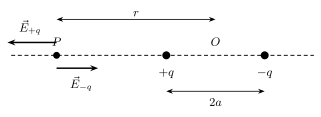
Let the dipole have charges at and at , separated by , with centre . Let be a point on the equatorial line (perpendicular bisector of ) at distance from .
Distance of from each charge:
Magnitude of field due to each charge at :
(due to ) points from towards ; (due to ) points from towards (away from ). By symmetry, the components of and perpendicular to the dipole axis (i.e., along extended) cancel each other, while the components parallel to the dipole axis (both pointing in the direction from side to side, i.e. antiparallel to ) add up.
Each field's component along the axis has magnitude , where (with the angle each of , makes with the axis).
Since :
directed antiparallel to (i.e., from side towards side).
…
Unlock everything free for 14 days
- Full step-by-step solutions
- Concept-first explanations
- Methods, shortcuts & mistakes
- PYQ mapping + timed mock tests
Full access for 14 days. No credit card required.