Q.Write the Biot-Savart law in scalar form. Use this law to find the magnitude of the magnetic field due to a circular coil carrying current () at a point along its axis. How does a circular loop carrying current () behave as a magnet? (1+3+1=5) OR State Ampere's circuital law. Use the law to find the magnitude of the magnetic field inside a long, straight, air-cored solenoid. Also write the expressions for the magnitude of the magnetic field
You're viewing a preview — the full solution, concept, methods & PYQ mapping are locked.
Start your 14-day free trial to unlock the full solution →Integrating the Biot-Savart law around a circular current loop gives the axial field , and the loop itself behaves as a magnetic dipole with moment .
Biot-Savart law (scalar form)
where is a current element, is the distance from the element to the field point, and is the angle between the current element's direction and the line joining it to the field point. is directed perpendicular to the plane containing and (right-hand rule).
Magnetic field on the axis of a circular coil
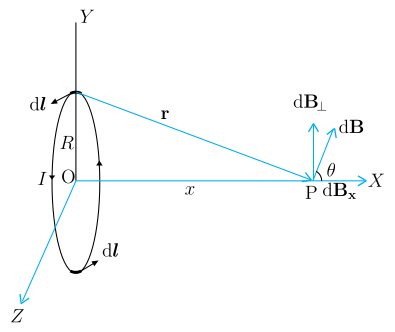
Consider a circular loop of radius carrying current ; let be a point on its axis at distance from the centre. Every current element is perpendicular to the line joining it to (), and each element is at the same distance from :
By symmetry, the components of perpendicular to the axis cancel in pairs (from diametrically opposite elements); only the components along the axis add. Each element's axial component is where :
Integrating around the full loop ():
(At the centre, : .)
A current loop as a magnet
A current-carrying circular loop sets up a magnetic field pattern very similar to that of a bar magnet: one face acts like a north pole (field lines emerge, by the right-hand rule) and the other like a south pole (field lines converge). It possesses a magnetic dipole moment ( = loop area) directed along the axis — so the loop behaves as a magnetic dipole, just like a small bar magnet.
…
Unlock everything free for 14 days
- Full step-by-step solutions
- Concept-first explanations
- Methods, shortcuts & mistakes
- PYQ mapping + timed mock tests
Full access for 14 days. No credit card required.