Question of 53
Q.a. Discuss the ultrastructure of nucleus with the help of a diagram. OR b. Draw a labelled diagram of bacterial cell and mention its characteristics.
Nagaland NbseNagaland Board of School Education (Class XI) 2025Subjective· 5mImportance★★★★★
0% · 0/53 Questions
You're viewing a preview — the full solution, concept, methods & PYQ mapping are locked.
Start your 14-day free trial to unlock the full solution →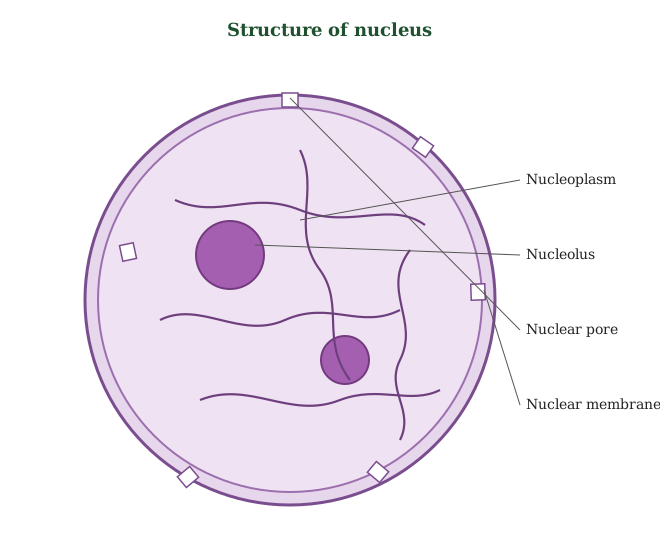
The nucleus consists of a porous double-membrane envelope enclosing a nucleoplasm that houses chromatin (DNA-protein complex) and a dense, RNA-rich nucleolus.
The eukaryotic nucleus, first described by Robert Brown, is generally spherical and consists of the following ultrastructural components:
- Nuclear envelope: a double membrane structure (outer and inner) with a perinuclear space in between; the outer membrane is continuous with the endoplasmic reticulum and often bears ribosomes on its surface. The envelope is interrupted at intervals by nuclear pores, which allow the regulated exchange of RNA and protein molecules in both directions between the nucleus and cytoplasm.
- Nucleoplasm (karyolymph): the semi-fluid matrix within the nuclear envelope in which the nucleolus and chromatin are suspended.
- Nucleolus: a dense, spherical, non-membrane-bound structure present within the nucleoplasm; it is the site of active ribosomal RNA (rRNA) synthesis and ribosomal subunit assembly, and its number and size correlate with the cell's protein-synthesising activity.
- Chromatin: a loose, entangled network of thread-like chromatin fibres, consisting of DNA and histone proteins; during cell division, chromatin condenses to form visible, discrete chromosomes.
A neat diagram should show the double nuclear membrane with nuclear pores, nucleoplasm, chromatin fibres, and a labelled nucleolus.
…
Unlock everything free for 14 days
- Full step-by-step solutions
- Concept-first explanations
- Methods, shortcuts & mistakes
- PYQ mapping + timed mock tests
Full access for 14 days. No credit card required.