Q.Use Lenz's law to determine the direction of induced current in the situations described by Fig. 6.16:
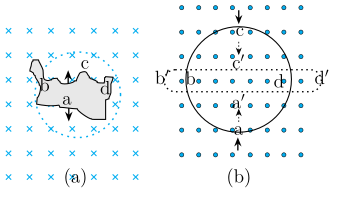
Lenz’s law says induced current opposes the change in magnetic flux. In (a), area increases → flux into page increases → induced current creates flux out of page → anticlockwise. In (b), area decreases → flux out of page decreases → induced current creates flux out of page → anticlockwise.
The Core Idea
Lenz’s law is the most elegant way to find induced current direction without getting tangled in right-hand rules. It states: the induced current flows in such a direction that its magnetic field opposes the change in the original magnetic flux through the loop. Think of it as the loop “fighting back” against whatever is happening to it — if flux is increasing, the loop tries to decrease it; if flux is decreasing, the loop tries to increase it.
In both parts of this problem, the magnetic field is uniform and constant. The only thing changing is the area of the loop. So the flux change comes purely from area change, and the induced current’s job is to oppose that area-driven flux change.
(a) Irregular wire turning into a circular shape
1. Identify the initial and final flux.
The field is uniform and directed into the page (shown by × marks). The wire starts as an irregular closed loop and is reshaped into a circle. A circle encloses the maximum area for a given perimeter, so the area increases as the shape becomes circular. Since is constant and into the page, the magnetic flux also increases.
2. Apply Lenz’s law.
Flux into the page is increasing. The induced current must create its own magnetic field that opposes this increase — that is, it must produce flux out of the page (to cancel some of the incoming flux).
3. Determine the current direction.
To produce a magnetic field out of the page, the induced current must flow anticlockwise (as seen from above). Use the right-hand grip rule: curl your fingers in the direction of current; your thumb points in the direction of the magnetic field inside the loop. Anticlockwise current gives a field out of the page.
A common mistake is to think that because the area increases, the induced current should somehow “help” the increase. Lenz’s law says the opposite — the induced effect always opposes the change, not the existing flux itself.
(b) Circular loop being deformed into a narrow straight wire
1. Identify the initial and final flux.
Here the field is uniform and directed out of the page (shown by • dots). The loop starts as a circle and is squeezed into a narrow straight wire. As it narrows, the enclosed area decreases dramatically — eventually approaching zero. So the flux (out of the page) decreases.
2. Apply Lenz’s law.
Flux out of the page is decreasing. The induced current must oppose this decrease — that is, it must try to increase the out-of-page flux. So it must produce its own magnetic field out of the page.
3. Determine the current direction.
To produce a field out of the page, the induced current must again flow anticlockwise (same reasoning as part (a)).
Both parts give the same direction (anticlockwise) but for opposite reasons: in (a) the induced field opposes an increase in into-page flux, while in (b) it opposes a decrease in out-of-page flux. Always focus on what is changing, not what is constant.
In both cases, the induced current flows anticlockwise as seen from above.
Unlock everything free for 14 days
- Full step-by-step solutions
- Concept-first explanations
- Methods, shortcuts & mistakes
- PYQ mapping + timed mock tests
Full access for 14 days. No credit card required.