Physics · Ch 4 — Laws of Motion
Friction
Friction
The Origin of Friction
When a body rests on a horizontal table, two vertical forces balance: the weight downward and the normal reaction upward. Now apply a small horizontal force to the body. If were the only horizontal force, Newton's second law demands an acceleration — yet the body stays at rest. Something else must be acting horizontally to cancel .
That opposing force, arising parallel to the contacting surfaces, is friction. It is not an independent force that exists on its own; it appears only when an external force tries to cause motion. With no applied force, there is no friction.
Static Friction
The frictional force that acts while the body remains at rest is called static friction, denoted . As the applied force increases, increases too, always matching in magnitude and opposing it in direction, keeping the net horizontal force zero. This self-adjusting behaviour continues only up to a certain limit.
Static friction opposes impending motion — the motion that would occur if friction were absent, but which does not actually take place.
The Limiting Value of Static Friction
Experiment shows that the maximum possible static friction, , has two key properties:
- It is independent of the area of contact between the surfaces.
- It is proportional to the normal force pressing the surfaces together.
Mathematically:
where is the coefficient of static friction, a dimensionless constant that depends only on the nature of the two surfaces in contact (e.g., wood on wood, rubber on concrete).
Since static friction can take any value from zero up to this maximum, the complete law is:
If the applied force exceeds , the body begins to slide.
The inequality is often misread as an equality. Static friction is not always — it is only equal to at the instant just before motion starts. For any smaller applied force, is less than .
Kinetic (Sliding) Friction
Once relative motion begins, the frictional force drops from its static maximum to a lower, roughly constant value. This force, which opposes actual sliding between surfaces, is called kinetic friction or sliding friction, denoted .
Kinetic friction shares two properties with static friction:
- It is independent of the area of contact.
- It is nearly independent of the velocity of sliding (over a wide range of ordinary speeds).
Its magnitude obeys a similar law:
where is the coefficient of kinetic friction. Experiments consistently show:
The coefficients and are empirical — they come from experiment, not from fundamental theory. The laws of friction are approximate but extremely useful in practical mechanics.
Motion Under Kinetic Friction
For a body already sliding under an applied force , the net horizontal force is , giving acceleration:
If the body moves with constant velocity, the applied force exactly balances kinetic friction:
If the applied force is removed entirely, the only horizontal force is opposing the motion, producing a deceleration:
until the body comes to rest.
The Nature of the Contact Force
When two bodies are in contact, each exerts a contact force on the other. This force has two perpendicular components:
- The normal component () perpendicular to the surfaces.
- The frictional component () parallel to the surfaces.
By definition, friction is the component of the contact force parallel to the surfaces in contact that opposes impending or actual relative motion.
Friction opposes relative motion, not motion itself. A box stationary on the floor of an accelerating train is moving with the train — the static friction acting on it is what causes its acceleration, not what opposes it.
Rolling Friction
A ring or sphere rolling without slipping over a horizontal surface has, at every instant, exactly one point of contact with the surface. That point has zero velocity relative to the surface — it is instantaneously at rest. In this ideal case, neither static nor kinetic friction acts, and the body should continue rolling with constant velocity forever.
In practice, this does not happen. Surfaces deform slightly at the point of contact, creating a finite contact area rather than a point. This deformation produces a small opposing force called rolling friction.
For the same weight, rolling friction is much smaller than static or sliding friction — often by two or three orders of magnitude. This is why the invention of the wheel was a major milestone: it dramatically reduced the resistance to motion.
Reducing Friction …
Drawn by us to help you understand the concept clearly, and verified to make sure it's accurate. For exams, practice from your textbook's own diagram.
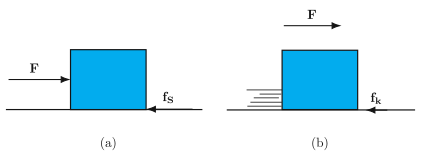
Figure 4.10 is a two-panel diagram that draws a sharp line between two very different regimes of friction: the block is at rest in panel (a) and already sliding in panel (b). In both panels a horizontal force is applied to the block, but the friction force that answers it changes character once motion begins.
In panel (a) the block is still stationary. The applied force is trying to start motion, but static friction opposes that impending motion. The arrow for points opposite to , and its length is exactly equal to — because as long as the block does not move, the net horizontal force must be zero. This is the regime of static friction: it is a self-adjusting force that grows with up to a maximum value , where is the coefficient of static friction and is the normal force. The figure shows the moment just before the block slips, so is at its maximum.
Panel (b) shows the same block after it has broken free and is moving to the right (motion lines behind it indicate velocity). Now the friction is kinetic friction , which is generally smaller than the maximum static friction. The arrow for still opposes the motion, but its magnitude is constant for a given pair of surfaces: , where is the coefficient of kinetic friction. The applied force in this panel is larger than , so the block accelerates.
The central lesson of this figure is that static friction is a variable force that matches the applied force up to a limit, while kinetic friction is a constant force once sliding begins. This is why you need a larger push to start an object moving than to keep it moving.
The textbook develops the following key formulas from this picture:
…
Drawn by us to help you understand the concept clearly, and verified to make sure it's accurate. For exams, practice from your textbook's own diagram.
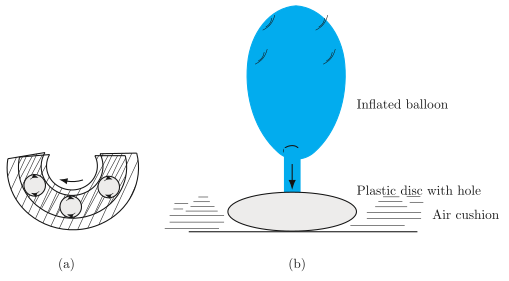
The figure appears in the section on common forces, specifically where the textbook discusses friction as a contact force and the practical methods used to reduce it. The drawing is split into two panels, (a) and (b), each showing a different engineering solution.
Panel (a) shows a cross-section of two solid surfaces — imagine a shaft rotating inside a housing. Between them, instead of direct metal-to-metal contact, the gap is filled with a ring of small spheres: ball bearings. The balls sit in a curved raceway (a grooved track) that keeps them evenly spaced. The key visual point is that the balls roll between the two surfaces, converting what would be sliding friction into much smaller rolling friction. The arrows in the diagram typically indicate the direction of motion of the shaft relative to the housing, and the balls are shown rotating in place.
Panel (b) depicts a different approach: a flat plastic disc with a central hole, resting on a smooth floor. Above the disc sits an inflated balloon, its neck fitted over the hole. The drawing shows air escaping downward through the hole, forming a thin cushion of compressed air between the disc and the floor. The disc is thus lifted slightly — it never touches the ground. The arrows here show the air flow: from inside the balloon, through the hole, and spreading radially outward beneath the disc. This is the principle of an air hockey table or a hovercraft.
The physical idea is straightforward: friction arises from interlocking asperities (microscopic bumps) when two surfaces are in direct contact. To reduce friction, you either replace sliding with rolling (ball bearings) or eliminate solid contact entirely (air cushion). Both methods drastically lower the coefficient of friction.
The textbook uses this figure to introduce the concept of rolling friction and to contrast it with sliding friction. The key formula is the one for the force of sliding friction:
where is the kinetic friction force (opposing motion), is the coefficient of kinetic friction (a dimensionless constant depending on the materials), and is the normal reaction force (the perpendicular contact force between the surfaces). For rolling friction, the force is typically much smaller — often written as , with . The air cushion in panel (b) reduces effectively to zero (the disc floats), so the friction force becomes negligible. …