Q.Four displacement-time (-) plots for the linear motion of a particle are described below. In each plot is on the vertical axis and time (in seconds) on the horizontal axis. State which plots represent periodic motion and give the period in each periodic case.
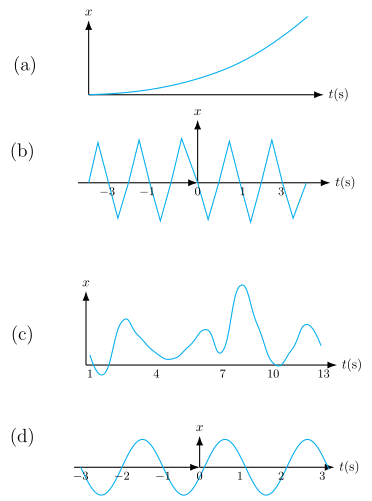
A motion is periodic only when its displacement-time graph repeats exactly after a fixed interval called the period. Of the four plots, only the saw-tooth (b) and the sine curve (d) repeat identically, each after s. The continuously rising curve (a) and the irregular humped curve (c) never repeat, so they are non-periodic.
Concept
A motion is periodic if the particle returns to the same state (same and same direction of motion) after equal intervals of time , and keeps doing so indefinitely. On an - graph this appears as a shape that repeats identically along the time axis. The period is the smallest time after which one complete pattern recurs.
Examining each plot
- (a) increases continuously (a concave-up curve) and never comes back to a previous value. There is no repetition, so the motion is not periodic.
- (b) The saw-tooth shape rises, drops sharply, and rises again, the identical pattern recurring along . Consecutive identical features are s apart, so it is periodic with .
- (c) The curve is a collection of humps of unequal height and spacing between s and s; no single sub-pattern repeats, so it is not periodic.
- (d) A pure sine curve, one full oscillation occupying s and then repeating, so it is periodic with .
Plots (b) and (d) represent periodic motion, each with period . Plots (a) and (c) are non-periodic.
Unlock everything free for 14 days
- Full step-by-step solutions
- Concept-first explanations
- Methods, shortcuts & mistakes
- PYQ mapping + timed mock tests
Full access for 14 days. No credit card required.