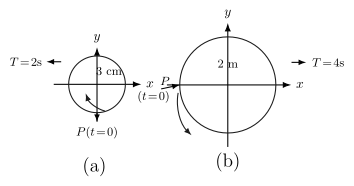
Q.Two particles each move uniformly on a circle lying in a plane, the centre of each circle at the origin of its own and axes. For each, obtain the simple harmonic motion of the -projection of the radius vector of the revolving particle P.
Motion (a): circle of radius cm, period of revolution s. At the instant the particle P is at the lowest point of the circle, on the negative -axis at coordinates , and it revolves in the clockwise sense.
Motion (b): circle of radius m, period of revolution s. At the particle P is at the left-most point of the circle, on the negative -axis at coordinates , and it revolves in the anticlockwise sense.
You're viewing a preview — the full solution, concept, methods & PYQ mapping are locked.
Start your 14-day free trial to unlock the full solution →Each uniformly revolving particle casts an -projection that executes SHM with amplitude equal to the circle's radius and angular frequency . Reading off the starting point and the sense of rotation fixes the phase. Motion (a) gives cm; motion (b) gives m.
Concept - SHM as the projection of uniform circular motion
If a particle P moves uniformly on a circle of radius with angular speed , its projection on the -axis is
a simple harmonic motion of amplitude and angular frequency . The phase constant is fixed by where P sits at and by the sense of revolution.
Motion (a) - radius 3 cm, T = 2 s, starts at the bottom, clockwise
Here and .
At , P is on the negative -axis, so its -coordinate is . Turning clockwise from the bottom, P first swings toward the left ():
The function with that then becomes negative is
Motion (b) - radius 2 m, T = 4 s, starts at the left extreme …
Unlock everything free for 14 days
- Full step-by-step solutions
- Concept-first explanations
- Methods, shortcuts & mistakes
- PYQ mapping + timed mock tests
Full access for 14 days. No credit card required.